
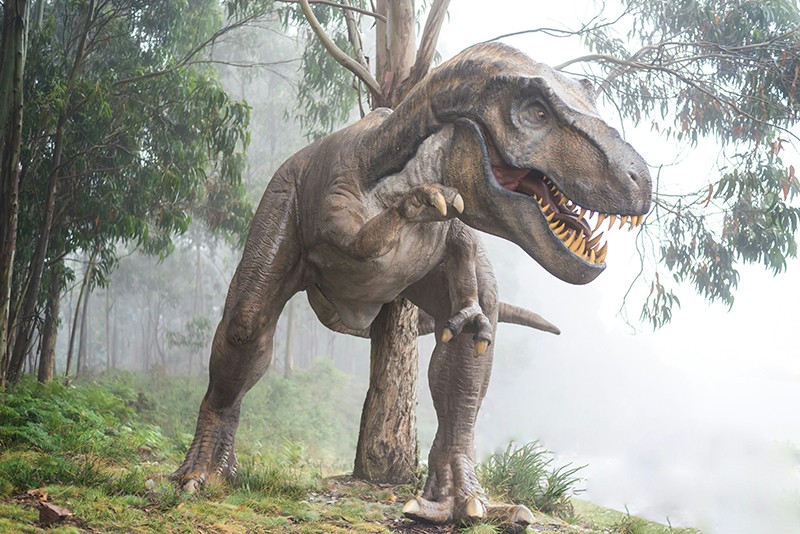
“Best estimates from previous studies suggested that T. rex typically stopped growing around age 25,” said Dr. Holly Woodward, professor of anatomy and paleontology at the Oklahoma State University Center for Health Sciences and lead author of the new study.
However, an extensive analysis of 17 tyrannosaur specimens—ranging from early juveniles to massive adults—reveals that the iconic predator took nearly 40 years to reach its full-grown size of about eight tons, reads the Oklahoma State University Center for Health Sciences website.
The study, published in January in the journal PeerJ, represents the most comprehensive life-history analysis of Tyrannosaurus rex to date. By combining advanced statistical algorithms with microscopic examination of bone slices under specialized lighting, researchers uncovered previously undetected growth rings that were missed in earlier studies.
In addition to extending T. rex’s growth period by roughly 15 years, the findings suggest that some well-known specimens may not belong to the species at all, but could represent other closely related tyrannosaur species or variants.
“This is the largest data set ever assembled for Tyrannosaurus rex,” Woodward said. “Examining the growth rings preserved in fossilized bones allowed us to reconstruct the animals’ year-by-year growth histories.”
Unlike tree rings, which record an organism’s entire lifespan, cross sections of T. rex bones typically preserve only the final 10 to 20 years of growth. To overcome this limitation, the research team developed a novel statistical method that integrates growth data from multiple specimens.
“We came up with a new statistical approach that stitches together growth records from different individuals to estimate the growth trajectory of T. rex across all life stages,” said Nathan Myhrvold, a mathematician and paleobiologist at Intellectual Ventures who led the statistical analysis. “The composite growth curve provides a much more realistic picture of how tyrannosaurs grew and how much they varied in size.”
The results indicate that rather than growing rapidly and reaching adulthood early, Tyrannosaurus rex matured more slowly and steadily than previously believed.
“A four-decade growth phase may have allowed younger tyrannosaurs to occupy a wide range of ecological roles,” said coauthor Jack Horner, lecturer and presidential fellow at Chapman University in California. “That flexibility may have helped them dominate ecosystems at the end of the Cretaceous Period.”
Although T. rex is the most famous member of the tyrannosaur group, recent research has raised questions about whether all fossils attributed to the species truly belong to it. To address this, the new study includes specimens considered part of the Tyrannosaurus rex species complex, which may encompass multiple species or subspecies.
One striking result involves two well-known specimens nicknamed “Jane” and “Petey.”
“Their growth curves are statistically incompatible with those of the other specimens,” Woodward said. “While growth data alone cannot confirm they represent separate species, the findings raise that intriguing possibility among other explanations.”
During the study, the researchers also discovered that using different types of light revealed a previously unknown form of dinosaur growth ring, helping resolve long-standing discrepancies in growth estimates.
This discovery, supported by robust statistical evidence, could have far-reaching implications for re-evaluating the growth patterns of other dinosaur species beyond T. rex, Myhrvold noted.
“Even after more than a century of study, Tyrannosaurus rex continues to surprise paleontologists,” Woodward said. “By combining expanded sampling, innovative statistics and detailed bone analysis, this study offers a clearer and more accurate picture of T. rex as a living, growing animal—from juvenile to giant.”