
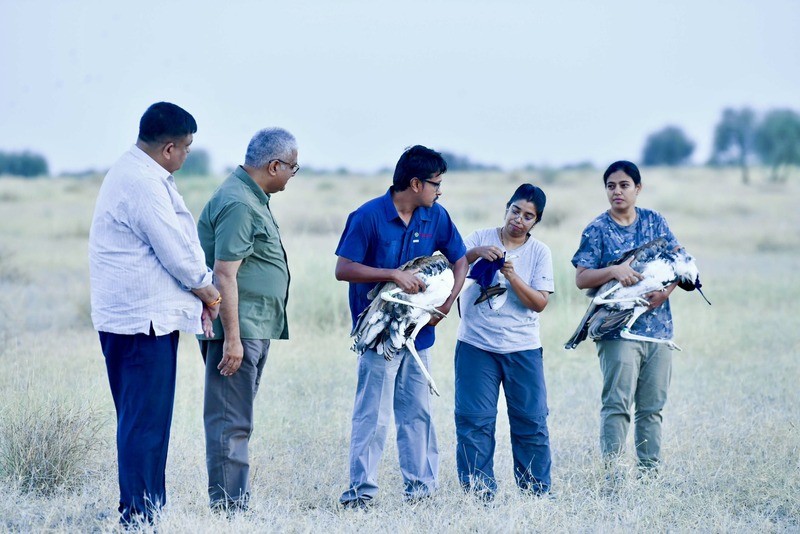
Union Minister for Environment, Forest and Climate Change Bhupender Yadav carried out the release, with Rajasthan's Forest and Environment Minister Sanjay Sharma and senior officials from both governments in attendance.
Yadav called the release the product of nearly a decade of sustained work. "This milestone is the outcome of nearly a decade of unwavering dedication of our scientists, researchers and ground staff to help the Great Indian Bustard reclaim the deserts of Rajasthan," he said.
The release shifts India's bustard conservation programme from building a captive breeding population toward rewilding and expanding the species in its natural range, with officials saying lessons from this release will shape the protocols for further releases.
In a milestone move, released two male Great Indian Bustards in Sam, Desert National Park, Jaisalmer, today morning. This landmark success has been made possible by the nearly decade-long unwavering dedication of our scientists, researchers and ground staff who have spent years to ensure GIB reclaims the deserts of Rajasthan. I thank PM Shri @narendramodi ji for his continued guidance, encouragement and constant support in ensuring our scientific community can work for the conservation of all our species, including the GIB. #IndiaRewildsGIB
— Bhupender Yadav (@byadavbjp) October 4, 2026
The Bustard Recovery Programme, run jointly by the environment ministry, the Rajasthan Forest Department and the Wildlife Institute of India, with technical input from the International Fund for Houbara Conservation and funding from National CAMPA, covers breeding, habitat management, threat mitigation and community engagement.
Facilities at Sam and Ramdevra currently hold 97 birds, 40 hatched from wild-laid eggs and 57 bred in captivity. Of these, 86 are being kept for continued breeding and 11 have been set aside for release, two of which were freed on Saturday.
The captive breeding programme produced 24 chicks in 2025 and 29 in 2026.
A separate technique known as the "jumpstart" approach, in which captive-laid eggs are placed in wild nests, has also contributed to the recovery effort, resulting in six chicks hatching in Rajasthan and two in Gujarat after being accepted by incubating wild females.
The Rajasthan Forest Department has backed the programme with habitat restoration work, fencing off roughly 200 square kilometres of grassland inside the Desert National Park.
Long-term tracking studies by the Wildlife Institute of India have identified these enclosures as prime breeding habitat for the species.
The broader conservation effort is being carried out under directions from the Supreme Court of India, based on recommendations from an expert committee set up for the purpose.