
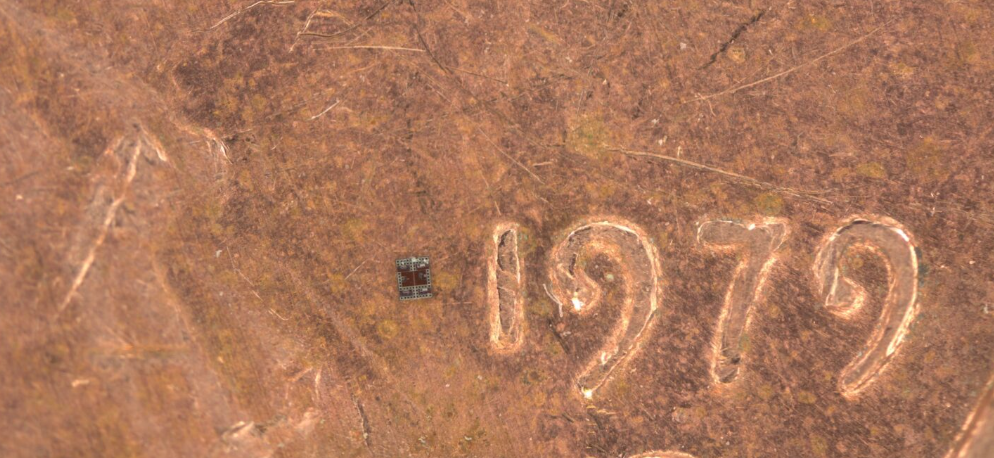
These microscopic swimming machines can independently sense and respond to their surroundings, operate for months, and cost just a penny each, reads the University of Michigan website.
Barely visible to the naked eye, each robot measures roughly 0.2 by 0.3 by 0.05 millimeters—comparable in size to many microorganisms. They can be programmed to move in complex patterns, detect local temperatures, and adjust their paths in response to environmental cues.
These light-powered robots, developed with primary support from the National Science Foundation, could revolutionize medicine by monitoring the health of individual cells, and advance manufacturing by aiding in the construction of microscale devices, researchers said.
“We’ve made autonomous robots 10,000 times smaller,” said Marc Miskin, assistant professor of electrical and systems engineering at Penn and senior author of two studies published in Science Robotics and the Proceedings of the National Academy of Sciences. “That opens up an entirely new scale for programmable robots.”
The robots can move in coordinated groups, similar to schools of fish, and their propulsion system—free of moving parts—makes them exceptionally durable. They can be transferred using a micropipette and continue swimming for months without failure.
Bridging a 40-Year Microscale Robotics Gap
For decades, electronics have continually shrunk, exemplified by the record-setting sub-millimeter computers developed in the lab of David Blaauw and Dennis Sylvester, professors of electrical and computer engineering at U-M. Robots, however, have struggled to achieve independent motion at the microscale—a problem Miskin says has hindered the field for 40 years.
“We saw that Penn Engineering’s propulsion system and our tiny computers were just made for each other,” said Blaauw, a senior author of the Science Robotics study.
Operating at the microscale in water is like moving through tar due to drag and viscosity. Miskin’s team overcame this by reversing the problem: instead of moving themselves, the robots move the surrounding water. By generating an electrical field that nudges ions in the liquid, the resulting ion movement pushes nearby water molecules, propelling the robot.
On the computing side, Blaauw’s team designed the robot’s program to run on just 75 nanowatts of power—100,000 times less than a smartwatch requires. The robot’s solar panels, which power the device, occupy most of its minuscule body. “We had to totally rethink the computer instructions, condensing what would normally require many instructions into a single, specialized command to fit the program into the robot’s tiny memory,” Blaauw said.
Light-Powered and Individually Programmable
The robots are both powered and programmed by light pulses, and each carries a unique identifier for individualized programming. This allows multiple robots to perform different parts of a task simultaneously.
The batch described in Science Robotics is equipped with temperature sensors capable of detecting changes within a third of a degree Celsius. The robots can move toward warmer areas or report temperature variations as a proxy for cellular activity, effectively allowing them to monitor the health of individual cells. They communicate these readings through wiggling movements, reminiscent of the honeybee “waggle dance,” Blaauw noted.
Future iterations of the robots may store more complex programs, move faster, integrate additional sensors, or operate in more challenging environments.
“This is really just the first chapter,” Miskin said. “We’ve shown that you can put a brain, a sensor, and a motor into something almost too small to see, and have it survive and work for months. Once you have that foundation, you can layer on all kinds of intelligence and functionality. It opens the door to a whole new future for robotics at the microscale.”