
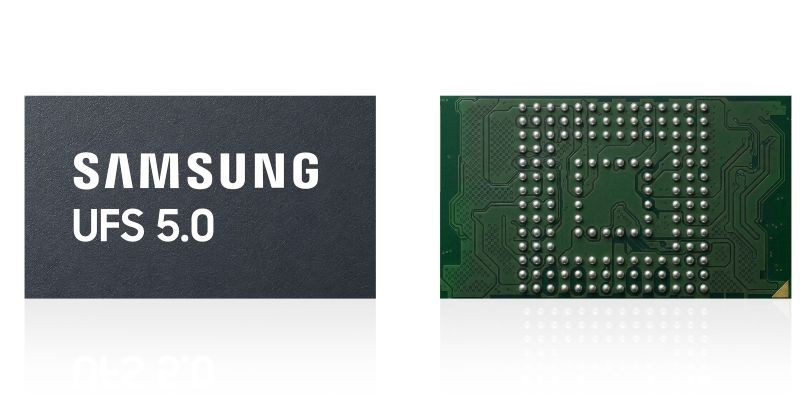
The company said the new storage technology is expected to enable seamless and highly efficient AI experiences by reducing latency and improving response times when running large language models (LLMs) directly on mobile devices.
The launch marks a new benchmark for the mobile memory industry as generative AI increasingly shifts from cloud-based computing to on-device processing, driving demand for faster and more efficient storage.
"In the era of on-device AI, storage devices are evolving into a key driver defining AI experiences," said Jangseok Choi, Head of Memory Product Planning at Samsung Electronics.
"As we successfully move beyond the development stage of the industry's first UFS 5.0 solution, Samsung is setting a new standard for storage on the go and will continue to drive innovation for the next-generation mobile platform market," he added.
Samsung said its UFS 5.0 integrates the latest embedded memory interface standard from JEDEC, delivering a bandwidth of up to 10.8 gigabytes per second (GB/s).
The solution offers sequential read speeds of up to 10.8 GB/s and sequential write speeds of up to 9.5 GB/s—more than double the performance of the previous UFS 4.1 standard.
"This significant advancement enables much faster storage and processing of large data for on-device AI applications," the company said in a statement.
Samsung also said power efficiency has been significantly improved over its UFS 4.1 solution through technologies such as clock gating and multi-voltage architecture. These enhancements reduce the power required to transfer data, helping lower overall energy consumption while extending battery life in next-generation mobile devices.
The company has packaged UFS 5.0 into an ultra-compact 7.5 mm × 13 mm × 0.9 mm form factor, making it 16.7% smaller than its predecessor. According to Samsung, the reduced size provides greater design flexibility and improves internal space utilisation across smartphones, wearables and XR devices.
Samsung plans to begin mass production of UFS 5.0 in the fourth quarter of this year, with storage capacities ranging up to 1 terabyte (TB).