
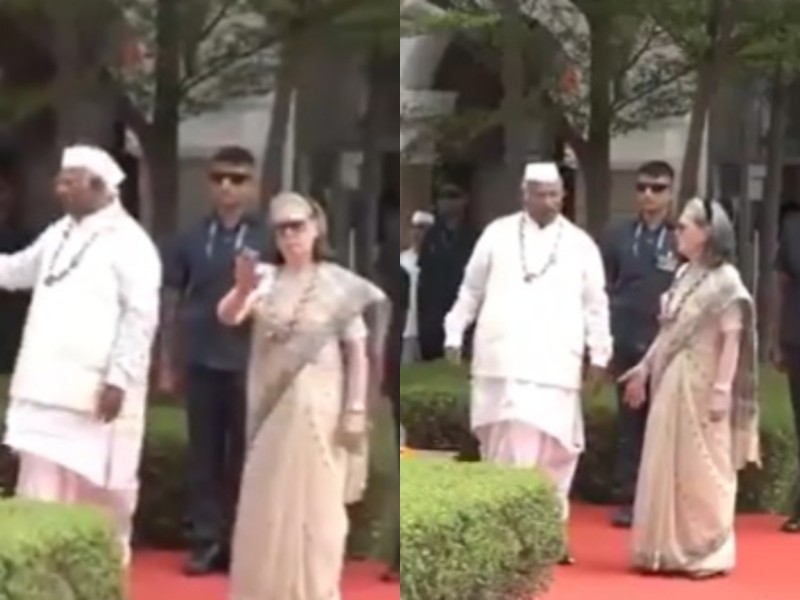
The Congress rejected the allegation, saying Gandhi was not attempting to stop the national song but was asking for a chair for party president Mallikarjun Kharge, who had been standing for some time.
The dispute followed the singing of the full version of Vande Mataram at the Congress headquarters during the Independence Day programme.
BJP attacks Sonia Gandhi
BJP MP Sudhanshu Trivedi criticised the Congress over what he described as the party's conduct during the rendition.
“Thanks to Prime Minister Narendra Modi's resolve and in tune with the sentiments of crores of Indians, this is the first Independence Day where Vande Mataram has been sung in its entirety,” Trivedi said.
आज स्वतंत्रता दिवस पर जब करोड़ों भारतवासियों की भावनाओं के अनुरूप ‘वंदे मातरम्’ संपूर्ण रूप में गाया गया, उसी समय कांग्रेस कार्यालय में कांग्रेस की सुप्रीम लीडर सोनिया गांधी, सुपर अध्यक्ष राहुल गांधी और वर्तमान अध्यक्ष मल्लिकार्जुन खरगे जिस तरह एक-दूसरे से बातचीत करते और असम्मान… pic.twitter.com/A7UigQaVax
— Dr. Sudhanshu Trivedi (@SudhanshuTrived) August 15, 2026
He then alleged that Sonia Gandhi, Rahul Gandhi and Kharge were seen speaking to one another and signalling towards someone while the song was being performed.
“Yet, a very strange, ironic, and unfortunate scene was witnessed. While Vande Mataram was being sung at the Congress office, the party's supreme leader Sonia Gandhi, 'super-president' Rahul Gandhi, and current president Mallikarjun Kharge were seen conversing with each other and beckoning someone in a manner that was highly peculiar, objectionable, and disrespectful,” he said.
Trivedi alleged that the incident suggested the Congress had not fully accepted Vande Mataram as the national song.
Amit Malviya alleges Sonia Gandhi was ‘agitated’
BJP IT cell chief Amit Malviya also targeted Gandhi over the incident.
Malviya claimed on X that Gandhi appeared agitated after the rendition continued beyond the opening stanzas and alleged that she sought to have it stopped.
“After the initial stanzas of Vande Mataram were sung, Sonia Gandhi became agitated and asked for the rendition to be stopped rather than played in full. Rahul Gandhi too appeared to signal that it should end,” Malviya wrote.
For the first time, the entire ‘Vande Mataram’ was sung at the Congress headquarters on Independence Day.
— Amit Malviya (@amitmalviya) August 15, 2026
After the initial stanzas of Vande Mataram were sung, Sonia Gandhi became agitated and asked for the rendition to be stopped rather than played in full. Rahul Gandhi too… pic.twitter.com/ITgkkBvStG
He further claimed that the leaders were told to allow the rendition to continue and that the complete song was eventually performed.
“For decades, the Gandhis and the Congress have displayed an uneasy relationship with the idea of a culturally confident, civilisationally rooted India. That discomfort stood exposed, ironically, on Independence Day,” Malviya alleged.
Congress rejects BJP’s allegation
The Congress disputed the BJP's account of the incident and maintained that Gandhi had not objected to Vande Mataram being sung in full.
According to the Congress, Gandhi was asking for a chair for Kharge because the party president had been standing for some time.
The party also stressed that the full version of Vande Mataram was ultimately sung at its headquarters during the Independence Day event.
The contrasting accounts turned an otherwise ceremonial programme into a fresh political confrontation between the BJP and Congress.
Why Vande Mataram remains politically contentious
The controversy also comes against the backdrop of a long-running debate over which portions of Vande Mataram should be officially performed.
Bankim Chandra Chatterjee wrote Vande Mataram in 1875. The first two stanzas were adopted as the National Song in 1937, while four subsequent stanzas containing references to Hindu goddesses were left out.
The decision was linked to concerns that those portions could be viewed as exclusionary, including by sections of the Muslim community.
The BJP has repeatedly criticised the Congress over the omission of the remaining portions and has accused the party of treating the National Song in a divisive manner.
Full rendition becomes a fresh political flashpoint
The dispute has gained renewed significance following the Centre's decision in February to mandate the singing of the complete Vande Mataram at public gatherings, schools and official government functions, among other venues.
Parliament also passed legislation last month making intentional obstruction, disruption or prevention of the singing of Vande Mataram a criminal offence. The legislation subsequently received presidential assent.