
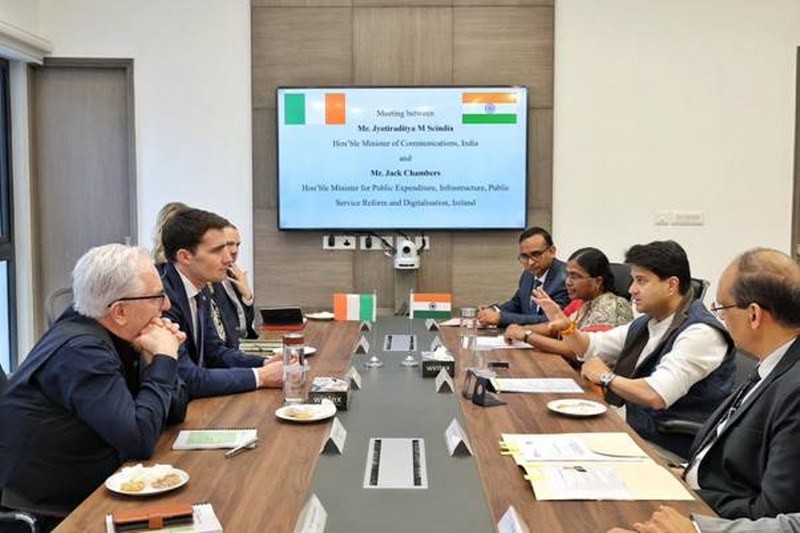
The Indian delegation included Jyotiraditya M. Scindia, Union Minister for Communications and Development of the Northeastern Region, India; Amit Agrawal, Secretary, Department of Telecom; and other senior officials from the DoT. The Irish delegation comprised Jack Chambers, Minister for Public Expenditure, Infrastructure, Public Service Reform, and Digitalization, Ireland; Kevin Kelly, Ambassador of Ireland to India; and other senior officials from Ireland.
The meeting focused on deepening cooperation in telecommunications, digital infrastructure, emerging technologies, and regulatory collaboration, reaffirming the strong and friendly ties between the two countries.
Both sides acknowledged strong complementarities between India’s scale and rapid deployment capabilities, Ireland’s research-driven innovation ecosystem, and EU-aligned regulatory architecture.
The potential for structured collaboration between DoT and Ireland’s Commission for Communications Regulation (ComReg), supported by academia, startups, and industry stakeholders, was emphasized.
Minister Scindia said, “As dynamic, innovation-driven democracies, India and Ireland both have immense potential to collaborate in quantum communications, AI, regulatory innovation, and rural broadband services. We also look forward to Ireland’s support for India’s candidature at the International Telecommunication Union. Together, we can build a strong and future-ready digital partnership.”
The Hon’ble Minister briefed the Irish side on India’s ICT transformation journey since 2014.
He noted that India today represents one of the world’s largest digital ecosystems, with over 1.23 billion telecom subscribers and nearly a billion internet users. 5G coverage extends to approximately 99.9% of the districts, supported by data tariffs averaging around USD 0.10 per GB, making connectivity widely accessible and affordable.
He highlighted the availability of affordable voice and data tariffs, which are among the lowest globally, and underscored India’s success in building Digital Public Infrastructure (DPI). In particular, he referred to the transformative impact of the Unified Payments Interface (UPI), which has scaled globally as a model for interoperable digital payments, and the Direct Benefit Transfer (DBT) system that enables seamless transfer of government funds directly into beneficiaries’ bank accounts, enhancing transparency and efficiency.
He sought Ireland’s support for India’s candidature in the forthcoming elections at the International Telecommunication Union (ITU), including the candidature of M. Revathi for the position of Director, Radiocommunication Bureau; India’s re-election to the ITU Council for the term 2027–2030; and India’s proposal to host the ITU Plenipotentiary Conference (PP) in 2030.
The Indian side also shared experiences with key digital initiatives such as DigiLocker, which incorporates robust privacy algorithms to safeguard personal data, and Digi Yatra, enabling seamless, paperless travel experiences at airports.
The Sanchar Saathi initiative and its modules, including CEIR for recovery of lost or stolen mobile devices, CIOR for blocking international spoofed calls, SPAM call alert mechanisms by operators, and ASTRA for identifying forged mobile connections, were also highlighted by the Indian side.
Jack Chambers, the minister from Ireland, shared insights into Ireland’s National Broadband Plan, noting that it offers valuable lessons in delivering universal, meaningful, and affordable connectivity, particularly to rural and remote areas. He also acknowledged the significant contribution of the Indian community to the Irish economy, innovation landscape, and job creation.
The Irish minister highlighted Ireland’s multi-billion-euro fiber rollout project across the country and noted the strong and growing trade relationship between India and Ireland, which accounts for a significant share of India’s trade with the European Union. He expressed interest in exploring further opportunities for ICT businesses and industry partnerships between the two countries.
Key Areas of Cooperation
Both sides agreed to work closely in the field of ICTs through structured engagement, exchange of best practices, capacity building, and industry linkages.
They reaffirmed their shared commitment to strengthening bilateral cooperation, fostering innovation, enhancing digital inclusion, and boosting trade and investment between India and Ireland.
Both sides expressed the need to work closely within the ITU framework and to exchange best practices in regulatory and technological domains.