
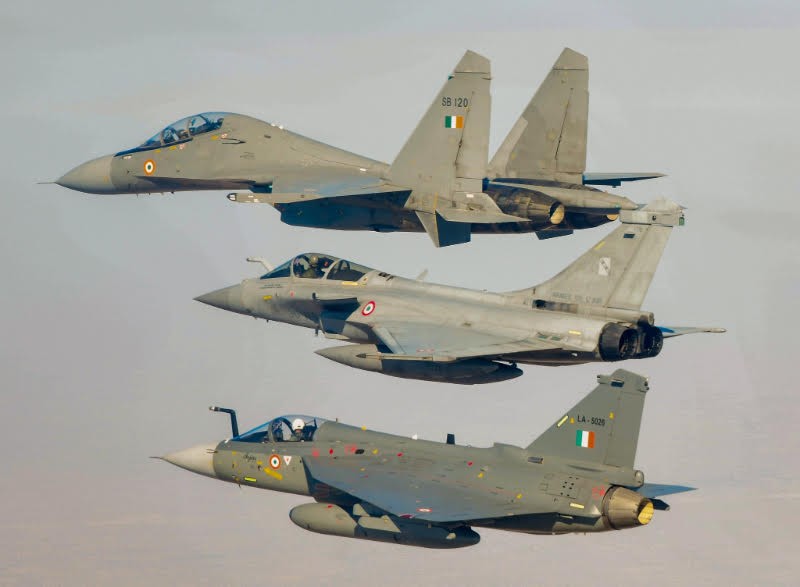
The WDMMA 2026 Global Air Power Rankings place only the United States Air Force and the Russian Aerospace Forces ahead of the IAF, reinforcing India's position among the world's leading military aviation powers.
IAF in global top three
The annual assessment evaluates 129 air services across 103 countries and examines more than 48,000 military aircraft worldwide.
Rather than relying solely on fleet size, the WDMMA uses its proprietary True Value Rating (TVR) system, which measures overall operational capability by analysing aircraft diversity, technological sophistication, logistical support, fleet modernisation and mission readiness.
According to the assessment, this marks the fifth successive ranking in which the IAF has remained ahead of China's PLAAF and the sixth occasion overall on which India has been placed behind only the United States and Russia.
Ranking goes beyond fighter numbers
The WDMMA methodology gives significant weight to the balance and versatility of an air force rather than simply the number of combat aircraft.
Its evaluation includes specialised platforms such as airborne early warning and control systems (AEW&C), aerial refuelling tankers, military transport aircraft, trainer aircraft, intelligence and surveillance platforms, and close air support assets.
The ranking also considers future acquisition programmes and the strength of a country's indigenous aerospace industry while assessing long-term operational capability.
IAF's over 1,700-aircraft fleet
According to the report, the Indian Air Force currently operates 1,716 military aircraft.
Its inventory includes 542 fighter aircraft spanning seven different aircraft types. The assessment notes that this figure still reflects the MiG-21 fleet, despite the aircraft's retirement in September 2025.
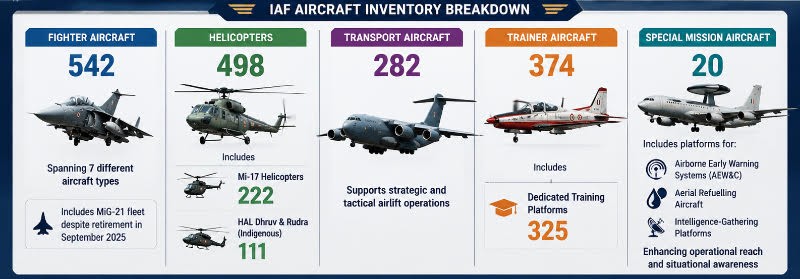 Chart designed by ChatGPT
The IAF also operates 498 helicopters, including 222 Mi-17 helicopters and 111 indigenous HAL Dhruv and Rudra platforms.
Its transport fleet comprises 282 aircraft, while 374 trainer aircraft remain in service, including 325 dedicated training platforms.
In addition, the Indian Air Force maintains 20 special mission aircraft, including airborne early warning systems, aerial refuelling aircraft and intelligence-gathering platforms designed to extend operational reach and improve situational awareness.
Comparison with US Air Force
The report also provides a breakdown of the United States Air Force, which continues to hold the top position globally.
According to the assessment, fighter aircraft account for 32 percent of the USAF inventory.
When bombers and close air support aircraft are included, combat aircraft represent around 41 percent of its fleet.
Transport aircraft constitute approximately 14 percent of the inventory, while helicopters make up around 4 percent.
Another 14 percent consists of special mission platforms supporting surveillance, command and aerial refuelling operations.
Capability gaps highlighted
Despite retaining its third-place ranking, the report identifies several operational challenges facing the Indian Air Force.
The IAF currently operates 29 fighter squadrons, well below its sanctioned strength of 42 squadrons.
Its long-term force structure is based on approximately 750 fighter aircraft, assuming an average of 18 aircraft per squadron.
The assessment also points to shortages in force-multiplier capabilities, including aerial refuelling tankers, airborne early warning and control systems, electronic warfare platforms, and Intelligence, Surveillance, Target Acquisition and Reconnaissance (ISTAR) assets.
Modernisation programme underway
The Indian Air Force is pursuing an extensive modernisation programme aimed at addressing these capability gaps through a combination of indigenous development and overseas procurement.
The service has placed orders for 180 Tejas Mk-1A fighter aircraft in two batches of 83 and 97 aircraft.
Deliveries are expected to strengthen squadron strength once final systems integration is completed.
India is also evaluating the acquisition of up to 114 additional Rafale fighter jets, a move that could significantly reinforce combat capability while replacing ageing aircraft.
More than 200 Jaguar, Mirage 2000 and MiG-29 fighter aircraft are expected to retire during the 2030s, making replacement programmes a key priority.
Alongside fighter induction, the IAF is advancing plans to acquire additional airborne warning and control systems, aerial refuelling aircraft and advanced ISTAR platforms to strengthen its network-centric warfare capabilities.