
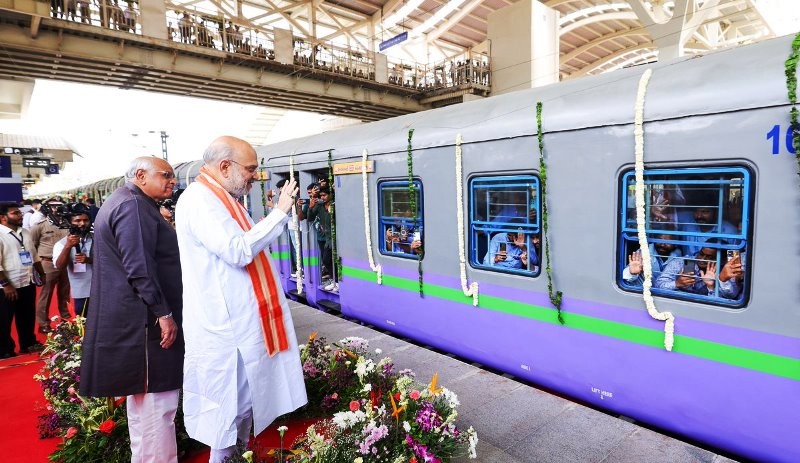
Shah said the LNG-powered train would make a significant contribution to environmental conservation in the coming years.
He also inaugurated a WAG-12 Maintenance Shed for railway locomotive engines.
Shah said the development projects inaugurated and those for which foundation stones were laid during the event, with a combined cost of ₹1,472 crore, would be significant for the region.
The WAG-12 Maintenance Shed has been constructed at a cost of ₹700 crore for the maintenance of railway locomotives.
The 'Kavach' train protection system has also been introduced on the Sabarmati-Kalol-Sabarmati rail section at a cost of ₹48 crore to enhance railway safety.
In addition, work has begun on implementing 'Kavach' on the Ahmedabad-Palanpur and Ahmedabad-Samakhiali rail sections, along with the doubling of the Sabarmati-Sarkhej railway line.
Shah said a 12,000-horsepower twin-section locomotive had also been commissioned. According to him, the locomotive can haul nearly as much freight as 600 trucks.
Earlier, two locomotives were required for the same task, but a single WAG-12 can now perform it, he said, describing the development as an important milestone for Indian Railways.
India’s First Hydrogen Train
The LNG-powered train launch comes after India introduced its first indigenous hydrogen-powered train earlier this year.
On July 17, Prime Minister Narendra Modi flagged off the hydrogen-powered train on the Jind-Sonipat section of Northern Railway. The train was developed using indigenous technology and marked India's entry into the group of countries operating hydrogen-powered trains.
According to the Ministry of Railways, the 10-coach hydrogen train uses hydrogen fuel-cell technology to generate electricity onboard, with water vapour as the only by-product.
आज साबरमती से शुरू हुई देश की पहली LNG ट्रेन पर्यावरण संरक्षण की दिशा में बहुत कल्याणकारी सिद्ध होगी। pic.twitter.com/79ZoRChKIL
— Amit Shah (@AmitShah) September 27, 2026