
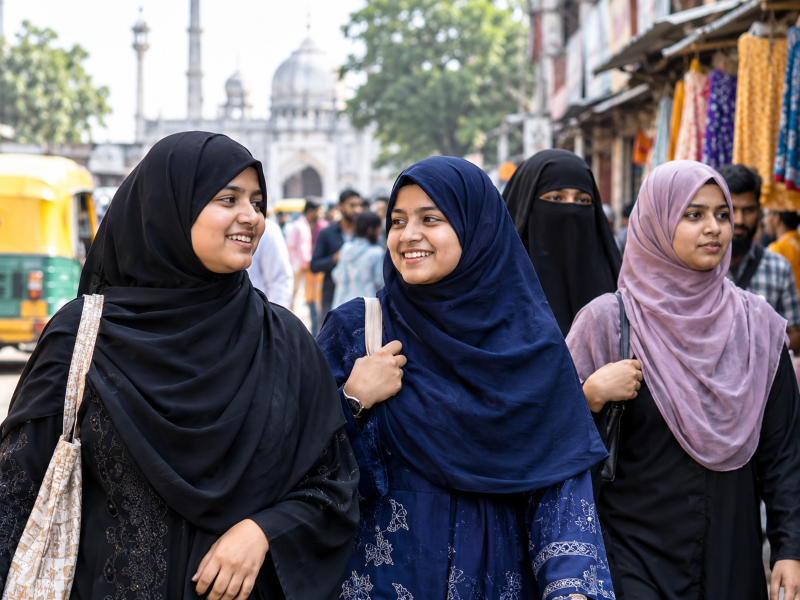
The study projects a gradual shift in India's religious composition, with Hindus continuing to constitute the overwhelming majority while the Muslim population grows at a faster rate.
It also predicts that Muslims could overtake Christians as the world's largest religious group by 2035.
According to the projections, Hindus will account for 76% of India's population in 2070, compared with 79% in 2020. The Muslim share, meanwhile, is expected to rise from 15% to 20% over the same period.
Hindu population to grow despite declining share
India's Hindu population is projected to increase from 1.11 billion (111 crore) in 2020 to 1.29 billion (129 crore) by 2070, representing an increase of approximately 176 million (17.6 crore).
However, the community's share of the country's overall population is expected to decline slightly.
This means that while the absolute number of Hindus will continue to rise, their proportion of India's population will become smaller.
The findings follow a 2024 study by the Economic Advisory Council to the Prime Minister (EAC-PM), which reported a decline in the Hindu share of India's population between 1950 and 2015, alongside an increase in the share of several minority communities.
Why is India's Muslim population growing faster?
Pew attributes the projected demographic shift primarily to differences in age profiles and fertility rates between religious communities.
In 2020, the median age of Indian Muslims was 24, compared with 29 among Hindus. A younger population generally has a larger proportion of people in their childbearing years, contributing to faster population growth.
Fertility rates have also played a role. The average number of children per Hindu woman is estimated to have declined to 1.9, from 3.3 around three decades ago.
For the 2025-2030 period, Pew projects an average of 2.3 children per Muslim woman in India, compared with 1.8 among Hindu women.
Despite these differences, fertility rates have been declining across religious communities in India.
India to have world's second-largest Muslim population
The study estimates that India's Muslim population will increase from 213 million (21.3 crore) in 2020 to 334 million (33.4 crore) by 2070.
This growth is expected to move India from third to second place among countries with the largest Muslim populations.
India is projected to account for 9.2% of the world's Muslim population by 2070.
In 2020, Indonesia had the largest Muslim population, followed by Pakistan and India. By 2070, Pakistan is projected to take the top position with 461 million Muslims. Nigeria is expected to rank third, followed by India.
Explaining the trend, Stephanie Kramer of the Pew Research Centre told the BBC that Muslims in India are younger and have higher fertility rates.
She also noted that Hindu fertility has already fallen below the replacement level, while Muslim fertility is projected to remain above it for another two decades.
Replacement-level fertility refers to the average number of children women need to have for a population to maintain its size from one generation to the next, without accounting for migration.
India to remain home to most of the world's Hindus
India will continue to account for the overwhelming majority of the global Hindu population, even as its share edges down.
In 2020, India was home to approximately 1.11 billion Hindus, representing 94.5% of the world's Hindu population. By 2070, the figure is projected to reach 1.29 billion, although India's share of the global Hindu population is expected to decline to 93.6%.
Globally, the Hindu population is projected to increase by 199 million over the same period. However, its share of the world's total population is expected to dip marginally from 15% in 2020 to 14% in 2070.
Outside India, Pakistan and the United States are also expected to witness growth in their Hindu populations.
Pakistan's Hindu population is projected to nearly double, from five million to 10.3 million, largely due to natural population growth.
The United States, meanwhile, is expected to have the world's fifth-largest Hindu population by 2070, with an estimated 7.4 million Hindus. Immigration is projected to be the primary driver of this increase.
Will these demographic projections become reality?
Pew's findings offer a possible picture of how the world's religious composition could evolve over the next 50 years.
The study examined seven religious groups across 201 countries and territories, collectively representing 99.98% of the global population.
However, the projections are based on 2020 demographic patterns and assumptions about fertility, mortality and migration.
Over a period as long as five decades, several factors could alter these trends. Economic development, improvements in healthcare, migration, conflicts, government policies and changing social behaviour can all influence population growth and fertility patterns.
Therefore, the figures should be viewed as projections rather than definitive predictions. The actual religious composition of India and the world in 2070 could look significantly different if demographic patterns change.