
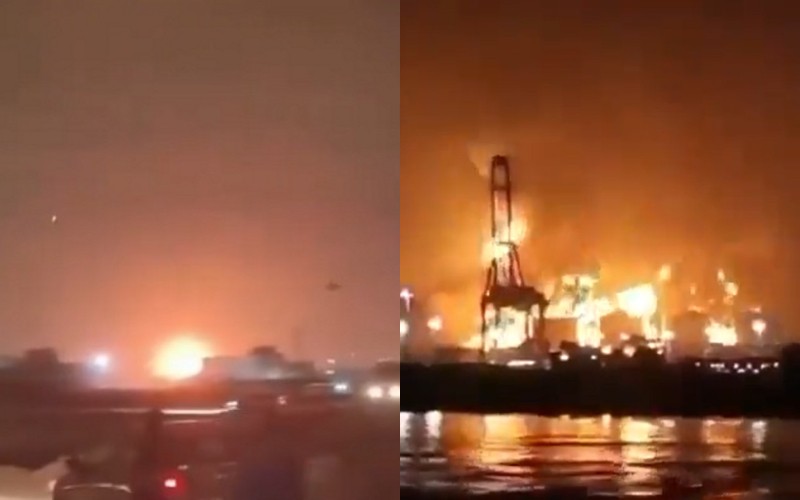
The attack has significantly escalated tensions in the Middle East, pushing energy infrastructure into the centre of the ongoing conflict.
Ras Laffan, widely regarded as the world’s largest LNG hub, plays a critical role in supplying natural gas to multiple countries.
Following the strike, operations at the facility have reportedly come to a complete halt, raising fears of prolonged disruption in global energy flows.
BREAKING: Iran strikes Qatar’s Ras Laffan – the world’s largest LNG terminal – hours after IRGC threatened to hit Gulf energy infrastructure. QatarEnergy confirms extensive damage. pic.twitter.com/OvG9s6YFw3
— Conflict Alarm (@ConflictAlarm) March 18, 2026
The development comes amid a broader escalation in hostilities triggered by US and Israeli strikes on Iranian targets.
In retaliation, Tehran has increasingly focused on energy assets across the Gulf region, intensifying concerns among major oil and gas producers.
Energy infrastructure becomes a war target
The latest strike underscores a sharp shift in the conflict, where energy facilities have become primary targets.
Iran’s actions are widely seen as retaliation for earlier attacks on its own energy infrastructure, including the strategically significant South Pars gas field.
The Gulf region, home to some of the world’s largest hydrocarbon reserves, has witnessed repeated strikes in recent weeks.
These attacks have extended beyond Qatar, with reported targeting of facilities in countries such as the United Arab Emirates.
The situation has already disrupted tanker movement through the Strait of Hormuz, a crucial maritime corridor that typically carries around 20 percent of global oil and liquefied natural gas shipments.
With traffic severely affected, global supply chains are under mounting strain.
🇶🇦⚡ Qatar Energy Co. annuncia che un attacco missilistico ha causato danni significativi al complesso industriale a Ras Laffan, in Qatar, uno dei più grandi centri di produzione di gas naturale liquefatto al mondo. https://t.co/J9H9TLOxuc pic.twitter.com/BHstWxjO3p
— Lukyluke31 (@Lukyluke311) March 18, 2026
Global gas supply faces severe disruption
Qatar remains one of the world’s top LNG exporters, alongside the United States, Australia, and Russia.
Any disruption to its production capacity has immediate global repercussions.
The shutdown at Ras Laffan follows earlier interruptions in Qatari gas production earlier this month.
These repeated disruptions have contributed to sharp increases in global energy prices, as markets react to tightening supply conditions.
The conflict has also led to a build-up of cargo vessels stranded near key ports in the region, further complicating logistics and delaying deliveries.
Analysts warn that prolonged instability could have lasting effects on global energy markets.
Why India is particularly vulnerable
India is among the countries most exposed to the current crisis due to its dependence on imported natural gas.
Approximately 50 percent of India’s gas requirements are met through imports, with a significant share sourced from Qatar.
A substantial portion of India’s LNG imports—around 40 percent—comes from Qatar alone, translating to roughly 20 percent of its total gas consumption.
This makes any disruption in Qatari supply a critical concern for the country’s energy security.
India’s daily natural gas consumption stands at nearly 189 million metric standard cubic metres, with domestic production covering just over half of that demand.
The remaining requirement depends heavily on international supplies, which are now facing uncertainty.
Supply disruptions and emergency measures
Recent disruptions have already affected a portion of India’s imported gas supply, prompting state-run companies to seek alternative LNG sources.
Emergency procurement efforts are underway to mitigate potential shortages.
The impact is expected to be felt across key sectors, particularly in industries that rely heavily on natural gas, including power generation and fertiliser production.
Any sustained disruption could force adjustments in consumption patterns.
A conflict reshaping global energy dynamics
The ongoing conflict has entered a new and more dangerous phase, where control over energy supply has become a strategic objective.
Attacks on oil and gas infrastructure signal a deliberate attempt to exert economic pressure on adversaries.
With global energy prices already reacting sharply, the long-term consequences could extend far beyond the Middle East.
Damage to large-scale LNG facilities often takes years to repair, raising the risk of prolonged supply constraints.
As tensions continue to escalate, the situation remains fluid.
For countries like India, heavily reliant on energy imports, the unfolding crisis poses a serious challenge to economic stability and energy planning.