
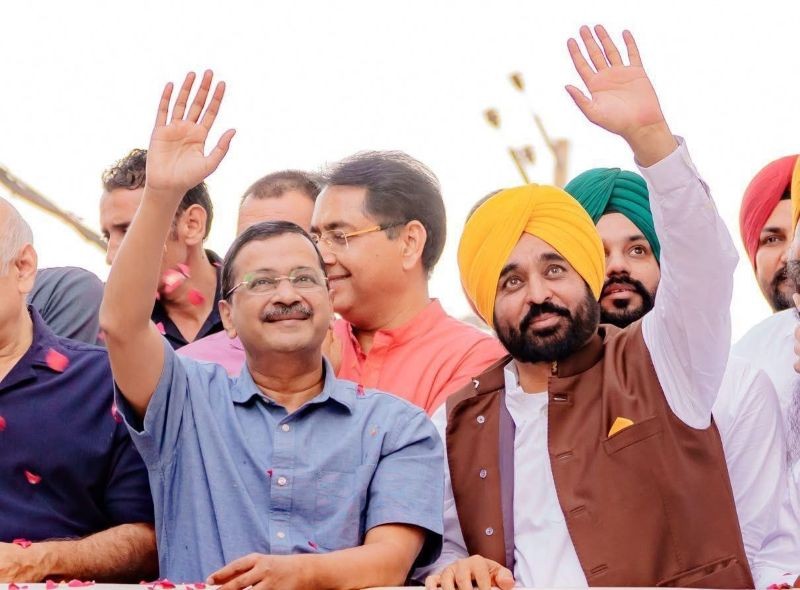
It comes amid a controversy involving Chief Minister Bhagwant Mann and just days before the Akal Takht is set to hear Sikh MLAs, including AAP ministers and legislators, over their support for the state's anti-sacrilege law.
The overlap of these developments has sparked debate over whether the ruling Aam Aadmi Party is attempting to strengthen its outreach to Hindu voters while navigating a politically sensitive phase in its relationship with Sikh religious institutions.
The visit comes just days before the Akal Takht is scheduled to hear Sikh MLAs, including ministers and legislators from the ruling Aam Aadmi Party (AAP), over their support for the state's anti-sacrilege legislation.
Timing of Visit draws political attention
The convergence of the two developments has fuelled speculation that AAP is seeking to shift the political narrative from a Sikh religious controversy towards a broader outreach to Hindu voters.
"Political parties always try to woo every section of society and AAP is also following suit," said Punjab-based political analyst Shiv Inder Singh.
"To woo Hindu voters, the party is launching this programme close to the day when the Akal Takht has summoned AAP ministers. While the party may appear to be in a collision with the highest temporal seat of the Sikhs, the anger on the ground is not yet very palpable," he added.
Hindu vote holds electoral significance
While Punjab politics has traditionally revolved around Sikh institutions, agrarian issues and regional identity, Hindu voters account for nearly 38 per cent of the state's population.
Their influence is particularly significant in urban and semi-urban constituencies across cities such as Amritsar, Jalandhar, Ludhiana, Pathankot, Batala, Hoshiarpur, Patiala and Mohali, where they often play a decisive role in electoral outcomes.
AAP's balancing act
For AAP, the challenge is increasingly one of perception as much as governance.
The recent controversy involving Chief Minister Bhagwant Mann and the Akal Takht's decision to summon Sikh legislators has provided opposition parties an opportunity to portray the ruling party as being at odds with sections of the Sikh religious establishment.
Against this backdrop, Kejriwal's participation in Hindu religious events assumes added political significance.
The programmes are being organised by the Punjab government and projected as cultural and devotional gatherings.
Religious outreach expands
AAP has already signalled a stronger emphasis on religious and cultural outreach in Punjab.
On June 13, Kejriwal and Mann attended a state-level 'Ek Shaam Bhagwan Shiv Ke Naam' event in Jalandhar that drew a large turnout.
During the programme, Kejriwal announced the expansion of Punjab's Tirth Yatra Scheme with three new pilgrimage circuits covering Salasar, Khatu Shyam and Mathura-Vrindavan.
He also unveiled plans to revamp the revered Kali Mata Temple in Patiala and announced efforts to bring actor Ashutosh Rana's Ramayana-based theatrical production to Punjab.
BJP, Congress also eye Hindu voters
Political observers believe AAP's outreach is unfolding amid increasing competition for Punjab's Hindu electorate.
Since parting ways with the Shiromani Akali Dal, the BJP has intensified efforts to consolidate Hindu voters while expanding its engagement with farmers, traders and professionals.
The Congress, too, appears keen to strengthen its appeal among Hindu voters.
Amid organisational restructuring in Punjab, former minister Vijay Inder Singla is being considered for a key leadership role, signalling a broader political recalibration within the party.
Focus on preserving AAP's coalition
Analysts note that AAP's sweeping victory in the 2022 Assembly elections was built on a broad social coalition rather than support from any single community.
With anti-incumbency concerns beginning to surface and religious issues increasingly shaping political discourse, maintaining that coalition has become a crucial challenge for the ruling party.
Kejriwal's latest Punjab visit may therefore represent more than participation in religious programmes.
It could also be part of a wider effort to reassure Hindu voters while navigating an increasingly delicate relationship with Sikh religious institutions ahead of the next Assembly elections.