
The assessment comes from the Centre for Military History and Perspective Studies in Switzerland and is authored by military historian Adrien Fontanellaz.
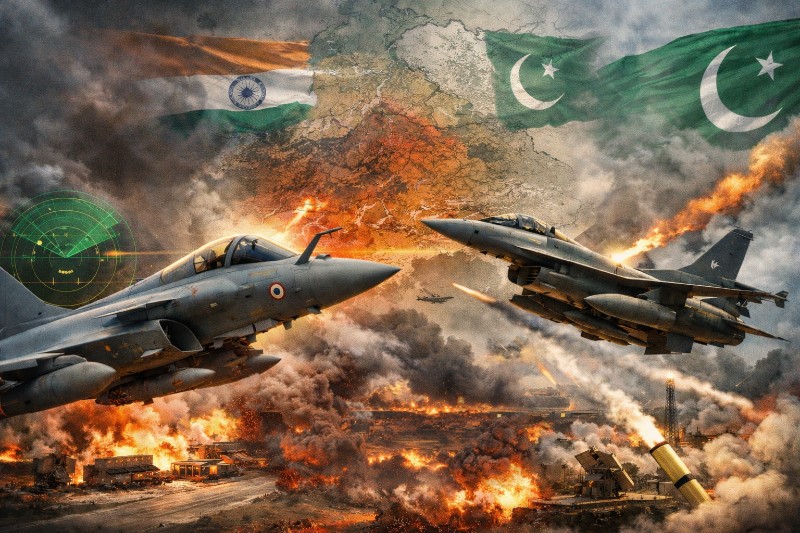
The report offers one of the most thorough independent reconstructions of the 88-hour India-Pakistan air conflict that unfolded between May 7 and May 10, 2025.
Beyond the Rafale narrative
While global media coverage at the time largely centred on the reported loss of at least one Indian Rafale fighter during the opening hours of the conflict, the Swiss analysis argues that this narrow focus obscured the broader operational reality.
According to the report, that initial setback, though tactically significant, did not define the operation’s outcome.
Instead, India went on to systematically dismantle Pakistan’s air defence and strike capabilities, eventually ending the confrontation on terms favourable to New Delhi.
Operation Sindoor
Operation Sindoor was launched following a deadly terrorist attack on tourists in Pahalgam, Jammu and Kashmir, which Indian authorities linked to Pakistan-based terror groups.
The report notes that India’s political leadership granted the armed forces considerable freedom to craft a response that would be forceful enough to restore deterrence, even at the risk of escalation between two nuclear-armed neighbours.
Precision strikes mark a strategic shift
In the early hours of May 7, the Indian Air Force carried out precision strikes on what the report describes as high-value terrorist infrastructure associated with Jaish-e-Mohammed and Lashkar-e-Taiba.
Key sites in Bahawalpur and Muridke were struck using long-range weapons, with post-strike analysis confirming extensive structural damage.
The Swiss study highlights these attacks as a marked departure from earlier Indian responses, citing greater depth, improved coordination across services, and more ambitious operational objectives.
Opening night: A tactical jolt for India
Pakistan responded with an aggressive aerial counter-move.
The first night witnessed one of the largest air engagements in South Asia in decades, involving roughly 60 Indian aircraft and over 40 Pakistani fighters operating across multiple sectors.
Backed by airborne early warning platforms and long-range Chinese-supplied PL-15 missiles, the Pakistan Air Force managed to inflict losses on the IAF, including at least one Rafale, a Mirage 2000 and another fighter aircraft.
The report describes this phase as a serious tactical and perception setback for India, allowing Pakistan to briefly seize the narrative.
India’s counter-offensive turns the tide
However, the Swiss assessment stresses that this initial exchange merely set the stage for a far more consequential Indian response.
Over the following days, the IAF transitioned into a systematic campaign aimed at suppressing and destroying Pakistan’s air defence network.
Employing standoff weapons such as SCALP-EG cruise missiles and BrahMos, alongside coordinated multi-axis strikes, Indian forces degraded radar coverage and surface-to-air missile systems, progressively weakening Pakistan’s defensive shield.
Air bases under sustained attack
Once Pakistan’s air defences were sufficiently eroded, India launched what the report terms a “spectacular” series of precision strikes against major Pakistani air bases.
Runways, infrastructure and support facilities were repeatedly hit, sharply limiting the Pakistan Air Force’s ability to generate and sustain combat sorties.
The study contrasts this phase with previous crises, noting that Pakistan was now facing direct and sustained attacks on the core of its air power rather than symbolic or limited actions.
Integrated air defence emerges as a surprise
One of the report’s most striking findings concerns the performance of India’s integrated air defence and command-and-control systems.
The Swiss analysts highlight the effectiveness of the IACCCS network and its coordination with the Army’s Akashteer system.
Combined with layered missile defences including Akash, Barak-8 and the S-400, these systems significantly blunted Pakistani retaliation attempts and emerged as one of the conflict’s major surprises.
Ceasefire after air superiority achieved
By May 10, the report concludes, the balance of power had clearly shifted.
With its air bases under pressure and its defensive network degraded, Pakistan was no longer able to contest airspace effectively.
India, having achieved de facto air superiority, was now in a position to dictate the pace and scale of operations.
It was at this point, Swiss analysts argue, that Islamabad moved to seek a ceasefire.
A turning point in India’s strategic doctrine
Beyond the immediate military outcome, the study suggests that Operation Sindoor represents a broader shift in India’s strategic posture.
Future large-scale terrorist attacks traced to Pakistan-based groups, the report notes, are now likely to be treated as inseparable from the state structures enabling them.
This signals the possibility of faster, wider and more forceful conventional responses in the future.
Strategic equation reset
In sum, the Swiss assessment concludes that while Pakistan enjoyed a brief tactical and propaganda advantage during the opening hours, the overall campaign demonstrated India’s superior depth, resilience and escalation control.
Operation Sindoor, the report argues, was not merely a retaliatory strike but a decisive demonstration of air power that reshaped the strategic balance in the subcontinent.