

Surrounded by family members in his final moments, Kundu's death marks the end of a journalistic career spanning more than five decades, during which he became one of the country's most authoritative voices on Sikkim's politics, society and strategic importance.
Beginning his association with Sikkim in 1977 as a bureau chief, Kundu reported on the Himalayan state at a time when its geopolitical significance was only beginning to draw wider national attention. Over the following decades, he emerged as one of the few journalists who consistently interpreted developments in the region through the larger prism of India's strategic interests.
For more than 40 years, he served as Special Correspondent for The Times of India in Sikkim and also contributed to several leading national publications. His reporting covered a wide spectrum—from India's border dynamics with China, Nepal and Bhutan to political developments in Sikkim and the Darjeeling hills—bringing national attention to issues often overlooked by the mainstream media.
Kundu was known for combining meticulous field reporting with historical perspective, producing journalism that was both accessible and deeply contextual. His writings helped bridge the gap between regional realities and national discourse, making the Eastern Himalayas a subject of sustained public and policy interest.
His book, Standpoint Sikkim: Under the Dragon's Shadow, remains an important account of the region's strategic and political evolution, reflecting decades of on-the-ground reporting and observation.
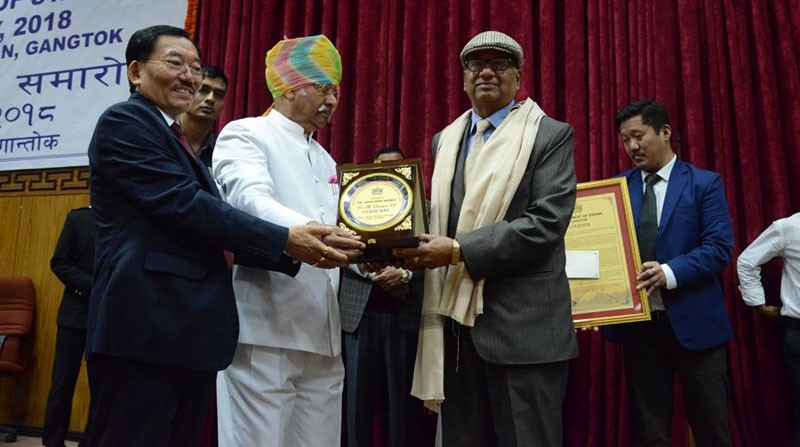
In recognition of his contribution to journalism, the Government of Sikkim honoured him with the Kashiraj Pradhan Lifetime Journalism Award during the state's 43rd State Day celebrations in 2018.
Colleagues remember Kundu as an old-school journalist whose commitment to accuracy, patient reporting and public interest remained unchanged despite the rapid transformation of the media industry. At a time when journalism increasingly favours immediacy, his work stood out for its depth, balance and understanding of the long-term implications of events.
Amalendu Kundu leaves behind a body of work that not only documented the history of Sikkim and the Eastern Himalayas but also helped shape the national understanding of one of India's most strategically sensitive frontiers. His legacy endures as a reminder that the finest journalism often comes from those who quietly devote themselves to telling important stories with accuracy, context and conviction.
(Text: Sayan Chatterjee. Photos: Writer)