
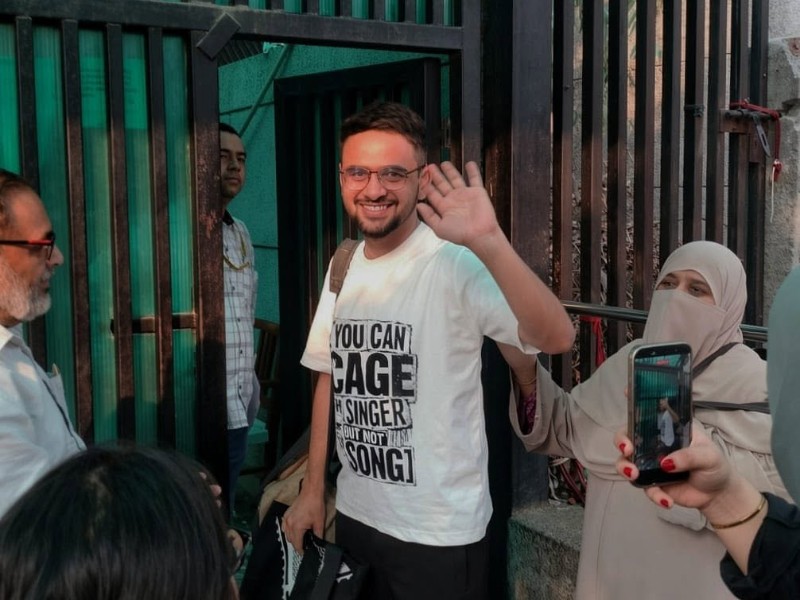
In an interview with The Guardian, Khalid said prolonged incarceration had affected both his mental well-being and sense of identity, while reiterating his criticism of the current political climate in India.
His remarks come as a Delhi court prepares to hear arguments on his fresh bail application in the larger conspiracy case linked to the 2020 Delhi riots.
'Humanity is a privilege'
Speaking to The Guardian through family members and friends because of restrictions on direct access, Khalid said years in prison had led to a process of "dehumanisation".
"You even hear murmurs about yourself from fellow prisoners you shared meals with, calling you a terrorist behind your back. This propaganda dehumanises me in people's eyes," he told the newspaper.
"Humanity is a privilege that is not granted to people like me."
Reflecting on his incarceration, the 38-year-old said the public image created around him had often eclipsed his identity as an individual.
"When you are reduced to just an image, either negative or positive, it becomes difficult to maintain not just your humanity but even your sanity at times," Khalid said.
"Even those who sympathise with you, or portray you as someone larger than yourself, forget that I am a human being with my own share of vulnerabilities, fears and imperfections. And that these long years in prison have wreaked havoc on my mind and body and exacerbated all these anxieties within me."
Comments on India's political climate
Khalid said his imprisonment had not altered his political beliefs.
He expressed concern over what he described as the increasing acceptance of hate speech and misinformation in public discourse.
"The process of India becoming a post-truth society is near complete," he told The Guardian.
He also criticised what he described as the silence of opposition parties, civil society organisations and public figures over the incarceration of activists and dissenters.
"Six years down the line, I must say that I am really disappointed and even feel isolated," he said.
"This silence, of opposition parties, of civil society groups, of celebrity activists who have made a career out of piggy-backing on people's movements, emboldens this regime to go after further dissidents."
Commitment to non-violence
Despite his prolonged incarceration, Khalid said he remained committed to the principles he advocated during the protests against the Citizenship Amendment Act (CAA) in 2019.
"We won't respond to violence with violence. We won't respond to hate with hate. If they spread hate, we will respond to it with love," he said.
Background of the case
Delhi Police arrested Umar Khalid in September 2020 under the Unlawful Activities (Prevention) Act (UAPA), alleging that he was a "key conspirator" in the larger conspiracy behind the 2020 Delhi riots and had plotted a "violent regime change".
Khalid has consistently denied all allegations against him.
The Bharatiya Janata Party (BJP) has maintained that India's judicial process operates independently and that Khalid's prosecution is not politically motivated.
Fresh bail plea before Delhi court
The interview comes weeks after a Delhi court issued notice to Delhi Police on Khalid's fresh bail application in the Delhi riots conspiracy case.
Additional Sessions Judge Sumedh Kumar Sethi of the Karkardooma Courts has listed the matter for arguments on July 4.
In his latest application, Khalid has cited a change in circumstances, relying on a Supreme Court judgment delivered on May 18 while granting bail to Jammu and Kashmir resident Syed Iftikhar Andrabi in a narco-terror case investigated by the National Investigation Agency (NIA).
The Supreme Court observed that prolonged incarceration and delays in trial could, in certain circumstances, outweigh the statutory restrictions on bail under Section 43D(5) of the UAPA, as laid down in the judgment in Union of India v. K.A. Najeeb (2021).
The apex court also expressed reservations over an earlier direction that Khalid and co-accused Sharjeel Imam could revive their bail pleas only after protected witnesses had been examined or after one year, whichever occurred earlier.
The Delhi court is expected to hear arguments on Khalid's fresh bail plea later this week.