
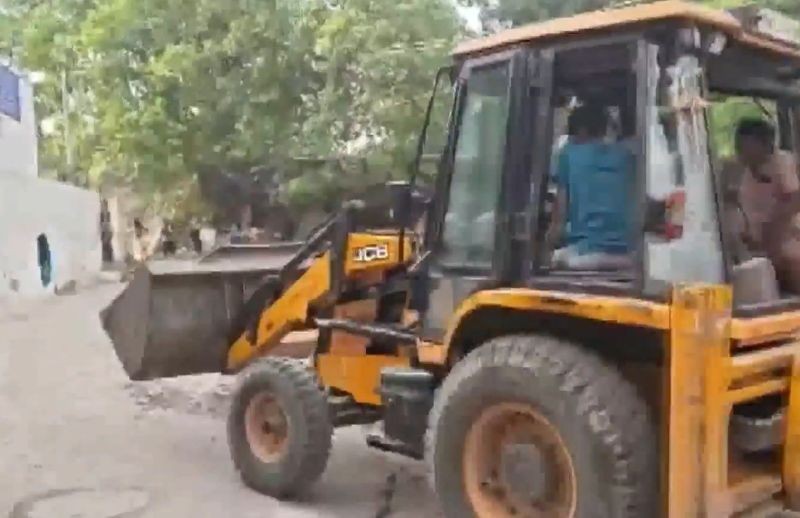
In just a few days, nearly 310 families lost not only their shelters but also livelihoods, community ties and a centuries-old way of life rooted in the river.
The Delhi Development Authority (DDA) carried out the demolition drive in the Yamuna Bazar area after classifying the settlement as part of the Yamuna floodplain, or 'O-Zone', where construction is prohibited.
The action followed directions issued by the National Green Tribunal (NGT) to remove encroachments from the ecologically sensitive zone.
#WATCH | Delhi | Delhi Development Authority (DDA) conducts a demolition drive in the Yamuna Bazar area near Nigam Bodh Ghat to remove unauthorised structures and encroachments. pic.twitter.com/hNSlgXOhbT
— ANI (@ANI) June 25, 2026
A notice issued on June 23 informed residents of Ghats 2 to 32 that all encroachments on the floodplain falling under the DDA's jurisdiction would be cleared in compliance with the tribunal's orders.
Centuries-old occupations uprooted
Most of those displaced belong to communities of priests, boatmen, barbers and flower vendors, whose livelihoods have been tied to the ghats for generations. Many families trace their roots in the area to five or six generations, with ancestors who migrated from Bihar and Uttar Pradesh.
Their work is closely linked to the traditional Jajmani system, under which service providers and the families they serve maintain hereditary relationships at specific religious sites.
Residents say this bond cannot simply be recreated elsewhere.
Gauri Shankar, a priest from Ghat No. 24, said his family had been conducting religious rituals at the site since the British era. With priests, boatmen and barbers displaced, he fears the ghats will lose the very communities that have sustained their religious significance for decades.
'We built this home with our own hands'
Residents say the manner in which the demolition was carried out added to their distress. Several claimed they were given little time to gather their belongings before their homes were razed.
Manish, a member of the barber community, said years of hard work vanished within hours.
"We won't go around begging. We built this home through years of labour, only to see it destroyed in a matter of days," he told NDTV.
Ganesh Pandit, who grew up on the ghats, said his entire life has revolved around the river.
"My education happened here. Families from Haryana and other states come to us because we preserve records of their ancestors across generations. We are allowed to perform rituals, but where are we supposed to live?" he asked.
No rehabilitation, no certainty
Among those hit hardest are elderly residents in their seventies and eighties, many of whom spent their entire lives at the ghats. Some were seen loading their remaining belongings onto cycle rickshaws without knowing where they would spend the night.
Residents say no alternative housing or rehabilitation has been offered to any of the displaced families, leaving children and senior citizens exposed to Delhi's scorching summer heat and the approaching monsoon.
Rajrani, 66, who has been living in a nearby temple, said she possesses documents dating back to 1905 but still found herself without a home.
She alleged that authorities had discouraged others from sheltering those evicted. Despite her own hardships, she distributed food and water to displaced families on Nirjala Ekadashi.
Legal action, human cost
The demolition was carried out under environmental protection rules governing the Yamuna floodplain, where permanent settlements are prohibited due to ecological concerns and flood risks.
However, residents point to a painful irony. They say they were always the first to suffer whenever the Yamuna flooded, and now they have become the first to lose everything in the name of restoring the floodplain.
For families whose livelihoods depend entirely on a specific stretch of the river and the pilgrims who visit it, relocating elsewhere is not simply a matter of finding a new address.
As they spend nights under the open sky, many are left asking a question that remains unanswered: Where do we go now, and how do we begin again?