
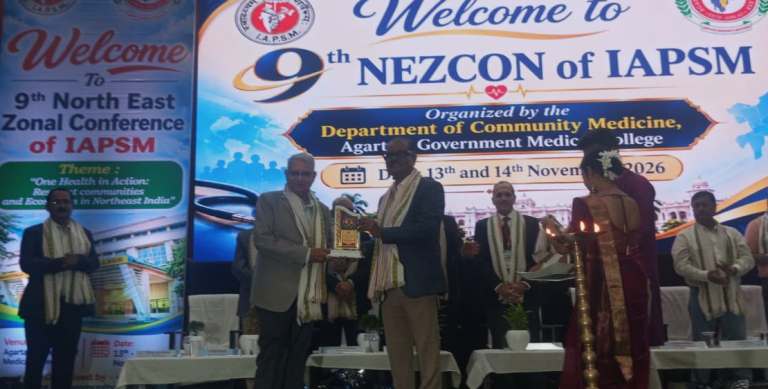
The Department of Community Medicine of Agartala Government Medical College (AGMC) organizes the 9th North East Zonal Conference of the Indian Association of Preventive and Social Medicine (IAPSM-NEZCON 2026) at AGMC on November 13 and 14, 2026. A pre-conference workshop on the theme “Artificial Intelligence in Health Care” was organized on November 12.
The central theme of this year’s conference was “One Health in Action: Resilient Communities and Ecosystems of Northeast India”. The conference aimed to provide an important academic platform for public health professionals, doctors, researchers, academicians and postgraduate students from the Northeast and other parts of the country to exchange knowledge, share innovative practices and deliberate on emerging public health challenges.
Special emphasis was placed on the interconnection between human health, animal health and environmental health, as well as the development of evidence-based, community-centred public health interventions.
The conference was graced by several distinguished national and state-level personalities. Major General Professor (Dr.) Atul Kotwal, National President of IAPSM, attended the programme as the chief guest, while Professor (Dr.) Manish Kumar Singh, Secretary General of IAPSM, was present as the guest of honour.
Other eminent dignitaries included Professor (Dr.) Brojen Singh Akoijam, President of IAPSM North East Zone; Professor (Dr.) H.P. Sharma, Director of Medical Education, Government of Tripura; Dr. Debashree Debbarma, Director of Health Services; Dr. Anjan Das, Director of Family Welfare and Preventive Medicine; Professor (Dr.) Girish N. Rao of NIMHANS; Professor (Dr.) Tapan Majumder, Principal of AGMC; and Dr. Bidhan Goswami, Medical Superintendent of AGMC and GBP Hospital.
The scientific programme covered a wide range of contemporary public health issues, including tuberculosis elimination, non-communicable disease control, the One Health approach, zoonotic diseases, antimicrobial resistance, climate change and health, digital health transformation, mental health systems, HIV/AIDS, malaria elimination, public health policy, immunization, viral hepatitis and tobacco control.
Particular attention was also given to the specific public health challenges and opportunities in Northeast India, including the health of indigenous communities, community participation and strengthening of healthcare systems.
The pre-conference workshop held on November 12 focused on two important areas: the application of artificial intelligence in research and public health, and implementation research and innovation in public health systems. The workshops were designed to provide practical knowledge and encourage the application of emerging technologies and research-based innovations in public health practice.
The inaugural session was held on November 13, followed by two days of scientific deliberations, expert panel discussions and presentations showcasing innovative public health initiatives from different northeastern states.
Participants discussed several pressing regional health concerns, including the growing risk of HIV transmission in Northeast India, measles outbreaks in specific areas, strategies for malaria elimination and initiatives to improve mental health.
Several important research projects, including STaR NCD and RAHAT, were also highlighted during the conference.
A significant highlight was the release of the Mental Health Systems Assessment (MHSA) report, specially prepared for the northeastern states. The report was released by Professor (Dr.) Girish N. Rao of NIMHANS, Professor of Epidemiology and Principal Investigator of the project.
The conference concluded with a valedictory session and distribution of awards.
The organizing committee was headed by Professor (Dr.) Subrata Baidya as Chairman, while Dr. Amar Tripura of the Department of Community Medicine, AGMC, served as Organizing Secretary. They coordinated the entire event with the support of the organizing committee and faculty members of the department.
The conference is expected to strengthen academic collaboration, expand regional research networks and promote innovative, sustainable and community-led public health initiatives. It also provided an important opportunity to highlight Tripura’s contributions and initiatives in the fields of public health and medical education at both regional and national levels.