
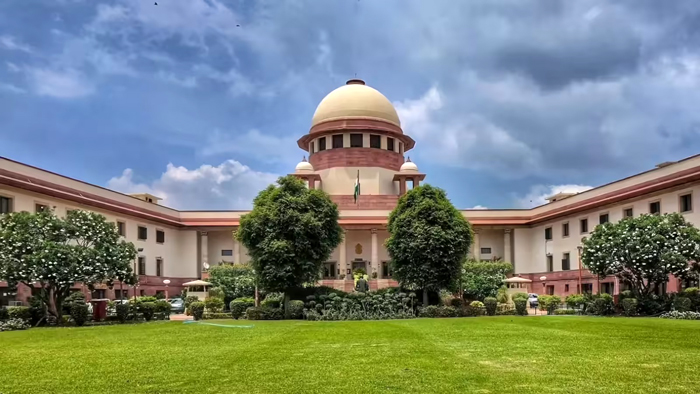
New Delhi: The Supreme Court of India has constituted a High-Powered Committee to reform and streamline Open Correctional Institutions (OCIs) across the country within three months, in a landmark judgment aimed at strengthening prison reforms and ensuring the dignity and rehabilitation of inmates.
A Bench comprising Justices Vikram Nath and Sandeep Mehta delivered the judgment on February 26, 2026, in a Public Interest Litigation (W.P.(C) No. 1082 of 2020) filed by human rights activist Suhas Chakma. The PIL raised concerns over overcrowding and inhumane treatment of prisoners in India.
High-Powered Committee Under Justice (Retd) Ravindra Bhat
The Court appointed Justice (Retd) Ravindra Bhat as the Executive Chairperson of the High-Powered Committee for Reform and Governance of OCIs.
The Committee will also include:
A member of the National Legal Services Authority (NALSA) nominated by the Member Secretary;
The Union Home Secretary or a representative not below the rank of Additional Secretary;
Home Secretaries of all States and Union Territories or their nominees;
Deputy Inspector General (Correctional Administration), Bureau of Police Research and Development (BPR&D);
Joint Secretary, Ministry of Social Justice and Empowerment;
Joint Secretary, Ministry of Skill Development and Entrepreneurship; and
Two Directors General of Prisons and Correctional Services from States, to be identified by the Executive Chairperson.
The Union Ministry of Home Affairs has been directed to bear all financial and logistical expenses of the Committee, and to complete necessary arrangements within two weeks.
Rehabilitation at the Heart of Criminal Justice
In a strongly worded judgment, the apex court observed:
“Reformation, rehabilitation and reintegration must lie at the heart of the criminal justice system.”
The Court held that the right to life under Article 21 of the Constitution includes the State’s obligation to facilitate rehabilitation and ensure prisoners can lead a life of dignity and normalcy. It noted that continued under-utilisation of existing OCI infrastructure reflects “systemic indifference” requiring immediate correction.
Key Issues Identified
The Supreme Court examined several structural concerns, including:
Under-utilisation of existing OCI facilities;
Absence of OCIs in several States and Union Territories;
Exclusion and under-representation of women prisoners;
Strict eligibility criteria limiting access;
Lack of uniform standards across States;
Need for expansion considering cost-effectiveness compared to closed prisons.
Directions to States and Union Territories
States that do not have OCIs — Arunachal Pradesh, Chhattisgarh, Goa, Haryana, Jharkhand, Manipur, Mizoram, Nagaland, Sikkim and Telangana — along with Union Territories including Andaman and Nicobar Islands, Chandigarh, Dadra & Nagar Haveli and Daman & Diu, Jammu and Kashmir, Ladakh, Lakshadweep and Puducherry, have been directed to assess feasibility and necessity of establishing OCIs within three months.
States and the National Capital Territory of Delhi, where significant under-utilisation has been reported, must develop time-bound protocols to fill vacancies in OCIs and open barracks before the respective Monitoring Committees within three months.
Special Focus on Women Prisoners
Calling the “systemic exclusion of women prisoners” plainly contrary to domestic and international norms, the Court directed all States and Union Territories to restructure OCIs and open barracks to allocate adequate capacity for women prisoners within three months.
Amendments to Rules and Uniform Standards
The Court directed States and Union Territories to amend or revise existing rules, regulations and administrative frameworks governing OCIs within three months.
To ensure uniformity, the High-Powered Committee will develop common minimum standards for governance and management of OCIs nationwide.
Monitoring by High Courts and Supreme Court
Noting that earlier directions issued in 2018 in In Re: Inhuman Conditions in 1382 Prisons had not yielded meaningful results, the Court adopted a stringent monitoring mechanism.
All High Courts have been directed to register suo motu writ petitions as continuing mandamus to monitor compliance with the present judgment. Each State and Union Territory must constitute a Monitoring Committee for OCI management within four weeks, headed by the Executive Chairman of the State Legal Services Authority or a former High Court judge nominee.
The first quarterly status report must be submitted before the concerned High Court by August 21, 2026.
Further, High Courts will compile annual consolidated reports and submit them to the Supreme Court, with the first such report due by March 31, 2027.
‘Historic and Unprecedented’ Judgment
Reacting to the verdict, petitioner Suhas Chakma described it as “historic and unprecedented,” stating that the judgment not only issued directions but also established an operational structure with strict timelines, monitored by both High Courts and the Supreme Court.
“The judgment of the Supreme Court is truly a genuine step to treat the lowest ones with human dignity,” Chakma said.
The ruling is expected to trigger a nationwide overhaul of open prison systems and strengthen India’s commitment to rehabilitation-based corrections.