
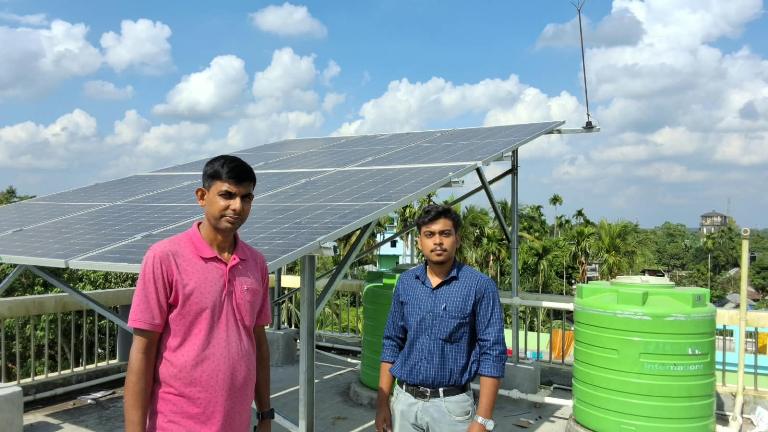
Tripura has achieved a significant milestone in renewable energy generation, with the cumulative installed capacity of rooftop solar power systems under the Centre's PM Surya Ghar Muft Bijli Yojana crossing the 20-megawatt mark.
The achievement is being viewed as the beginning of a new era in the state's power sector, with thousands of households emerging as contributors to electricity generation.
The initiative, launched under Prime Minister Narendra Modi's flagship scheme, is gradually transforming rooftops across Tripura into small power-generating units. Households are now able to generate electricity through solar panels, meet their own consumption requirements and feed surplus power into the main electricity grid.
According to statistics available up to November 3, 2026, a total of 18,186 registrations have been recorded under the PM Surya Ghar Muft Bijli Yojana in Tripura. Of these, 8,421 applications have been submitted, representing a proposed solar generation capacity of 26,961 kilowatt-peak (kWp).
Solar installations have already been completed in 5,819 households across the state, taking the cumulative installed capacity to 20,002 kWp, equivalent to approximately 20 MW.
The scheme has also registered considerable financial progress. So far, 5,092 beneficiaries have received government subsidies amounting to a total of Rs 43.01 crore. The financial assistance is helping households reduce their electricity expenditure while encouraging the adoption of clean and renewable energy.
The programme continues to attract new applicants. On November 3 alone, 11 new registrations were recorded, while 11 applications were submitted, involving a proposed generation capacity of 43 kWp.
The achievement is particularly significant as it reflects a gradual shift in the state's traditional electricity generation model. Instead of depending entirely on large power stations and conventional energy sources, thousands of households are now participating directly in electricity production.
The growing rooftop solar network is expected to reduce pressure on the conventional power distribution system while increasing the share of renewable energy in Tripura's overall energy mix.
Special emphasis is being placed on the implementation and expansion of the scheme under the leadership of Tripura State Electricity Corporation Limited (TSECL) Managing Director Biswajit Basu. The state government and the power utility are aiming to bring more households under the programme and transform rooftops into important centres of decentralized electricity generation.
One of the major advantages of the scheme is that beneficiaries can use the electricity generated during daylight hours for their household requirements and supply surplus power to the grid. This provides an opportunity to reduce electricity bills while making households active participants in the state's energy sector.
The initiative is also particularly relevant for a small state like Tripura, which has considerable potential to utilize solar energy. With the expansion of rooftop installations, the state has an opportunity to develop an alternative, environment-friendly and decentralized power infrastructure.
Meanwhile, the proposed ULA scheme, aimed at extending support to around 1.5 lakh economically disadvantaged households, is also expected to be launched soon. Preparations are underway to begin implementation in the near future, which could further expand the reach of solar energy among financially weaker sections of society.
The crossing of the 20 MW milestones is therefore being seen not as the final destination but as the beginning of a much larger transformation. With 5,819 households already equipped with rooftop solar systems, the state is looking to substantially increase the number of beneficiaries in the coming years.
The broader vision is to turn every suitable rooftop in Tripura into a small power-generating unit, with thousands of such installations collectively contributing to a major transformation in the state's electricity generation landscape.