
Donald Trump may impose the Insurrection Act, a martial law-type order, on April 20
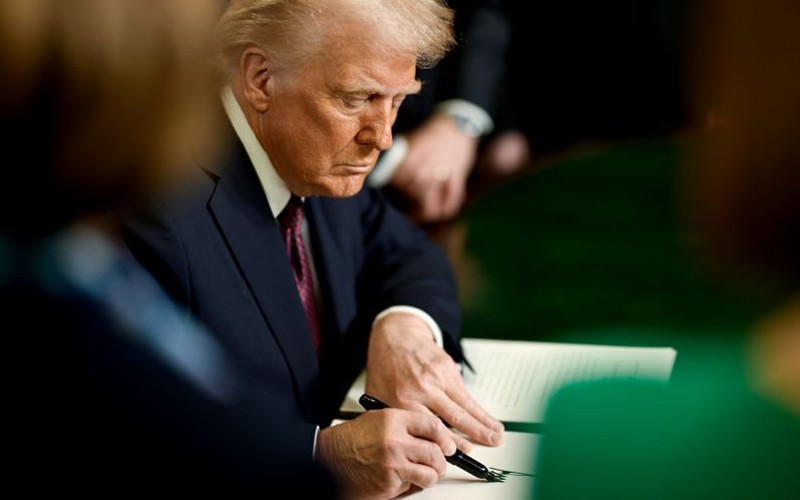
Washington DC/IBNS: One of the first executive orders that Donald Trump signed when he returned to the White House as the President of America on January 20 was to declare a "national emergency" along the United States' southern border.
That order had a clause attached that President Trump might "invoke the Insurrection Act of 1807" and possibly deploy the military on US soil on April 20, which is ninety days after the executive order was signed.
The clause in President Trump's executive order on January 20 stated: "Within 90 days of the date of this proclamation, the Secretary of Defence and the Secretary of Homeland Security shall submit a joint report to the President about the conditions at the southern border of the United States and any recommendations regarding additional actions that may be necessary to obtain complete operational control of the southern border, including whether to invoke the Insurrection Act of 1807."
According to the Insurrection Act of 1807, the President of the United States may permit the deployment of the military and the US National Guard to ensure that the law is enforced in certain conditions and situations.
The law empowers the military to completely suppress any rebellion, uprising, or any act of violence or resistance, including that by citizens.
The Insurrection Act has the power to override the Posse Comitatus Act, which is normally in place at all times and prohibits the US military from participating or interfering in any civil law enforcement.
It also gives the US President - the commander-in-chief of the US armed forces - complete powers to decide if, when, and where to deploy US troops within the United States of America.
The Insurrection Act, however, is somewhat different from martial law.
While martial law gives complete control of administration and running of the affairs of the state to a military general, usually the chief of defence staff or the army chief, the Insurrection Act keeps the powers of the state and administration with the US President, who selectively uses military powers to enforce law and order.
IBNS
Senior Staff Reporter at Northeast Herald, covering news from Tripura and Northeast India.
Related Articles

EU lawmakers freeze ratification of US trade deal amid Trump’s Greenland tariff threats
European Union lawmakers have agreed to delay ratification of a key trade agreement with the United States after President Donald Trump threatened tariffs against Denmark and other European allies over Greenland, media reports said.

Canada PM Mark Carney warns of ‘rupture’ in US-led global order in landmark Davos speech
Canadian Prime Minister Mark Carney delivered one of the most striking speeches at the 2026 World Economic Forum in Davos, declaring that the US-led “rules-based international order” is undergoing a historic rupture driven by intensifying great power rivalry and the erosion of global norms.

Trump rules out force on Greenland at Davos; slams Europe, threatens tariffs
US President Donald Trump said he would not use military force to acquire Greenland but doubled down on his claim that the United States is best positioned to control the territory, triggering sharp reactions from European allies during his speech at the World Economic Forum in Davos.

How Trump’s interest is turning Greenland’s independence dream upside down
Greenland’s long-standing aspiration for independence has entered a volatile new phase as US President Donald Trump’s renewed interest in the Arctic territory reshapes regional politics.
Latest News

ICC rejects Bangladesh’s request to move T20 World Cup matches out of India

EU lawmakers freeze ratification of US trade deal amid Trump’s Greenland tariff threats

'That expression of Kiara Advani stayed with me': Influencer alleges uncomfortable flight experience with Kiara Advani

Canada PM Mark Carney warns of ‘rupture’ in US-led global order in landmark Davos speech

