
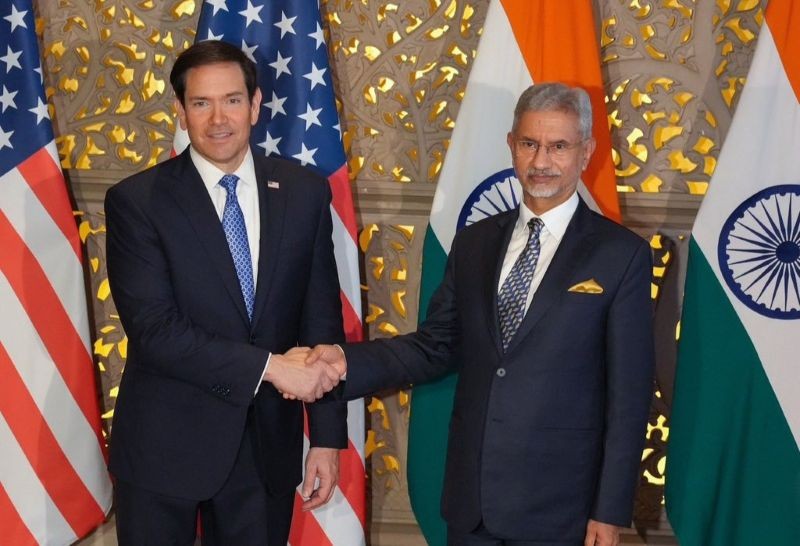
Responding to questions about the demonstrations, Rubio said Washington would not interfere in India's internal politics, stressing that protests and differences of opinion were part of a democratic system.
"No, it's a domestic political matter. I'm not going to get involved in their politics. This is a democracy. They have elections here so I'm not going to opine on their domestic political matters. We have protests every day in the United States..." Rubio said.
He added that peaceful demonstrations reflected the existence of political discourse and the freedom to express differing opinions.
"I'm not talking about the riots and vandalism but in many ways, the fact that people are out there expressing themselves, not talking about India and any country in the world, it's a sign that this is a country where there's a political discourse and so forth and differences of opinion," he said.
"We're not going to comment on internal political matters, that's for the Indians and people to decide and navigate," the US Secretary of State added.
#BREAKING: US Secretary of State Marco Rubio refuses to comment on protests in India, praises Indian democracy. “Domestic political matter, this is a democracy, they have election here, wont opine on their domestic political matter. We have protests in US every day”. This days after UK Trade Minister told me he won’t comment on protests in India and sand praise for Indian democracy. Welcome change in the western stance in times of UN HR Office’s vile propaganda campaign against India!
— Aditya Raj Kaul (@AdityaRajKaul) October 21, 2026
Rubio takes swipe at UN experts
Rubio also made a sarcastic remark when asked about the United Nations' criticism of the Indian authorities' handling of protests organised by the Cockroach Janta Party (CJP).
"The UN experts, my favourite. The UN experts are the oxymoron," he said.
The remarks came after UN human rights experts raised concerns over mass detentions and the alleged use of excessive force against protesters, calling for an impartial investigation into the authorities' response.
The Indian government has rejected the criticism, describing it as unwarranted interference in the country's internal affairs.
Why are protests taking place in India?
The protests, led by the CJP alongside opposition parties, student groups and civil society organisations, have centred on allegations of irregularities in the Election Commission's Special Intensive Revision (SIR) of electoral rolls.
Demonstrators have demanded the resignation of Chief Election Commissioner Gyanesh Kumar, alleging that the revision has led to the removal of millions of eligible voters from electoral rolls and could undermine voting rights.
The Election Commission has defended the exercise, saying it is intended to remove duplicate entries and the names of deceased, shifted and otherwise ineligible voters. Those affected have avenues to seek corrections and appeal against deletions.
Mass detentions spark rights concerns
The protests have led to large-scale police deployments and detentions in New Delhi and other cities. On October 10, authorities detained more than 2,000 protesters in the national capital ahead of a planned demonstration, according to media reports.
Police also detained CJP founder Abhijeet Dipke and several student activists during subsequent protests. Demonstrations were reported in other cities, including Mumbai, Bengaluru and Patna.
The UN Human Rights Office called for respect for the right to peaceful assembly and urged authorities to ensure that restrictions on demonstrations met standards of necessity and proportionality.
Human rights organisations have also raised concerns over the treatment of demonstrators and the use of preventive detention.
The Indian government, however, has maintained that law enforcement measures were necessary to maintain public order and has rejected allegations of wrongdoing.