
The US Supreme Court on Friday struck down former US President Donald Trump’s sweeping tariff measures, ruling that he exceeded his authority by imposing them under the International Emergency Economic Powers Act (IEEPA).
In a 6–3 decision authored by Chief Justice John Roberts, the Court held that the US Constitution grants Congress — not the president — the power to levy taxes and impose tariffs. The majority observed that if Congress had intended to give such authority to the president under IEEPA, it would have done so explicitly.
With the reciprocal tariffs struck down, India is expected to revert to the earlier tariff structure of 3.5 percent that existed before the sweeping measures were introduced last year.
However, shortly after the ruling — which Trump described as “outrageous” and a “disaster for US workers” — he announced fresh 10 percent tariffs on all countries, including India.
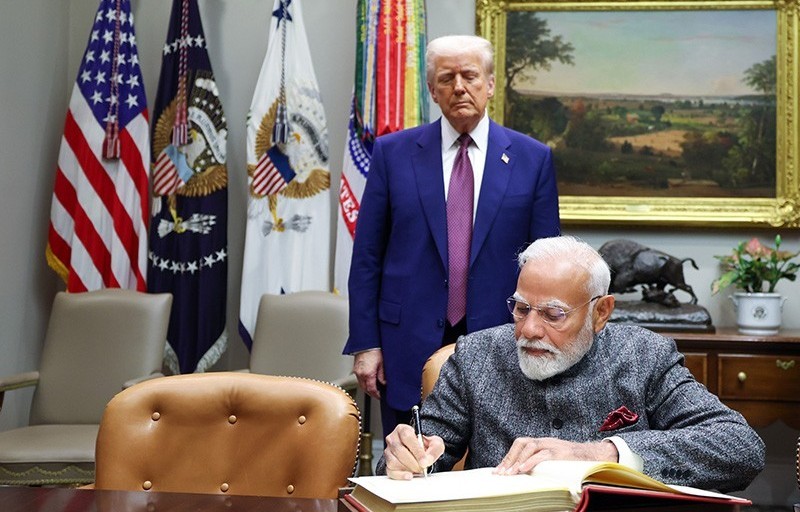
When asked specifically about tariffs on India, Trump said New Delhi would pay 18 percent as opposed to 0 percent for Washington under the recently signed trade agreement.
“Nothing changes, they’ll be paying tariffs, and we will not be paying tariffs. So, the deal with India is they pay tariffs. This is a reversal from what it used to be. I think Prime Minister Modi is a great gentleman, a great man, actually, but he was much smarter than the people that he was against in terms of the United States,” Trump was quoted as saying by The Times of India.
The Supreme Court’s three liberal justices joined three conservatives in the majority, while Justices Brett Kavanaugh, Clarence Thomas and Samuel Alito dissented.
Trump’s tariff measures had already generated more than $133 billion in revenue for the US Treasury, with potential long-term economic costs estimated at $3 trillion over the next decade, media reports said.
Several companies, including Costco, have moved court seeking refunds, underscoring the immediate legal and financial fallout of the ruling.
Analysts say the judgment reinforces the constitutional limits on presidential authority in economic policymaking and reaffirms Congress’s exclusive role in taxation and trade legislation.