
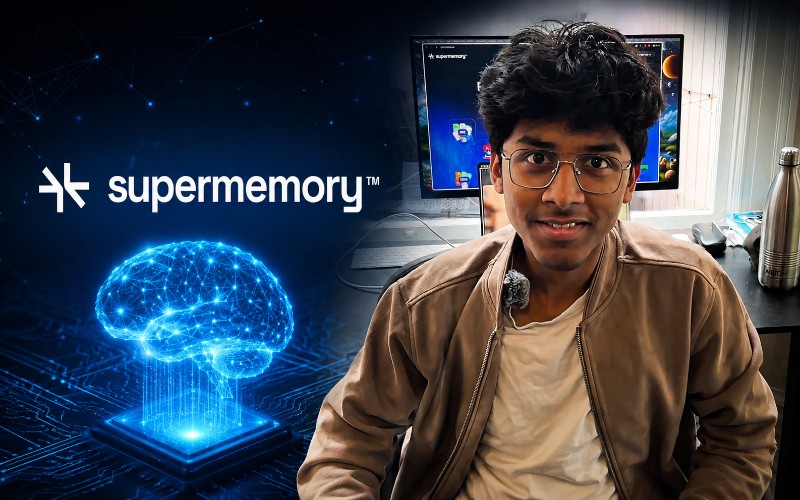
At just 19, Shah has attracted backing from leading venture capital firms and prominent technology executives after beginning his entrepreneurial journey by selling his first startup at the age of 16.
Supermemory has positioned itself as a solution to one of the biggest technical challenges facing AI applications—persistent memory—allowing AI systems to remember and retrieve relevant information across multiple user interactions.
From hackathon project to AI startup
Supermemory began as a hackathon project in 2024. The platform was initially introduced as a consumer-focused "second brain" application designed to help users organise and retrieve personal information.
The project quickly gained traction within the open-source community, surpassing 10,000 GitHub stars in a relatively short period.
The growing popularity soon attracted startups seeking to integrate long-term memory capabilities into their own AI products.
According to Solofounders, Shah recognised that the larger commercial opportunity lay in building AI infrastructure for developers rather than focusing exclusively on end users.
That realisation led Supermemory to evolve into a platform offering memory systems for AI-powered applications.
Building before turning 20
Before launching Supermemory, Shah had already developed and released more than 15 open-source projects while working from his college dormitory.
Among those projects was a personal context collection tool that later became the technological foundation of Supermemory.
Rather than commercialising the software immediately, Shah chose to make the projects freely available to developers.
His work gradually established his reputation within the AI developer community and laid the groundwork for the company's future growth.
$3 million secured in seed funding
Supermemory completed its seed funding round in October 2025.
While TechCrunch reported the investment at $2.6 million, several Indian media outlets estimated the round at approximately $3 million.
The funding round was led by Susa Ventures, Browder Capital and SF1.vc.
The investor group also included several well-known technology leaders, including Google AI chief Jeff Dean, Cloudflare Chief Technology Officer Dane Knecht, DeepMind product manager Logan Kilpatrick and Sentry founder David Cramer.
The investment is expected to support the startup's expansion as demand grows for AI infrastructure capable of maintaining context over extended interactions.
How Supermemory works
Supermemory is designed to transform unstructured information from emails, chats, documents and files into structured knowledge that AI systems can access efficiently.
The platform organises this information into a knowledge graph, enabling AI applications to retain relevant context across multiple sessions rather than treating every interaction as a fresh conversation.
According to the company, early customers using the platform include Cluely, Montra and Scira.
The startup also says its technology offers lower latency and improved access-control mechanisms compared with traditional retrieval-based AI memory systems.
Choosing startups over conventional path
Shah's entrepreneurial journey has drawn attention because he departed from the traditional academic route pursued by many Indian engineering aspirants.
Instead of continuing preparations for the Indian Institutes of Technology (IIT) entrance examinations, he decided to focus full-time on building technology startups.
That decision eventually led to the creation of Supermemory while he was still in his teens.
His achievements have also earned him a United States O-1 visa, a category reserved for individuals recognised for extraordinary ability in their respective fields.
Addressing growing AI challenge
As AI assistants become increasingly sophisticated, retaining relevant information across conversations has emerged as a major technical hurdle for developers.
Supermemory aims to solve that problem by providing a dedicated memory layer that allows AI systems to preserve context over time.
Backed by fresh funding and support from leading AI investors and technology executives, the company is positioning itself as an infrastructure provider for the next generation of AI applications.