
Rajasthan is synonymous with Rajmatas (Queen mothers), whose beauty, enduring grace and intellect have charmed generations for long. Be it Rajmata Gayatri Devi of Jaipur, Rajmata Krishna Kumari of Jodhpur, Rajmata Sushila Kumari of Bikaner and others. These queens broke barriers, opened schools for girls and stood up for women’s rights and education, defying the purdah system.
Now another Rajmata is being added to this illustrious list albeit with a twist. This Rajmata bred an entire generation, nurtured them, revived a derelict kingdom and brought hope to a barren, lost forest.
Meet ST-2, the tigress of Sariska Tiger Reserve, who was responsible for repopulating the reserve after it lost all its big cats in 2004. Today Sariska Tiger Reserve, which stretches over 881 square kms, has 41 tigers.
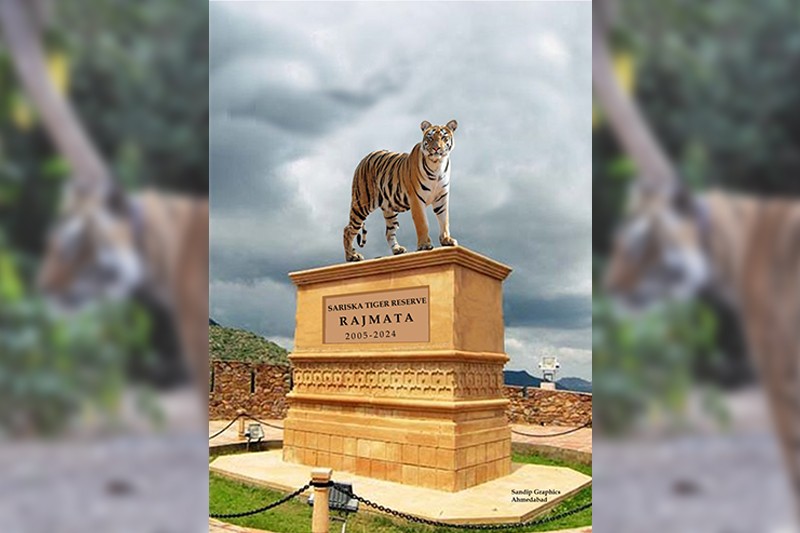
She has been anointed as a Rajmata and a first-of-its kind memorial is being dedicated to her immense contribution in safeguarding the endangered species.
In 2004, Sariska forest in the Aravalli ranges became bereft of tigers. Its number fell from 20 to zero, mostly due to poaching and official apathy. This was a serious wake-up call for the government and the public alike.
The Sariska episode was a turning point in India’s conservation history as it meant there was serious lacunae in the government’s Project Tiger launched in 1973. The Project Tiger was conceived after the tiger population dwindled from 40,000, which was the count when the British left the country, to merely 1141. Hunting was officially banned in 1972. Although the tiger count increased after the Project Tiger was initiated, the Sariska population’s extinction was an ominous portent of things to unfold.
At the same time, the idea of translocation of tigers from Ranthambhore, some 200 km away from Sariska, was introduced as part of what experts called the world’s first “scientifically planned” relocation of species. In June 2008, a male tiger ST1 was brought to Sariska. In July 2008, ST2 arrived in Sariska but the translocation did not give the desired results for at least four years, raising doubts about the feasibility of the experiment.
It wasn’t until 2012, that tigress ST-2 and her female cubs, ST-7 and ST-8 were captured on camera in the first week of August. In 2015, she produced her second litter, giving birth to a male ST-13 and female cub, ST-14. This female ST-14 in turn produced three litters at different times, helping the tiger population to grow and survive.
ST-2 is said to be the litter of the famous Machili of Ranthambore, who apart from being a skilful hunter, a daring combatant, had also delivered three litters and became a poster tigress, highlighting the conservation efforts in India. After she passed away in 2016, there were many requests for building a memorial for her. To this day, that request hasn’t been fulfilled.
But now her daughter ST-2 is all set to be remembered with a memorial. “The foundation work is in progress, the sculpture would be ready soon,” informs Sangram Singh Katiyar, the conservator of forest, Sariska.
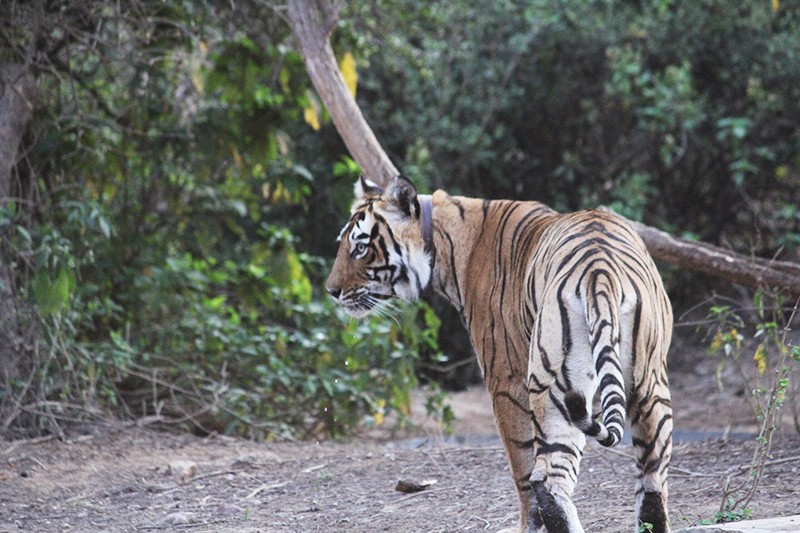 A tiger in the Sariska Tiger Reserve. Photo credit: Wikipedia Creative Commons
The budget for the project is Rs 10 lakh and the statue will be placed in the Sariska campus, where the offices and the ticket counters are located.
ST-2 passed away on January 11 in 2024, aged 19, succumbing to injuries and illness. Before she died, ST-2 was kept in an enclosure for three months for medical treatment.
“It’s a kind of tribute to ST-2 who helped to repopulate the barren Sariska. And the memorial would make tourists visiting Sariska aware about the need for conservation of endangered species,” says Katiyar.
He says he is not aware of any other memorial dedicated to a tiger in India but mentions a male tiger called ‘Charger’ of Bandhavgarh National Park in Madhya Pradesh which has been honoured with a point called Charger Point, his final resting place. Charger had the habit of mock-charging every jeep, mahout and elephants now and then. He ruled the area from 1991-99. All the tigers in Bandhavgarh are progeny of Charger and Sita, his mate and the most photographed tigress in the world.
Hailing the move, wildlife activist Dhirendra Godha says, “The memorial would preserve the legacy of ST-2 and create a lasting memory in the minds of the tourists and people inhabiting the areas around the forest.”
But there are others who differ from these views and would rather not construct a memorial.
Sunayan Sharma, former field director of Sariska and president, Sariska Tiger Foundation, says the memorial is an eye-wash. “Instead of spending funds on building a memorial, they should relocate the villages located inside the Sariska forest. They should stop the grazing. They should spend money on conserving the tiger population and consequently the entire ecosystem of the area. Sariska has a huge area, it has the capacity to hold more than 40 tigers but at least 40 % of its area is under grazing and encroached by human habitation. Sariska has folds and remote corners which are not visited by tourists.
Hence it is better suited for littering by tigers as they have places to hide when they litter and protect their cubs. Ranthambore National Park, on the other hand, is on a plateau and not very suited for littering.”
He adds: “ Because of the villages, there is fragmentation of the forest areas and as such more possibilities of human-animal conflict in Sariska. Conservation doesn’t mean only conserving the tigers, it means conserving the entire ecosystem and biodiversity of the region. But the focus is always on tigers because that’s what matters, that is what brings in the tourists and the moolah. Earlier Sariska had sloth bears as the vegetation and environment are suited for it. But now there is only one or possibly not even one, left. Tiger species is no doubt the flagship species but saving and conserving wildlife and biodiversity should be in its entirety.”
As per official records, there are 24 villages in three core areas of Sariska Tiger Reserve. In 1970, the forests came under the Project Tiger. Despite several official interventions, communities continue to live in the forests, coexisting with the wild animals and have been accessing and utilising the forest products.
The villagers are willing to relocate but have put certain conditions to the government before they move out including compensatory land for the children who have reached the age of adulthood since the last relocation exercise. Sources say the current monetary compensation of Rs 15 lakh is not acceptable to the villagers and say it needs to be hiked. Also, there is disparity in land values between forest areas and land outside reserves. Many a time, villagers choose precious land, which the government cannot afford as compensation and the proposal does not proceed further.
Katiyar, however, says the relocation of six villagers, comprising around 700 families, inside Sariska’s core areas in all likelihood would be completed in the next six months “as the plan of diversion of forest area is under process.”