
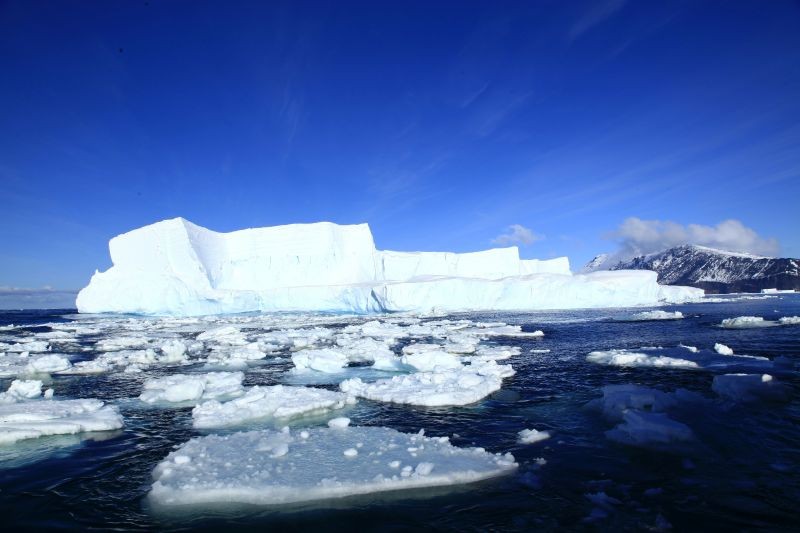
Together with ice sheets in Greenland and Antarctica, glaciers lock up about 70 per cent of the world’s freshwater reserves. They are striking indicators of climate change as they typically remain about the same size in a stable climate.
But, with rising temperatures and global warming triggered by human-induced climate change, they are melting at unprecedented speed, said Sulagna Mishra, a scientific officer at the World Meteorological Organization (WMO).
Hundreds of millions of livelihoods at risk
Last year, glaciers in Scandinavia, the Norwegian archipelago of Svalbard and North Asia experienced the largest annual loss of overall mass on record. Glaciologists determine the state of a glacier by measuring how much snow falls on it and how much melt occurs every year, according to UN partner the World Glacier Monitoring Service (WGMS) at the University of Zurich.
In the 500-mile-long Hindu Kush mountain range, located in the western Himalayas and stretching from Afghanistan to Pakistan, the livelihoods of more than 120 million farmers are under threat from glacial loss, Mishra explained.
The mountain range has been dubbed the “third pole” because of the extraordinary water resources it holds, she noted.
‘Irreversible’ retreat
Despite these vast freshwater reserves, it may already be too late to save them for future generations.
Large masses of perennial ice are disappearing quickly, with five out of the past six years seeing the most rapid glacier retreat on record, according to WMO.
The period from 2022 to 2024 also experienced the largest-ever three-year loss.
“We are seeing an unprecedented change in the glaciers,” which in many cases may be irreversible, said Mishra.
Ice Melt
WGMS estimates that glaciers, which do not include the Greenland and Antarctica ice sheets, have lost more than 9,000 billion tonnes of mass since 1975.
“This is equivalent to a huge ice block of the size of Germany with a thickness of 25 metres,” said WGMS director Michael Zemp. The world has lost 273 billion tonnes of ice on average every year since 2000, he added, highlighting the findings of a new international study into glacier mass change.
“To put that into context, 273 billion tonnes of ice lost every year corresponds about to the water intake of the entire [world] population for 30 years,” Zemp said. In central Europe, almost 40 per cent of the remaining ice has melted. If this continues at the current rate, “glaciers will not survive this century in the Alps.”
Echoing those concerns, WMO’s Mishra added that if emissions of warming greenhouse gases are not slowed “and the temperatures are rising at the rate they are at the moment, by the end of 2100, we are going to lose 80 per cent of the small glaciers” across Europe, East Africa, Indonesia and elsewhere.
Large-Scale Floods
Glacial melt has immediate, large-scale repercussions for the economy, ecosystems and communities.
The latest data indicates that 25 to 30 per cent of sea level rise comes from glacier melt, according to the World Glacier Monitoring Service.
Melting snowcaps are causing sea levels to rise about one millimetre higher every year, a figure that might seem insignificant, yet every millimetre will flood another 200,000 to 300,000 persons every year.
“Small number, huge impact,” glaciologist Mr. Zemp said.
Everyone Is Affected
Floods can affect people’s livelihoods and compel them to emigrate from one place to another, WMO’s Mishra continued.
“When you ask me how many people are actually impacted, it’s really everyone,” she stressed.
From a multilateral perspective, “it is really high time that we create awareness, and we change our policies and...we mobilise resources to make sure that we have good, policy frameworks in place, we have good research in place that can help us to mitigate and also adapt to these new changes,” Mishra insisted.
World’s Glaciers
Providing added momentum to this campaign, the World Day for Glaciers on 21 March aims to raise awareness about the critical role that these massive frozen rivers of snow and ice play in the climate system. It coincides with World Water Day.
To mark the occasion, which is one of the highlights of the 2025 International Year of Glaciers’ Preservation, global leaders, policymakers, scientists and civil society representatives are due to gather at UN Headquarters in New York to highlight the importance of glaciers and to boost worldwide monitoring of the cryospheric processes of freezing and melting that affect them.
WGMS’s Zemp, who also teaches glaciology at the University of Zurich, is already preparing for a world without glaciers.
“If I think of my children, I am living in a world with maybe no glaciers. That’s actually quite alarming,” he told UN News.
“I really recommend going with your children there and having a look at it because you can see the dramatic changes that are going on, and you will also realise that we are putting a big burden on our next generation.”
Glacier Of Year
This year’s Glacier of the Year 2025 is South Cascade Glacier in the US state of Washington.
The body of ice, which has been continuously monitored since 1952, provides one of the longest uninterrupted records of glaciological mass balance in the western hemisphere.
“South Cascade Glacier exemplifies both the beauty of glaciers and the long-term commitment of dedicated scientists and volunteers who have collected direct field data to quantify glacier mass change for more than six decades,” said Caitlyn Florentine, from the U.S. Geological Survey.