
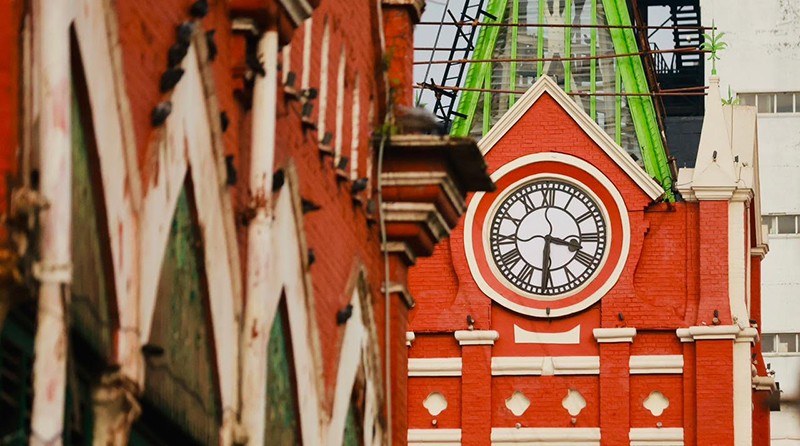
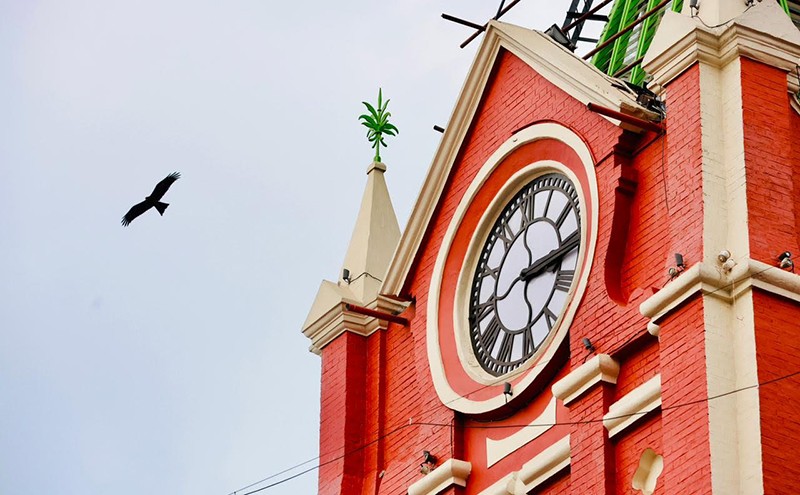
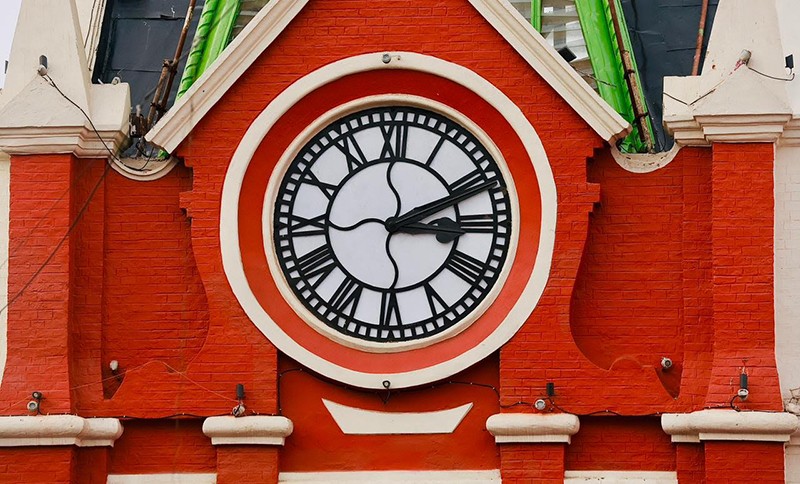
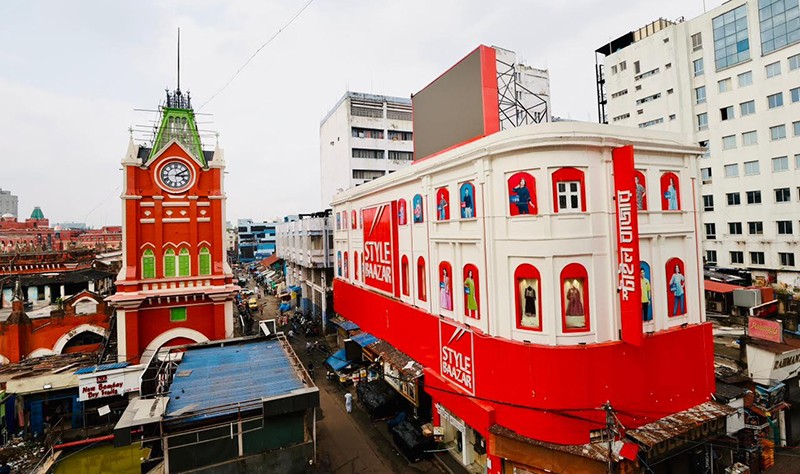
‘The New Market clock’ as people fondly call it, is a colonial time relic but has not lost its appeal even after Independence. New Market was the original supermarket or ‘mall’ if you will, in old Calcutta, now Kolkata. The city was British India’s capital then with a reputation of glamour and an overcrowded social calendar that reached beyond its confines. The rich and famous, the white tea planters and mining bosses from the hinterland came to shop in New Market as the four-faced Gillet & Johnson Westminster clock at the entrance tower looked on proudly. For Kolkatans, its continued reassuring presence means that even a piece of mechanism can bring up memories, nostalgia as a part of the cityscape.
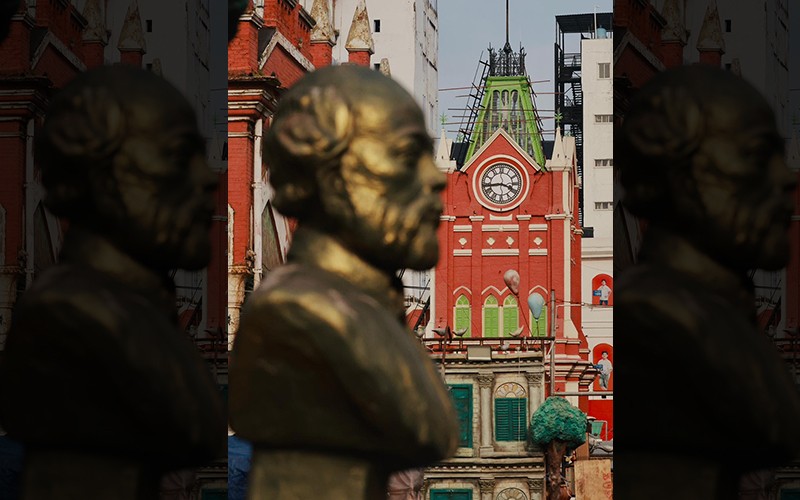
It stopped chiming for a decade, though it was repaired in 2014. A painstaking restoration process by a father-son duo Swapan Dutta and Satyajit Dutta and initiated by a group of city’s heritage enthusiasts has now seen life come back to bring joy to citizens with knowledge of the city’s antecedents.
It makes one ponder on other signature tower clocks in cities around the world elevating them from a mere engineering marvel - though beautiful, to symbolise a city’s heartbeat to tell their own stories.
Think of the 14th century astronomical clock set into the Old Town Hall Tower in Prague, the Czech capital. It shows Old Czech, Babylonian, and Central European times, plus the sun and moon's positions, acting as a functional medieval timekeeper. As the hour strikes from 9 am to 11pm, figurines of Twelve Apostles emerge from the conclave. Other figures on the clock include a skeleton, a vain man carrying a mirror, a philosopher, an astronomer and a stone angel. A golden rooster was added to the clock in 1882, which makes a crowing sound created by a set of bellows.
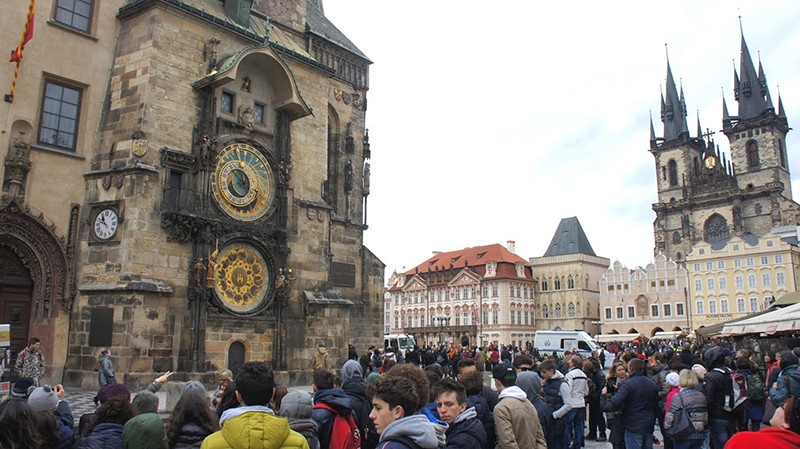 As the hour strikes, crowds gather in Prague’s Old Town Square, craning to catch the clock’s animated spectacle. Photo: Sujoy Dhar
You can see tourists and locals standing around the square to watch this display of engineering marvel. The clock has been repaired many times, especially after getting damaged due to bombing during the Second World War. And so, it ticks away even after five hundred years after the first installation and retains its position as a Prague icon.
Another clock that comes to mind as a crowd-puller is in Vancouver on Canada's west coast. It is a steam clock lording over Gastown, the city’s old quarter with its quaint shops, eateries and boutiques. Every fifteen minutes the clock toots and lets out some steam. Every hour, the clock whistles a cheerful tune and emits steam from pipes. Visitors wait around to clap with the tune (as I did too). Leafing through the clock’s history pages you come to know that to cover a steam grate and make effective use of the steam, the city decided to build this clock. Steam is fed to the clock by pipes which run below the streets and provide heat to downtown Vancouver.
Talking about historical clocks, how can one not mention the Big Ben of London (so famous that copycats spring up here and there with aspirations to become a great city). The clock uses its original mechanism and was the largest and most accurate four-faced striking and chiming clock in the world after completion. In 1987 it was designated by Unesco as a World Heritage Site.
Big Ben is actually a nickname for the Great Bell of the Great Clock of Westminster which first chimed on May 31, 1859. Housed in the 96-meter (320-foot) Elizabeth Tower at the Palace of Westminster, it is renowned for its precision, usually accurate to within two seconds per week. When it was shut down between 2017-2022 for restoration it was as if Londoners missed an old friend and welcomed back the original Victorian Prussian blue and gold coloured clock with joy.
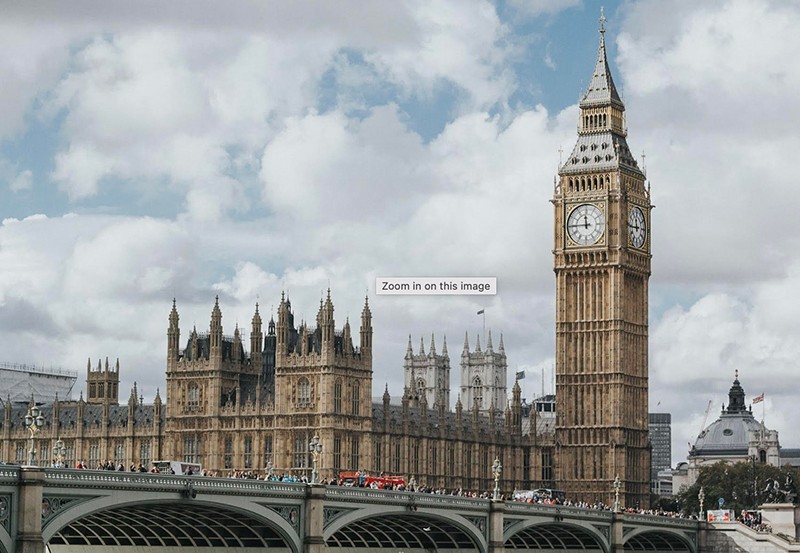 Big Ben stands as London’s most iconic timekeeper, its chimes echoing the city’s history and identity across generations. Marcin Nowak/Unsplash
Big Ben is actually a nickname. At first it was named after Sir Benjamin Hall, the first commissioner of works; the large man was affectionately called ‘Big Ben’. Another theory is that it was named after a heavyweight boxing champion of the time, Benjamin Caunt.
In India, the Rajabai Clock Tower in Mumbai has a chime mechanism like the Big Ben. Built in 1878, standing tall at 85 meters at the University of Mumbai’s Fort campus it features Venetian-Gothic architecture with
And we have a Unesco heritage site tag attached to a clock too, in Mumbai’s Chhatrapati Shivaji Maharaj Terminus. Ensconced in the 19th-century tower with intricate Victorian-Gothic design, the signature clock beckons passengers from distance.
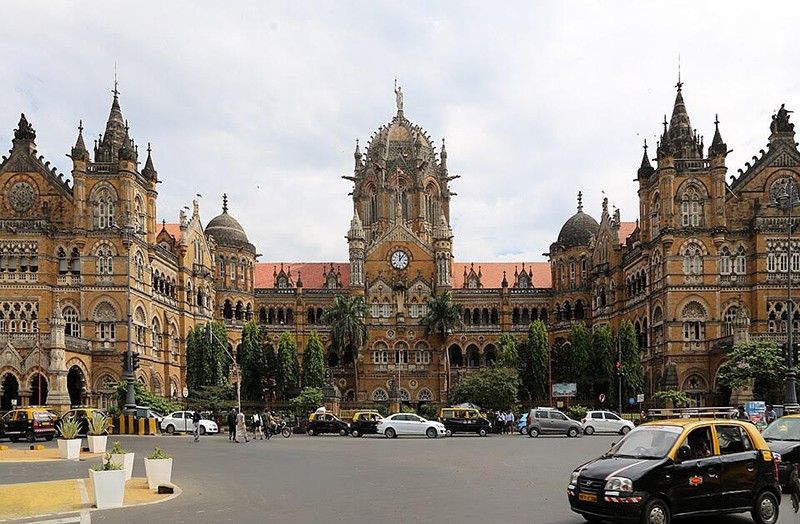 At Chhatrapati Shivaji Maharaj Terminus, the historic clock crowns the Gothic facade, quietly keeping time amid the ceaseless rhythm of Mumbai’s busiest railway hub. Photo: Wikipedia Creative Commons
Clock towers, however, are not just medieval or modern inventions, they date back to antiquity. The earliest example cited is the Tower of the Winds in Athens (1st century BC), featuring sundials and a water clock. However, modern, fully mechanical turret clock towers emerged in Europe between 1270 and 1300, designed to signal time for communities via bells.