
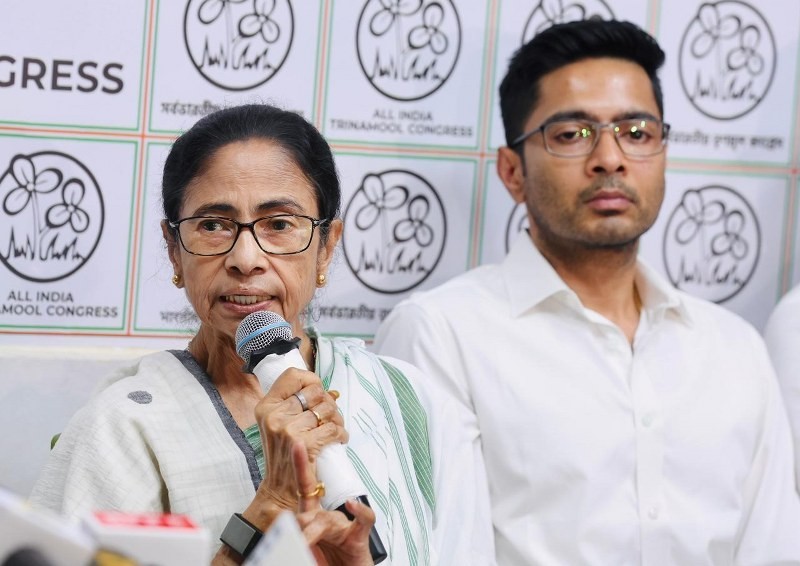
The crisis erupted on Wednesday when 58 rebel MLAs broke away from the party and elected expelled leader Ritabrata Banerjee as Leader of Opposition in the West Bengal Assembly.
The move secured recognition from Speaker Rathindra Bose and effectively handed control of the TMC legislature party to the dissident camp.
The development marks the first formal split in the party founded by Mamata Banerjee in 1998 and comes only weeks after its heavy defeat in the West Bengal Assembly elections.
Rebel MLAs cross anti-defection threshold
Under anti-defection provisions, the dissidents needed the support of at least two-thirds of the legislature party to seek recognition as a separate bloc.
With the TMC holding 80 MLAs in the Assembly, the threshold stood at 54 legislators.
The rebel camp claimed the backing of 58 MLAs, later asserting support from two more members as well.
The party leadership responded swiftly by dissolving organisational committees and frontal wings across West Bengal in an apparent attempt to regain control over an increasingly fragmented organisation.
However, political attention has now shifted beyond the Assembly, with growing discussion about whether dissatisfaction within the party could spread to Parliament.
Discontent among senior MPs predated the split
Signs of unease within the TMC had emerged months before the Assembly rebellion.
Several senior leaders publicly questioned the party's internal functioning, organisational structure and decision-making process following the electoral setback.
Kakoli Ghosh Dastidar's public differences
One of the most prominent developments involved veteran Lok Sabha MP Kakoli Ghosh Dastidar, who resigned from all organisational positions within the party.
A four-time MP and long-standing TMC leader, Dastidar openly expressed dissatisfaction with the party's functioning and leadership approach.
Her participation in an administrative meeting chaired by Chief Minister Suvendu Adhikari, despite objections from party leaders, further intensified speculation about internal divisions.
Tensions also surfaced in Parliament when she sought permission from Lok Sabha Speaker Om Birla to lodge a complaint against fellow TMC MP Kalyan Banerjee, accusing him of misogynistic behaviour and repeated verbal abuse.
Sukhendu Sekhar Roy questions party functioning
In the Rajya Sabha, senior MP Sukhendu Sekhar Roy emerged as one of the party's most vocal internal critics.
Roy publicly raised concerns about internal democracy within the TMC and alleged the existence of institutionalised corruption.
He also criticised the growing influence of political consultancy firm IPAC in shaping organisational decisions.
Given his long association with Mamata Banerjee, his comments attracted significant attention.
Roy warned that the party risked further weakening unless it honestly examined the reasons behind its electoral defeat and undertook corrective measures.
Shantanu Sen and other leaders step back
Former minister and Rajya Sabha MP Shantanu Sen also stepped down as the party's national spokesperson in May.
Sen said he was resigning in order to respect the public mandate following the election results.
His departure from a key party role added to perceptions of growing dissatisfaction among senior leaders.
Meanwhile, several younger leaders and elected representatives have maintained a noticeably lower profile since the election defeat, while some senior figures have avoided publicly defending organisational decisions.
Dev's remarks add to speculation
Actor-turned-politician and Lok Sabha MP Deepak Adhikari, popularly known as Dev, further fuelled speculation after making remarks that appeared conciliatory towards the incoming BJP-led government.
He called for an end to political hostility and misinformation and expressed confidence in the new administration.
Although Dev has not indicated any intention to leave the TMC, his comments were widely interpreted as reflecting changing political sentiments within sections of the party.
Focus shifts to Abhishek Banerjee's leadership
Several reports and statements from dissident leaders suggest that much of the frustration within the party centres on the growing influence of Mamata Banerjee's nephew, Abhishek Banerjee.
Many critics have argued that decision-making authority has become concentrated within a small leadership circle.
Even some dissenting leaders continue to express loyalty to Mamata Banerjee while criticising the party's internal structure and leadership model.
AJUP's Humayun Kabir predicts another split
Expelled TMC leader Humayun Kabir, who now heads the Aam Janata Unnayan Party (AJUP), has claimed that discontent among MPs could lead to another split within the party.
According to Kabir, a section of TMC MPs is considering a move to remove Abhishek Banerjee as the party's leader in the Lok Sabha.
“Twenty of the 29 MPs will split from the party in the Lok Sabha,” Kabir told NDTV.
He further alleged that discussions on the issue were already underway and suggested that MPs could approach the Lok Sabha Speaker regarding Abhishek Banerjee's position.
“The MP from Barasat, Kakali Ghosh Dastidar, and all the other MPs who are in the discussion are talking about this. Please wait for some more time,” Kabir said.
“When the time comes, they will pressurise the Lok Sabha's Honourable Speaker to remove him. This is my information,” he added.
Allegations against Abhishek Banerjee and IPAC
Kabir also repeated allegations regarding the role of Abhishek Banerjee and the political consultancy firm IPAC in party affairs.
“From the time the panchayat was elected in 2023, Abhishek Banerjee, who was the party's general secretary, took money from the three-star members of the panchayat,” Kabir claimed.
“The money was channelled into IPAC, which also took money to provide tickets,” he alleged.
Kabir further stated that he had raised concerns with Mamata Banerjee but claimed no action was taken.
“I brought many issues to Mamata Banerjee's attention. But she didn't listen to me. No one supported me. Whatever Abhishek did for the party, she approved it. Today, many people are speaking against Mamata Banerjee,” he said.
Could NDA benefit in Parliament?
The implications of the crisis may extend beyond West Bengal politics.
Any weakening of the TMC's parliamentary strength could affect the balance of numbers within the opposition bloc and potentially benefit the BJP-led National Democratic Alliance (NDA) in Parliament.
The issue has gained particular significance following the NDA government's inability to secure the two-thirds majority required to pass the Constitution (One Hundred and Thirty First Amendment) Bill, commonly known as the Delimitation Bill.
During voting on the legislation, the INDIA bloc remained united, with 230 MPs opposing the measure.
The NDA secured 298 votes, falling short of the constitutional requirement.
The TMC's 28 Lok Sabha MPs played a significant role in strengthening the opposition's position alongside other INDIA bloc partners.
Any future defections, resignations or internal divisions within the party could therefore have consequences not only for West Bengal politics but also for parliamentary arithmetic at the national level.