
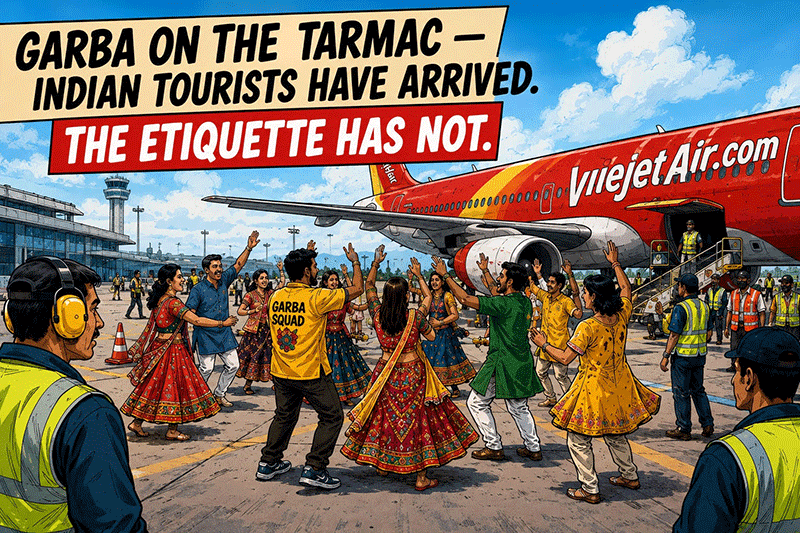
The latest to go viral is a group of Indian tourists performing an impromptu garba circle on a Vietnam airport tarmac, right beside a parked VietJet Air aircraft, clapping and moving to traditional rhythms while ground crew and airport workers moved around them.
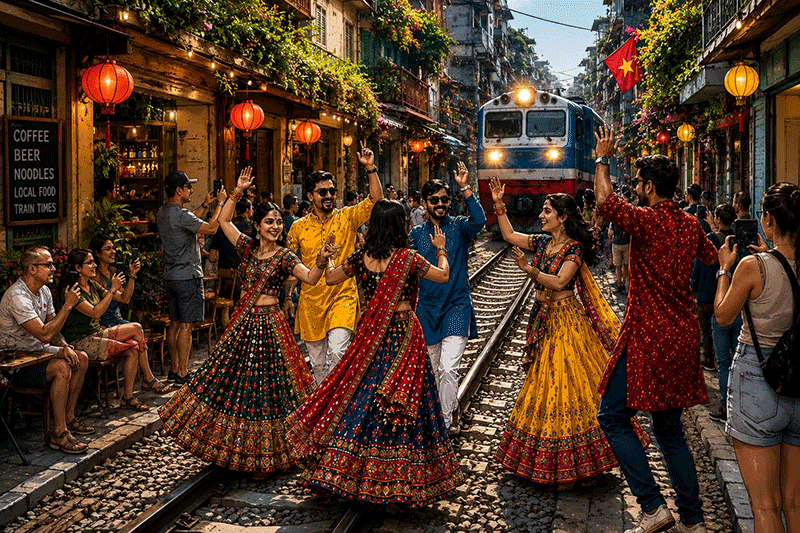
Before that, another video showed the same dance at Hanoi's famous Train Street, received with identical bewilderment and mockery. And before Vietnam, there was the Burj Khalifa. A group of Gujarati tourists, dressed in matching yellow T-shirts, performed a listless garba on the 124th floor in Dubai. The world's tallest building. The world's most famous observation deck. A dance floor, apparently.
This is the India that has arrived on the global stage — economically, militarily, demographically. Twenty-seven million Indians travelled abroad in 2024 alone, a 30 per cent jump from pre-pandemic levels, driven by cheap airfares, flexible work cultures and social media FOMO. With quantity, inevitably, came chaos.
The incidents accumulate with depressing regularity. In 2024, a luxury spa chain in Hanoi stopped accepting group bookings from Indian men. In Switzerland, hotel lobby boards began posting notices requesting that Indian guests lower their voices in public areas.
"It's not racism — it's exhaustion," a Swiss hotel manager told Deccan Chronicle. Industrialist Harsh Goenka recounted seeing an Indian businessman blast Punjabi music at full volume in a Davos club, calling it soft power. The entire town was annoyed. Soft power, as a concept, requires the other party to also enjoy it.
Men ogling at women, gesticulating at them, capturing them on mobile cameras in Venice's waterways, at nudist beaches in Europe, at temple complexes in Southeast Asia — the pattern is consistent and cringe-inducing. Surreptitiously photographing women, eating on public transport, and breaking into unrequested dance performances in restricted spaces have become the markers of a recognisable Indian tourist archetype abroad.
None of this happens in a vacuum. Indian celebrity culture exports a particular model of behaviour. Ostentatious destination weddings — live-streamed, colour-coordinated, budgeted in crores — announce that wealth is the primary credential for going abroad.
Bollywood, for its part, has spent decades glamourising the loud, the brash, and the unapologetic as comic relief rather than civic failure. Influencer culture does the rest, turning every foreign trip into a performance for followers back home. The tarmac garba was not spontaneous joy. It was content.
There is a real consequence to all of this. Thailand's Cabinet approved revised visa measures recently, moving India out of its visa-exemption regime into the Visa on Arrival category, rolling back a policy Indians had enjoyed since 2024.
A senior IPS officer put it plainly: "I am not worried about what foreigners think of the uncivilised and uncouth behaviour of some of us. What worries me more is that because of such behaviour, visa rules are getting tougher for all Indians." Thailand is the most popular international destination for Indian tourists. The message from Bangkok was not subtle.
Every time the Indian passport is treated with suspicion at an embassy window or downgraded in a visa regime, the reflexive Indian response is to blame the government. It is a convenient fiction. No prime minister, however tall the rhetoric, can override what a section of Indian travellers broadcast about themselves on social media every weekend. The passport reflects the citizen. The citizen, right now, is dancing on the tarmac.
To be fair — and it must be said — the majority of Indian travellers are doing nothing of the sort. Bad tourist behaviour is a global phenomenon, and no nationality holds the patent on it. Western tourists vandalise ancient ruins. Russian travellers desecrate temples in Bali. Chinese tourists have had their own decades-long reckoning with international etiquette. Pointing at others is the oldest evasion in the book. It changes nothing.
India has, genuinely, arrived. The economy is the fifth largest in the world. The military is consequential. The cultural exports are real and growing. But arriving on the global stage is not the same as knowing how to behave on it. One requires growth. The other requires self-awareness.
Domestic habits travel. The man who talks loudly through a film at a cinema in an Indian metropolis will talk loudly on a flight to Hanoi. The family that litters on a highway in Rajasthan will leave its mark on a beach in Phuket. The group that treats a train platform as a dance floor in Mumbai will find a tarmac in Vietnam and ask: why not here?
This is not criminal behaviour. Nobody is being harmed. But it is cringe, it is odious, and it has consequences — for visa policies, for how India is perceived, and for the countless Indian travellers who conduct themselves with grace and dignity and are tarred with the same garba circle.
India has spent decades wanting to be taken seriously. Behave accordingly.
Photos: ChatGPT / Unsplash