
The agreement was signed between the Digital India BHASHINI Division (DIBD) under the Ministry of Electronics and Information Technology (MeitY), Government of India, and Kathmandu University's Centre for Digital Public Infrastructure and Artificial Intelligence (DPI-AI), Nepal.
Following up on the productive meeting with FM Shisir Khanal @shisir #Nepal:
— Dr. S. Jaishankar (@DrSJaishankar) June 6, 2026
✅ Handed over virtually 72 health facilities & 12 cultural heritage projects under Reconstruction Programme post 2015 Earthquake.
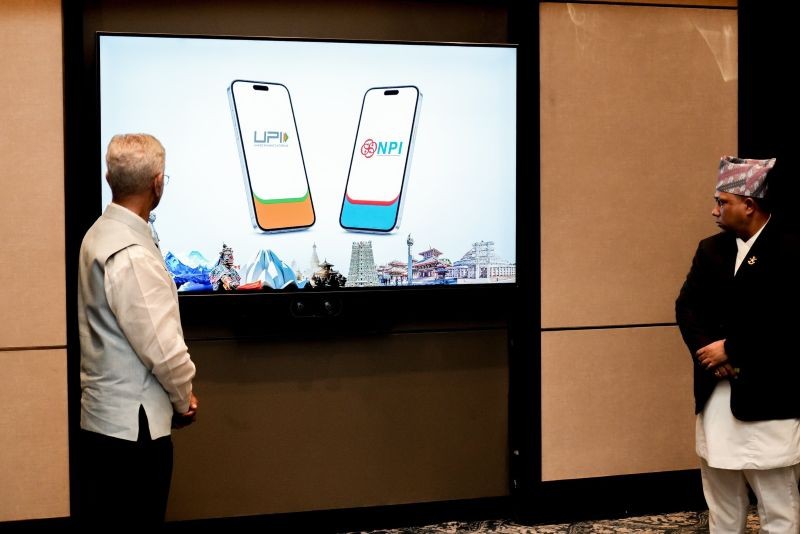
✅ Jointly launched the linkage between @UPI_NPCI #India and National… pic.twitter.com/J5hvzDLrTc
The MoU was signed by Amitabh Nag, Chief Executive Officer of the Digital India BHASHINI Division, and Bal Krishna Bal, Associate Dean of Kathmandu University.
The exchange of the agreement took place in the presence of India's External Affairs Minister Dr. S. Jaishankar and Nepal's Minister of Foreign Affairs Shishir Khanal during bilateral engagements held in New Delhi.
The occasion highlighted the shared commitment of India and Nepal to strengthening cooperation in emerging technologies, Digital Public Infrastructure, and inclusive digital transformation.
The partnership reflects the two countries' common vision of leveraging technology to promote inclusive growth, social empowerment, and regional cooperation. Beyond technological collaboration, the initiative aims to strengthen people-to-people ties, preserve linguistic heritage, and ensure equitable access to opportunities by overcoming language, literacy, and digital barriers across the region.
Under the MoU, the two institutions will collaborate on developing high-quality Nepali language datasets, speech corpora, and multilingual AI resources, including speech-to-text, text-to-speech, machine translation, and multilingual conversational AI capabilities.
The partnership will also support the preservation and digitisation of linguistic and literary heritage, particularly for low-resource and underrepresented languages across the India-Nepal region. The initiative seeks to ensure that communities whose languages face the risk of digital extinction can access AI-enabled tools and services in their mother tongue.
Leveraging BHASHINI's open and interoperable language technology ecosystem, the collaboration will assist the Government of Nepal in delivering digital public services in citizens' preferred languages, thereby reducing language, literacy, and digital access barriers at the last mile.
The MoU also envisages joint research, capacity-building initiatives, training programmes, and pilot projects in Natural Language Processing (NLP), multilingual AI, and Digital Public Infrastructure. These efforts will bring together universities, researchers, language experts, and technology practitioners from both countries.
The partnership is expected to generate new economic and social opportunities for Nepali citizens, students, entrepreneurs, and professionals by enabling multilingual access to education, skill development, digital commerce, and public services within Nepal and across regional and global markets.
Amitabh Nag, CEO of the Digital India BHASHINI Division, said: "This partnership with Kathmandu University represents a significant step in India's commitment to building inclusive language technology for the region. BHASHINI's open Digital Public Infrastructure model has the potential to transform digital access for millions across South Asia. This collaboration will help extend that vision beyond India's borders, strengthening our shared linguistic and cultural heritage while building the next generation of multilingual AI for the Global South."
A pleasure to meet FM Shisir Khanal #Nepal and his delegation today. @shisir
— Dr. S. Jaishankar (@DrSJaishankar) June 6, 2026
A detailed discussion on our unique partnership, including on development cooperation, connectivity, energy, especially hydropower development, education, health, capacity building, digital, culture… pic.twitter.com/k42FIdOhvL
Bal Krishna Bal, Associate Dean of Kathmandu University, said: "This MoU reflects a shared commitment between Nepal and India to harness the power of artificial intelligence for linguistic inclusion and social impact. Through collaboration between the DPI-AI Center at Kathmandu University and BHASHINI, we aim to advance research, innovation, and capacity building in multilingual AI, ensuring that our rich linguistic heritage becomes a catalyst—not a barrier—for participation in the digital future."