
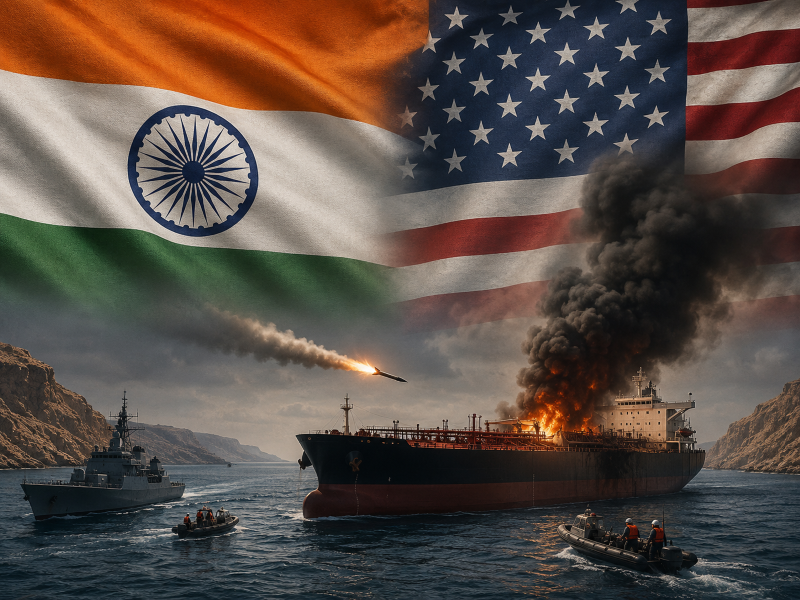
In a significant diplomatic move, Nagaraj Naidu, Additional Secretary in the Ministry of External Affairs (MEA), summoned Jason Meeks, the United States Charge d'Affaires in New Delhi, and issued a demarche over the attack.
India protests attack, seeks accountability
The development came hours after New Delhi strongly condemned the strike on the Palau-flagged oil tanker Settebello, which was carrying 28 crew members, including 24 Indian nationals.
The vessel came under attack while sailing about 20 nautical miles northeast of Sohar, a key port city in Oman.
A missile struck the ship's engine room, triggering a fire and forcing the crew to issue a distress call.
The MEA said 21 Indian crew members had been rescued, while search operations were continuing for the remaining three sailors.
"The Indian Embassy in Muscat is closely monitoring the situation and remains in touch with Omani authorities involved in the search and rescue efforts," the ministry said.
Our statement on the attack on a commercial vessel off the coast of Oman ⬇️https://t.co/w405oJsHmZ pic.twitter.com/m0U3U81hQn
— Randhir Jaiswal (@MEAIndia) June 10, 2026
Attack adds to concerns over Gulf shipping security
The strike is the latest flashpoint in the increasingly volatile Strait of Hormuz, one of the world's most critical maritime trade routes through which a substantial portion of global oil and gas supplies pass.
The attack comes amid heightened tensions in the Gulf following the US-led blockade targeting Iran-linked shipping and a series of retaliatory actions that have transformed the region into a dangerous zone for commercial vessels.
The Palau-registered tanker was carrying 28 crew members, including 24 Indians, when it issued a distress signal after coming under attack while navigating about 20 nautical miles northeast of Sohar, a major port city in Oman.
In a post on X, US Central Command said American forces had disabled an oil tanker in the Gulf of Oman after alleging that the vessel had breached the naval blockade.
"U.S. Central Command (CENTCOM) disabled Palau-flagged M/T Settebello as it transited the Gulf of Oman. A U.S. aircraft fired precision munitions into the ship's engine room after the crew repeatedly failed to comply with directions from American forces," the post stated.
— U.S. Central Command (@CENTCOM) June 10, 2026
Part of a growing pattern of attacks
The Settebello incident follows several attacks on commercial vessels across Gulf waters since March. Shipping lanes near Oman, the United Arab Emirates and Kuwait have witnessed repeated disruptions as regional hostilities escalated.
Just weeks ago, another tanker was reportedly struck east of Muscat, while earlier incidents targeted vessels operating near Oman's northern coastline.
For India, which supplies one of the world's largest pools of merchant sailors, the deteriorating security situation has become a growing concern. Hundreds of Indian seafarers continue to operate aboard vessels navigating the Gulf's increasingly contested waters.
Diplomatic pressure mounts
India's decision to summon the senior-most US diplomat currently posted in New Delhi marks one of its strongest diplomatic responses since the Gulf maritime crisis intensified.
The move underscores New Delhi's concern over the safety of Indian nationals working in international shipping and signals its expectation that major powers involved in the region's confrontation take steps to prevent civilian vessels from becoming targets.
As rescue teams continue to search for the three missing Indian sailors, the tanker attack has added a new diplomatic dimension to an already volatile crisis in the Gulf.