
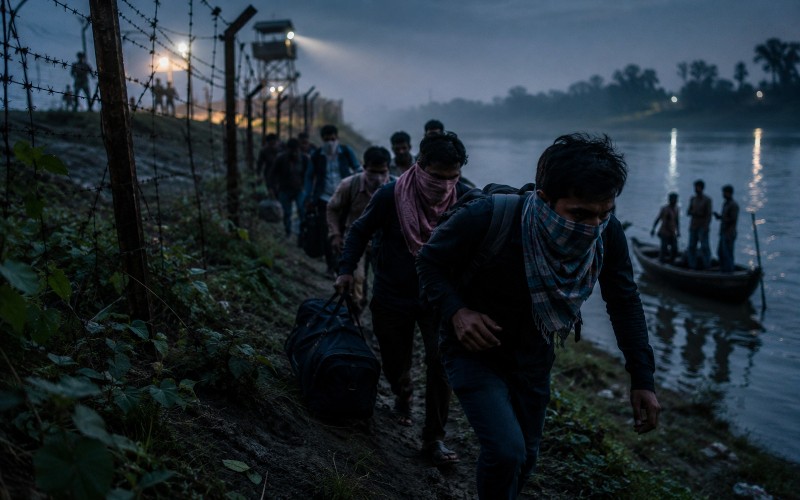
The ex-agent said the business effectively ceased around eight months ago following the introduction of the Special Intensive Revision (SIR) process and subsequent political developments in the state.
According to him, the prospects of the trade reviving in the near future remain uncertain, forcing many involved in the network to seek alternative livelihoods.
The network of ‘ghats’
The man, a resident of the Swarupnagar area in North 24 Parganas district, lives just a few kilometres from the India-Bangladesh border.
Speaking on condition of anonymity, he described how the alleged operation functioned across a long stretch of border villages and settlements located between the Sonai and Ichamati rivers.
The region includes villages and localities such as Arshikari, Padmabila, Hakimpur, Tarali, Amudia, Khalsi, Dobila, Kaijuri, Gabarda, Paikardanga, Panitar, Ghojadanga, Soladana, Hariharpur, Dakshin Bagundi and Taki.
According to the ex-middleman, these areas contained numerous crossing points, locally referred to as “ghats”, which were considered suitable for moving people across the border.
“People on the Bangladeshi side often had better information about surveillance patterns than we did. The movement of people was planned accordingly,” he claimed.
How the operation worked
The middleman alleged that contacts in Bangladesh would determine when and where crossings would take place, based on information about border monitoring.
Prospective entrants were reportedly gathered at locations considered safe near the border.
On the Indian side, individuals known as “linemen” allegedly remained hidden in agricultural fields and monitored the movement of Border Security Force (BSF) patrols.
Their role, he claimed, was to relay information about patrol routes and surveillance gaps to contacts across the border.
Once a safe window was identified, groups waiting to cross were moved quickly through the designated routes.
According to the man, crossings did not occur exclusively at night.
“Whenever an opportunity arose during the day or night, people were moved,” he said.
Money flow across the border
Explaining the financial structure of the alleged network, the ex-middleman claimed that Bangladeshi nationals seeking entry into India paid around 15,000 Bangladeshi taka per person to operators on the Bangladeshi side.
“Those operators contacted us directly. Many of them used Indian SIM cards, while people on this side also had Bangladeshi SIM cards. Phones were used for communication and financial transactions. In many cases, money was transferred through mobile payment applications,” he said.
After individuals crossed into Indian territory, local intermediaries allegedly assumed responsibility for moving them further inland.
This reportedly included transporting them from border areas to nearby railway stations or bus stands and arranging guides to accompany them towards major transit hubs such as Sealdah, Howrah and Bidhannagar Road.
The man claimed that operators on the Bangladeshi side sent approximately Rs 3,000 in Indian currency for each person who crossed.
“Out of that amount, Rs 2,000 went to the Indian-side crossing operators. Linemen and guides each received around Rs 500,” he alleged.
‘Rs 6 lakh a month per ghat’
When asked about the scale of the operation, the middleman said the number of crossings varied depending on surveillance conditions.
“There was no fixed figure. It depended on which crossing point was favourable on a given day,” he said.
According to him, five crossing points operated in and around the Hakimpur area, with an average of 30 to 35 people entering through them each day.
Based on those figures, he estimated that around 1,000 people crossed monthly through five crossing points in the region, generating roughly Rs 6 lakh in monthly business per ghat.
He acknowledged that losses occasionally occurred when individuals were intercepted by security forces.
“If a group was caught, the money had to be compensated. The losses had to be borne by those involved in the operation,” he claimed.
Claims of a statewide network
The former agent alleged that at the peak of infiltration activity, nearly 1,000 such crossing points existed across West Bengal’s border areas, with some of the highest activity concentrated in parts of Bongaon, Malda and Murshidabad.
Based on his estimates, the alleged network generated between Rs 70 crore and Rs 80 crore every month.
“The annual turnover was around Rs 800 crore to Rs 900 crore,” he claimed.
These figures could not be independently verified.
Allegations regarding border surveillance
The man alleged that members of Bangladesh’s border guarding force played a significant role in facilitating crossings.
At the same time, he claimed that conditions on the Indian side had changed considerably over the past decade.
“Earlier, both sides were involved in taking money, but things began changing around ten years ago. For the last five years, we had no arrangements with the BSF. The business only worked if people could evade detection. If they were caught, the money was lost,” he said.
Fake documents and settlement in India
According to former participants in the network and local sources, crossing the border was only the first step.
Long-term settlement allegedly required access to official documents, including Aadhaar cards, voter identity cards and PAN cards.
The ex-middleman and others alleged that forged birth certificates and domicile certificates were often created with the help of corrupt local functionaries.
A police official, speaking anonymously, claimed that a former Trinamool Congress (TMC) panchayat chief from the Swarupnagar area continued issuing fraudulent certificates even after leaving office.
The officer alleged that old letterheads were used to create backdated certificates designed to appear authentic.
Alleged forgery techniques
A local political leader familiar with one such incident claimed that a birth certificate was prepared for an individual seeking documentation for visa-related purposes abroad.
According to the account, the certificate was deliberately aged through physical manipulation to make it appear decades old.
“The paper was treated in a way that gave it the appearance of an old document. Corners were folded and edges slightly damaged before it was handed over,” the leader alleged.
The former panchayat chief reportedly provided the document free of charge because of personal connections, but sources claimed that similar services often fetched thousands of rupees from others seeking documentation.
An abrupt end to a lucrative trade
According to the former operative, not only have brokers and intermediaries lost a significant source of income, but individuals allegedly involved in related documentation and settlement processes have also been affected.
He described the suspension of the network as sudden and far-reaching, bringing an end to what he claimed had been a long-running cross-border operation involving multiple actors and substantial financial transactions.
For now, he said, many who once depended on the trade are searching for alternative ways to earn a living as the alleged infiltration business remains dormant since the BJP has come to power in Bengal.