
The resolution comes amid a renewed debate over language and cultural identity in Tamil Nadu, with the state continuing to oppose the Centre's three-language formula in schools.
Tamil Thaai Vazhthu made mandatory
The resolution, backed by legislators across party lines, including members of the Opposition DMK and AIADMK, mandates that Tamil Thaai Vazhthu be sung at the commencement of programmes organised by government offices, educational institutions, universities, public sector undertakings and other public institutions across the state.
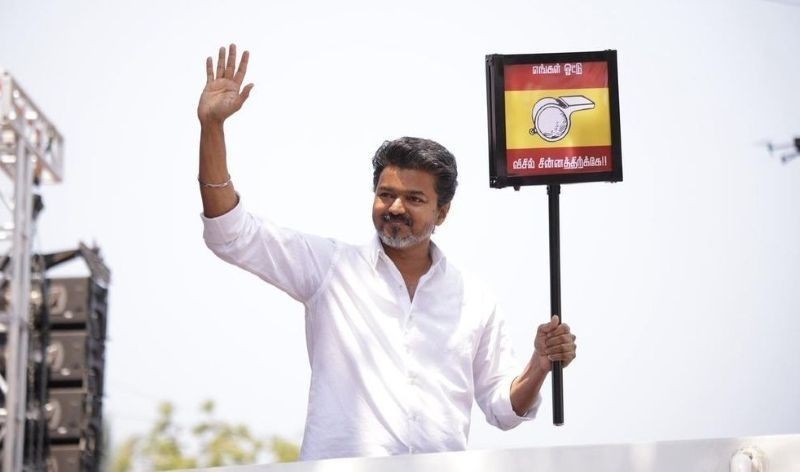
Vijay asserted that his government would not compromise on Tamil Nadu's linguistic and cultural rights.
"The mother tongue is as pure as one's mother," the Chief Minister said, according to Hindustan Times.
"Tamil is not only a language but also our life and emotions," he added.
Tamil Thaai Vazhthu, taken from the prologue of Manonmaniam by Manonmaniam Sundaranar, has been sung at government functions in Tamil Nadu since 1970. It was accorded official status as the state song in 2021.
Move follows Vande Mataram controversy
The resolution comes against the backdrop of a controversy over the order in which Tamil Thaai Vazhthu, Vande Mataram and the national anthem are rendered at official events.
A Union Home Ministry directive has prescribed Vande Mataram to be sung first, followed by Jana Gana Mana, effectively placing Tamil Thaai Vazhthu after the two national songs at such events. The change triggered criticism from political parties in Tamil Nadu, which argued that the established state protocol should be maintained.
The issue had earlier erupted at Vijay's swearing-in ceremony in May, when Tamil Thaai Vazhthu was rendered after Vande Mataram and the national anthem. The arrangement drew criticism from both Opposition parties and some of the ruling government's allies.
Tamil Nadu's two-language policy
The latest resolution also comes amid Tamil Nadu's longstanding resistance to the three-language formula in school education.
Tamil Nadu follows a two-language policy under which students study Tamil and English. Successive governments, including the DMK and AIADMK, have opposed the three-language formula, particularly over concerns that it could lead to the indirect imposition of Hindi in the state.
The issue gained renewed prominence following the National Education Policy (NEP) 2020, which advocates a three-language framework but does not specifically mandate Hindi. The policy says the choice of languages should be made by states, regions and students, provided at least two of the three are Indian languages.
Tamil Nadu, however, has maintained that the three-language system could effectively encourage Hindi in non-Hindi-speaking states and undermine its established two-language model.
State rejects three-language formula
Tamil Nadu unveiled its own State Education Policy in 2025, reiterating its commitment to the Tamil-English two-language system as an alternative to the NEP framework.
The issue has also become part of a wider Centre-state dispute over education funding. Tamil Nadu has resisted linking central education schemes and funding to implementation of the NEP and its language framework.
The state's opposition has historically been rooted in the anti-Hindi agitations of the 1930s, 1940s and 1960s. The two-language policy subsequently became a defining feature of Tamil Nadu's education and linguistic politics.
Language, identity and federalism
For Tamil Nadu, the language debate extends beyond the question of what students learn in school. Successive state governments have framed opposition to the three-language formula as a matter of protecting Tamil identity, preserving the state's linguistic autonomy and resisting perceived centralisation in education.
The latest Assembly resolution on Tamil Thaai Vazhthu therefore adds another layer to Tamil Nadu's continuing assertion of its linguistic and cultural identity amid its broader disagreement with the Centre over language policy.