
"@narendramodi Yesterday, you visited SRCC at Delhi University. It was an opportunity for dialogue on the country's youth, education and their future. But alas, instead of facing the youth's questions, the speech turned into yet another political campaign," Kharge wrote on X.
.@narendramodi जी कल दिल्ली विश्वविद्यालय के SRCC में गए। यह देश के युवाओं, शिक्षा और उनके भविष्य पर संवाद का अवसर था। लेकिन अफसोस, युवाओं के सवालों का सामना करने के बजाय भाषण फिर एक राजनीतिक प्रचार में बदल गया।
— Mallikarjun Kharge (@kharge) September 6, 2026
मोदी जी की Modus Operandi —
लोकतंत्र में सवालों को दबाने के लिए…
"Modi ji's modus operandi — in a democracy, suppress questions by giving the Opposition a new adjective every year so that their own failures remain hidden!" he said.
Kharge criticised Modi for repeatedly giving the Opposition a new adjective.
"Adjectives keep changing, but the Modi government's anti-people policies do not change. Modi ji, outreach is only needed when you become out of reach," he said.
The Congress president said Modi had effectively presented his "report card", which included unemployment, government recruitments remaining stuck for years, students being affected by paper leaks, increasingly expensive education, dwindling scholarship opportunities and growing pressure on the autonomy of universities.
"Listen to #ChhatronKiGoonj, solutions won't come from beating around the bush!" Kharge said.
Meanwhile, Cockroach Janta Party chief Abhijeet Dipke also attacked the Prime Minister over his speech and linked his remarks to the collapse of a six-storey hostel building in Delhi, in which one person was killed.
"Yesterday, the PM visited DU, gave a political speech and even invoked the term 'Dimagi Naxal', while speaking very little about the state of our educational infrastructure," Dipke wrote on X.
Yesterday, the PM visited DU, gave a political speech and even invoked the term “Dimagi Naxal,” while speaking very little about the state of our educational infrastructure.
— Abhijeet Dipke (@abhijeet_dipke) September 6, 2026
Today, a hostel building in South Campus has collapsed, with students feared trapped under the debris.…
"Today, a hostel building in South Campus has collapsed, with students feared trapped under the debris. The number of casualties is still unknown. For how long will students in this country have to pay the price for failing infrastructure and neglect?" he said.
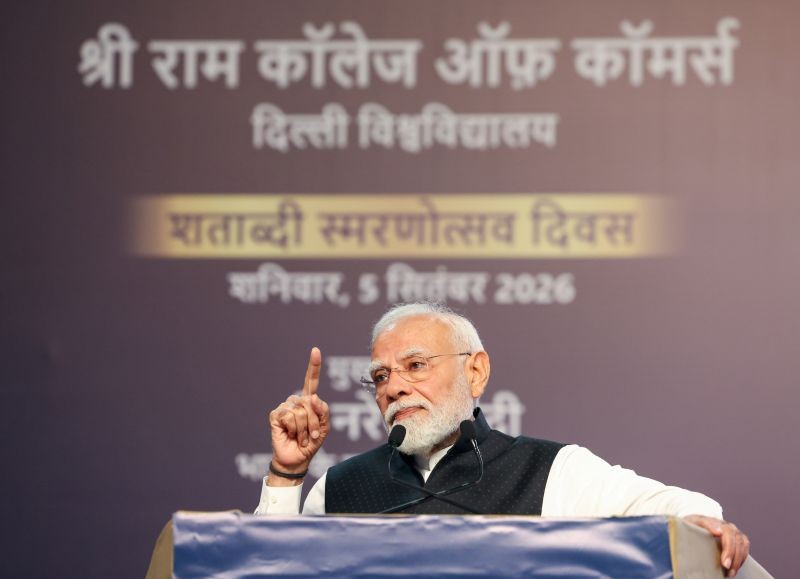
Kharge and Dipke were referring to Modi's comments during his address at SRCC, where he sought to target the Opposition and said people could be divided into two categories.
"You will meet two kinds of people. Some of them transform the strength of society into the strength of the nation," Modi said.
"The other becomes 'Naraz Fufa' whenever any work is started and opposes everything," he added.
During his speech, Modi also recalled his 2013 visit to the college and highlighted the progress he said had been made since then.
Contrasting the challenges of the past with what he described as today's achievements, the Prime Minister said terrorism had been defeated, with the armed forces confidently striking enemies in their own homes, while peace had been restored from Jammu and Kashmir to the Northeast.
He also said the world now recognised India's policy dynamism and its position as the fastest-growing major economy.
"Achieving a 7.8 per cent quarterly growth amidst the West Asia war and global trade hurdles demonstrates India's intrinsic capability," Modi said.
Presenting economic data to counter his critics, Modi said electricity production had increased by 9 per cent between April and June, while overall vehicle sales surged by more than 20 per cent. He said two-wheeler sales grew by 20 per cent and three-wheeler sales by nearly 30 per cent.
He further said an 8 per cent increase in steel and cement consumption showed that construction, housing and commercial activity were expanding rapidly.
Delighted to join the centenary celebrations of Shri Ram College of Commerce. Over the years, this institution has given generations of students the opportunity to learn, grow and make a difference.@SRCCOfficial
— Narendra Modi (@narendramodi) September 5, 2026
https://t.co/2YyZBJuFAy
"Despite this, for the people who saw the glass as half-empty in 2013, their mindset remains exactly the same today," Modi said.
Recalling his 2013 promise of Pro-People Good Governance (P2G2), the Prime Minister said his government had permanently moved away from what he described as the reactive approach of previous administrations.
He cited the Pradhan Mantri Jan Dhan Yojana as an example of the government's achievements, saying that until March 2014, more than 50 per cent of India's population lacked bank accounts, while the scheme had since brought around 60 crore people into the formal banking system.
"Today almost every family in the country is connected to the banking system, which has formed the foundation of India's fintech revolution," Modi said.
Targeting his critics, he said: "Despite this, for those who saw the glass half-empty in 2013, their thinking remains the same even today. For them, the glass will always be half-empty. When I speak of the glass, I am not speaking of anything being empty."