
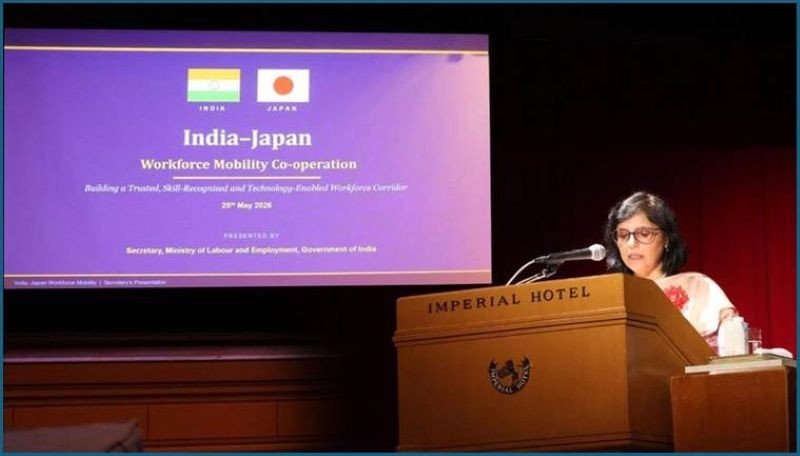
The seminar was jointly organised by the Embassy of India in Japan and ASEAN ONE Co. Ltd.. Vandana Gurnani, Secretary in India’s Ministry of Labour and Employment, delivered the keynote address.
The event was attended by several prominent dignitaries from both countries, including members of Japan’s House of Representatives such as Yamashita, former Minister of Justice; Ino; Nakamura; Tadashi Maeda; Kengo Otsuka; and Nagma Mohamed Mallick.
In her keynote address, Gurnani highlighted India’s growing role as a trusted global workforce partner. She underlined the Government of India’s commitment to building transparent, ethical and scalable international labour mobility pathways.
She emphasised that India’s demographic strength, robust skilling ecosystem and institutional reforms position the country as a reliable source of skilled manpower for global economies, including Japan.
She also elaborated on India’s large-scale workforce preparation ecosystem, supported by higher education institutions, Industrial Training Institutes, apprenticeship systems, digital skilling platforms and career services.
Highlighting India’s international labour mobility framework, she referred to the Ministry of External Affairs’ eMigrate platform, the National Career Service, Model Career Centres, and the broader skilling ecosystem involving the Ministry of Skill Development and Entrepreneurship, state governments and educational institutions.
The secretary further stressed the need to strengthen Japanese language readiness, sector-specific skilling, testing infrastructure, skill mapping, occupational alignment, structured demand aggregation, ethical recruitment practices and institutional collaboration between India and Japan.
Special messages were received from Japanese Prime Minister Shigeru Ishiba, Himanta Biswa Sarma, and the Director of IIT Guwahati, outlining a medium- to long-term vision for proactive India–Japan personnel exchange.
The growing role of Indian states and higher education institutions in preparing a globally skilled workforce aligned with international requirements was also highlighted.
The seminar witnessed participation from around 250 representatives of leading Japanese companies, including senior executives and human resource managers exploring structured engagement with India’s skilled workforce ecosystem.
Participants identified strong potential for India–Japan cooperation across sectors such as manufacturing, caregiving, construction, automobile maintenance, hospitality, agriculture, IT and digital services, as well as emerging green economy sectors.
Discussions also underscored the importance of digital public infrastructure and employment facilitation systems in creating transparent and scalable workforce mobility pathways.
As a way forward, both sides discussed expanding Japanese language and testing centres in India, strengthening collaboration between Japanese employers and Indian skilling institutions, improving demand visibility from Japan, promoting skill recognition and occupational alignment, and building trusted workforce mobility pathways through closer institutional cooperation.
The Assam government’s Foreign Language Initiative for Global Talent (FLIGHT) was highlighted as a state-led programme to prepare candidates for global workforce opportunities, particularly Japan-oriented pathways.
The event concluded with remarks by Toshiaki Nishikawa, who reiterated the importance of long-term India–Japan people-to-people partnerships.
He expressed optimism about future workforce cooperation and conveyed his enthusiasm for realising a Japan–India personnel exchange programme involving 50,000 people over the next 10 years.