
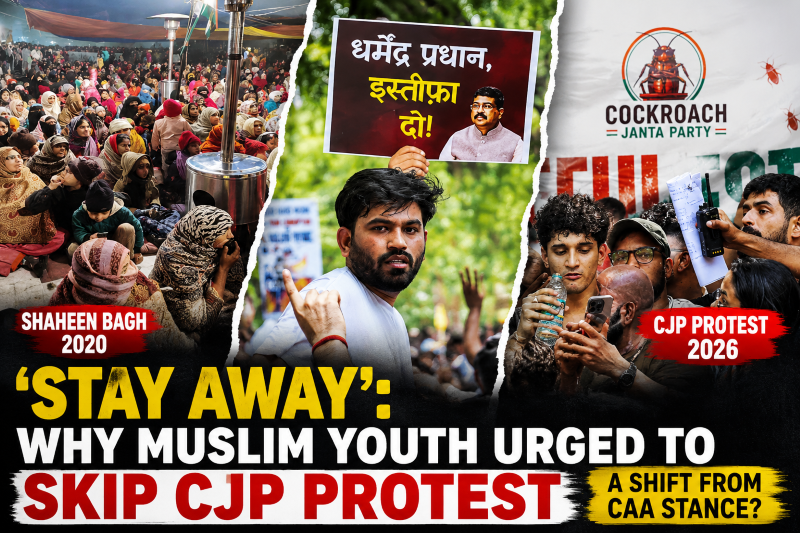
Through mosque announcements, WhatsApp groups and social media posts, many community leaders urged Muslim youth not to attend the protest.
A widely circulated advisory as reported in the media, carried an even sharper message: "Don't participate. Don't even go near the protest site."
The Cockroach Janta Party's first major on-ground mobilisation at Delhi's Jantar Mantar concluded peacefully after several hours of speeches, slogans and symbolic demonstrations demanding the resignation of Union Education Minister Dharmendra Pradhan over alleged exam and recruitment irregularities.
'Don't Participate'
In a stark contrast to the 2020 anti-CAA movement, several Muslim community leaders and clerics urged Muslim youth to refrain from participating in the Cockroach Janta Party (CJP) protest held at Jantar Mantar in New Delhi last Saturday, according to media reports.
According to a Times of India report, messages circulated through WhatsApp groups, Instagram reels and mosque announcements advised young Muslims to stay away from the protest, citing concerns about potential long-term consequences for the community.
Some community members also cautioned against visiting the protest site altogether, fearing that if any violence or unrest broke out, Muslims could end up being blamed.
Ashraf Masood, a college student, said his father discouraged him from joining the demonstration and instead advised him to focus on his personal growth.
"My father told me to focus on building myself and my career first, and then help people," Masood was quoted as saying. "As always, Muslims will be made the scapegoat," he added.
Clerics urge caution
The message was echoed by religious leaders as well.
"Muslim youth should remember that activism is not only on the streets," the Imam of the Shaheen Bagh mosque told young members of the community.
"Real change also comes through education and community work. Emotions are important, but decisions should be guided by wisdom and responsibility," he added.
Shaheen Bagh: A Muslim-led movement
The cautious approach marks a departure from the Shaheen Bagh protests of 2019-20, where Muslims played a central role in opposing the Citizenship Amendment Act (CAA) and expressing concerns over the proposed National Register of Citizens (NRC).
The protest, largely led by Muslim women, began in December 2019 and continued until March 2020. It drew participation from students, activists, religious leaders, professionals and local residents.
Protesters argued that the CAA, when combined with a nationwide NRC, could disproportionately affect Muslims and undermine India's secular framework.
The Union government, however, maintained that the CAA did not take away anyone's citizenship and was aimed at providing refuge to persecuted minorities from neighbouring countries.
As the movement expanded, it received support from civil society groups, opposition leaders, academics, artists and citizens from different faiths. Nevertheless, Muslims remained the principal participants and organisers, making Shaheen Bagh one of the most prominent examples of Muslim-led political mobilisation in contemporary India.
What is the Cockroach Janta Party?
The Cockroach Janta Party (CJP) is a youth-led protest movement that emerged in India in 2026. What began as a satirical online campaign later evolved into a broader agitation focusing on unemployment, examination irregularities and educational reforms.
Founded by Abhijeet Dipke, the movement gained significant traction on social media, particularly among students and young professionals.
The name "Cockroach Janta Party" stems from remarks that allegedly compared unemployed youth to "cockroaches"—a label that supporters subsequently embraced as a symbol of resistance and solidarity.
The movement's first major street protest was held at Jantar Mantar on June 6, 2026. Participants, many wearing cockroach masks, demanded the resignation of Union Education Minister Dharmendra Pradhan over the alleged NEET 2026 paper leak and other examination-related controversies.
Organisers described the demonstration as peaceful and centred on accountability in the education system.
While a report in The Week, citing government sources, estimated that approximately 1,500 people gathered at Jantar Mantar without clearly attributing that figure to Abhijeet Dipke, the CJP founder claimed the following day that the rally actually drew nearly 7,000 attendees and declared it a success, according to Mint.