
Q. What prompted you to take on music composition alongside directing Emperor vs Sarat Chandra?
Srijit Mukherji: I felt I was ready to explore a creative department I hadn't worked in before. I have a lot of patriotic fervour inside me, and I thought I would be able to articulate that musically. That's why I decided to become a composer.
Q. What aspects of Sarat Chandra Chattopadhyay's life did you want to explore through the film?
Srijit Mukherji: The film interweaves two journeys — that of Sarat Chandra, who wrote a book that incited people to rise against the British Empire and whose work was banned, and that of the freedom fighter who struggled against British rule. The journeys of the author and the protagonist are intertwined, with both fighting against the British.
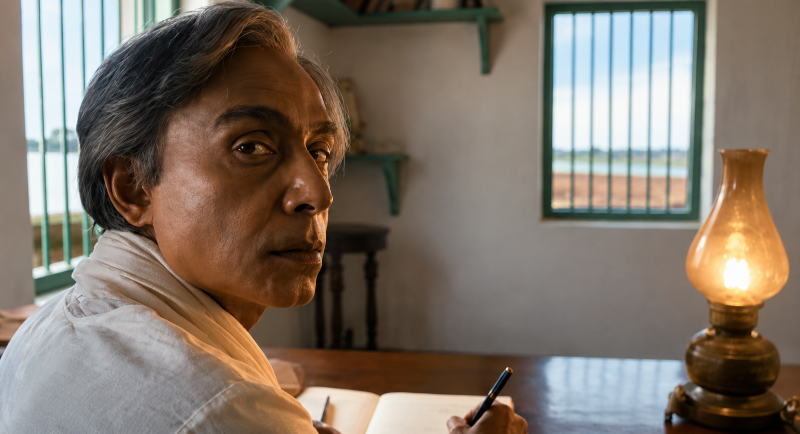 Tota Roy Choudhury as Sarat Chandra Chattopadhyay. Photo: Screen-grab
Q. How did you zero in on Tota Roy Chowdhury for the role?
Srijit Mukherji: Apart from getting the facial features right, Tota worked extensively on his body language and voice. We drew clues from biographies and discussed the character at length because there are no video or audio recordings that we could use as references.
Q. How did you maintain your individuality as a filmmaker while exploring a historical figure whose work has been referenced in other films?
Srijit Mukherji: Sarat Chandra's literary work is very different from his own life. When you adapt Sherlock Holmes, for instance, it is different from making a film about Arthur Conan Doyle's life. That is precisely what makes this film unique. For the first time, audiences can get to know the person behind the literary legacy. That has its own charm as well as challenges.
Q. Did researching and making the film change your perception of Sarat Chandra?
Srijit Mukherji: Definitely. Sarat Chandra is often regarded in literary circles as a popular novelist who wrote about ordinary people, their everyday worries and miseries, and rural Bengal. But when you read about how passionately he was involved in the freedom struggle and how he was persecuted for his activities, you realise that he was also a great patriot and a passionate advocate of freedom. The research really changed my perception of his work.
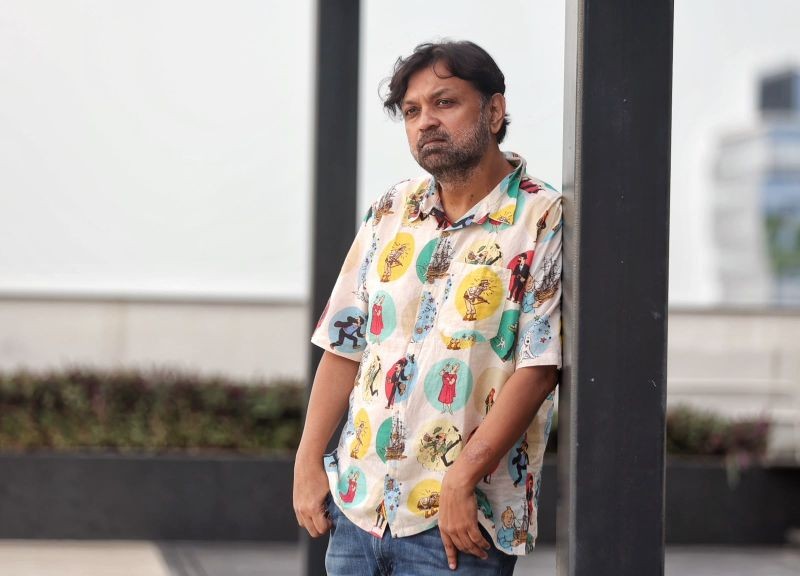
 Srijit Mukherji. Photo: Avishek Mitra/IBNS
Q. Do you think the film's themes of censorship and creative freedom remain relevant in 2026?
Srijit Mukherji: I don't think anything has changed. The same cycle that I explored in X=Prem is something I am exploring in Emperor vs Sarat Chandra as well. That is why the film remains relevant.
Q. How do you think the film will appeal to Gen Z, particularly those who may not read as much?
Srijit Mukherji: They may not read as much, but they listen to a lot of audio stories through different platforms and remain connected to their legacy. I think they are much more rooted than we imagine. They may not always appear that way, but they are deeply connected to their cultural roots.
Q. How do you plan to take your musical journey forward?
Srijit Mukherji: It depends on the film, its subject matter and the demands of the project. I will continue to explore music depending on what each film requires.