
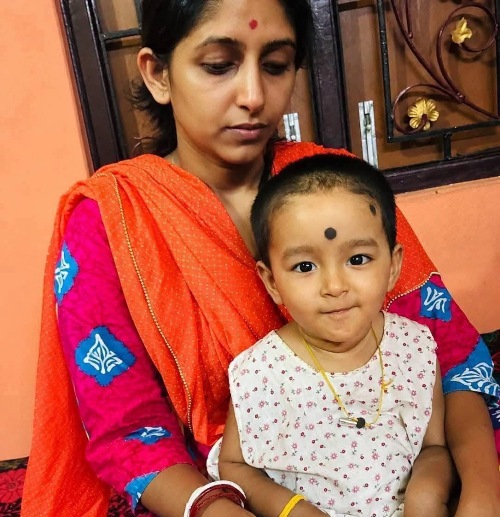
The government of Tripura has shared detailed the treatment and financial assistance extended to Manasri Chowdhury, a child from Hapania, Agartala, who has been diagnosed with Spinal Muscular Atrophy (SMA) Type 1, a genetic disorder that has affected her muscular and overall physical development.
According to a statement issued by the Health and Family Welfare Department on Saturday, Manasri’s father, Dhruba Chowdhury, had approached Chief Minister Dr Manik Saha during ‘Mukhyamantri Samipeshu’ in June 2026, seeking government intervention for his daughter’s treatment. Following the request, the Chief Minister wrote a demarche (DO) letter to the Union Health Minister on July 9, 2026, seeking possible assistance for the child’s treatment.
In response, the Union Health Ministry informed the Chief Minister that financial assistance of up to Rs 50 lakh per patient is available under the National Policy for Rare Diseases (NPRD), 2021, for treatment of identified rare diseases at designated Centres of Excellence (CoEs). The ministry also identified Assam Medical College and Hospital (AMCH), Dibrugarh, Regional Institute of Medical Sciences (RIMS), Imphal, and IPGME & R, Kolkata, as CoEs in the eastern and northeastern region.
The Health department subsequently shared the contact details of the relevant CoEs with Manasri’s parents. The family later visited AMCH, Dibrugarh, where the child was registered and received 12 vials of Risdiplam on August 21, 2026, which, according to the department, would be sufficient for approximately eight months of treatment.
As per the prescription and treatment plan issued by the CoE, the medication provided at AMCH cost around Rs 2.29 lakh. Since the medicine was provided under the Rare Disease Programme, the family remains eligible for further assistance of up to ₹47.31 lakh in the future. However, the CoE has informed the family that while Risdiplam has been found effective for other forms of SMA, its efficacy in SMA Type 1 is very limited.
The family had also approached the Tripura Government for a certificate detailing the nature and extent of financial assistance available to seek support from the Tata Trust. The Medical Superintendent of Agartala Government Medical College and GB Pant Hospital, on behalf of the Health Department, issued the certificate on July 27. Subsequently, the Tata Trust agreed to provide ₹20 lakh towards the child’s treatment, the statement said.
Meanwhile, Manasri was evaluated by an expert medical team at AIIMS, New Delhi, in July 2026. The evaluation noted that Zolgensma (Onasemnogene abeparvovec), a gene therapy designed to replace the deficient SMN1 gene, cannot regenerate motor neurons that have already undergone irreversible degeneration. The potential for near-normal development is therefore greatest when treatment is administered before symptoms appear, particularly before six weeks of age, while the expected benefit decreases as the disease progresses.
The AIIMS evaluation committee recommended Zolgensma for Manasri, with the treatment objective being disease modification and preservation or improvement of residual motor function rather than normalization of development. However, the statement noted that the drug was awaiting approval from the Drug Controller General of India at the time of the evaluation.
The Health and Family Welfare Department said government officials remain in regular contact with Manasri’s parents and are extending the best possible treatment and necessary assistance to the family.