
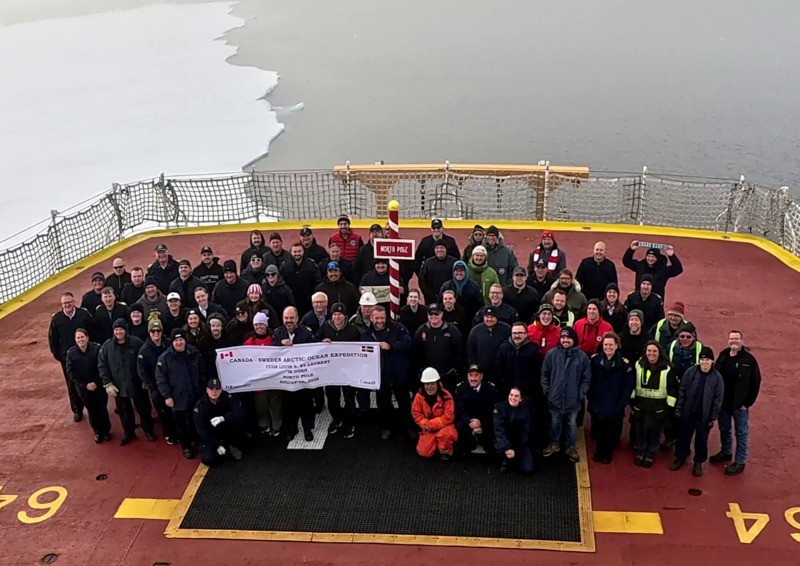
The milestone comes as Canada conducts scientific missions to map its continental shelf and establish its outer limits under the United Nations Convention on the Law of the Sea, the Canadian Coast Guard said.
The vessel is collecting high-resolution geoscience and hydrographic data as part of missions running from 2024 to 2027 in support of Natural Resources Canada and Fisheries and Oceans Canada.
The Coast Guard said the mission demonstrates Canada’s ability to operate in the Arctic while advancing its scientific, security and sovereignty interests in the region.
“The arrival of CCGS Louis S. St-Laurent at the North Pole is an important milestone that reflects Canada’s enduring commitment to the Arctic,” Defence Minister David J. McGuinty said.
He added that the mission advances scientific knowledge, strengthens Canada’s presence in the North and reinforces its sovereignty and security.
The Canadian Coast Guard said its icebreakers allow it to reach remote areas of the Arctic and support northern communities, scientific research and other federal government priorities.
The Coast Guard’s annual summer operational season runs from June to November, during which its vessels provide services to northern communities and support government missions across the Arctic.
Kevin Brosseau, commissioner of the Canadian Coast Guard, said reaching the North Pole reflected the professionalism of the Louis S. St-Laurent crew and those supporting Canada’s Arctic operations.
The mission is part of Canada’s broader effort to maintain an enduring presence in Arctic waters while advancing its scientific and strategic interests in the North.