
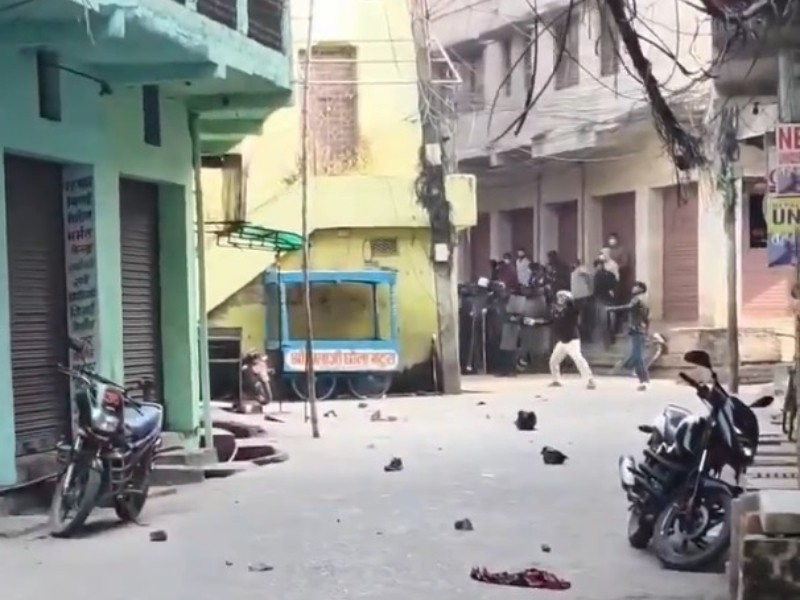
Communal tensions flared in Birgunj in Parsa district and Kamala Municipality in Dhanusha district after a TikTok video containing alleged offensive religious remarks went viral, rapidly escalating into street protests and violence.
What began as online outrage quickly spilled onto the streets, exposing how fast-moving digital content can inflame deep-rooted sensitivities in border regions where communities are closely intertwined.
How the controversy began in Dhanusha
The unrest first surfaced in Kamala Municipality of Dhanusha district after two local youths, identified as Haider Ansari and Amanat Ansari, uploaded a video on TikTok.
Locals alleged that the video contained remarks hurtful to religious sentiments, triggering anger among residents.
As the clip spread rapidly across TikTok and other social platforms, tensions rose sharply.
Concerned locals handed the two youths over to the police, claiming the content could disrupt communal harmony.
However, the situation worsened soon after, when a mosque in the area was reportedly vandalised — a development that transformed online outrage into physical protests.
Mosque vandalism deepens communal anger
The vandalisation of the mosque proved to be a turning point.
The incident intensified anger among residents and drew larger crowds onto the streets, with protests spreading beyond Dhanusha into nearby districts.
Demonstrators accused authorities of failing to act swiftly, while emotions ran high across communities.
What had initially been a social media controversy now became a broader communal flashpoint, with religious sensitivities, rumours, and anger feeding into one another.
Birgunj becomes epicentre
Birgunj, a busy commercial hub in Parsa district bordering Raxaul in India, soon became the epicentre of unrest.
Protesters took to the streets, burning tyres, chanting slogans, and confronting security forces.
Despite prohibitory orders, rival groups continued demonstrations in different parts of the town.
As clashes escalated, police were forced to lob tear gas shells to disperse crowds.
Stone-pelting incidents and damage to public property were reported, raising fears of wider violence in the densely populated border town.
Curfew imposed in Birgunj
With protests spiralling and public safety at risk, the local administration imposed a strict curfew in Birgunj to prevent further violence.
Officials said the move was necessary to separate rival groups, restore order, and prevent the situation from spreading to other sensitive areas.
The curfew marked a significant escalation, reflecting the seriousness of the situation and the difficulty authorities faced in containing unrest driven by fast-spreading digital content.
India seals border amid high security alert
As tensions flared in Nepal’s southern districts, India responded by completely sealing its border crossings in the affected areas.
All cross-border movement was restricted, barring emergency services, as a precautionary measure.
Birgunj’s proximity to Raxaul, one of the busiest India-Nepal border points, raised concerns about spillover effects.
Indian authorities maintained heightened vigilance to prevent unrest from crossing into border towns on the Indian side.
Role of social media in escalating tensions
Authorities and local observers pointed to TikTok’s speed and reach as a critical factor in the crisis.
The video spread faster than officials could respond, allowing outrage, misinformation, and communal emotions to build unchecked.
The incident highlighted how a single piece of online content can rapidly move from screens to streets, especially in regions where religious and communal sensitivities run deep.
What started as a local dispute became a broader security challenge within days.
A cautionary episode for Nepal’s border towns
The Birgunj unrest underscores the fragile balance in Nepal’s border regions, where digital platforms, local grievances, and communal identities intersect.
As curfews remain in place and borders stay sealed, authorities continue efforts to restore calm while assessing the wider implications of social media-driven unrest.