
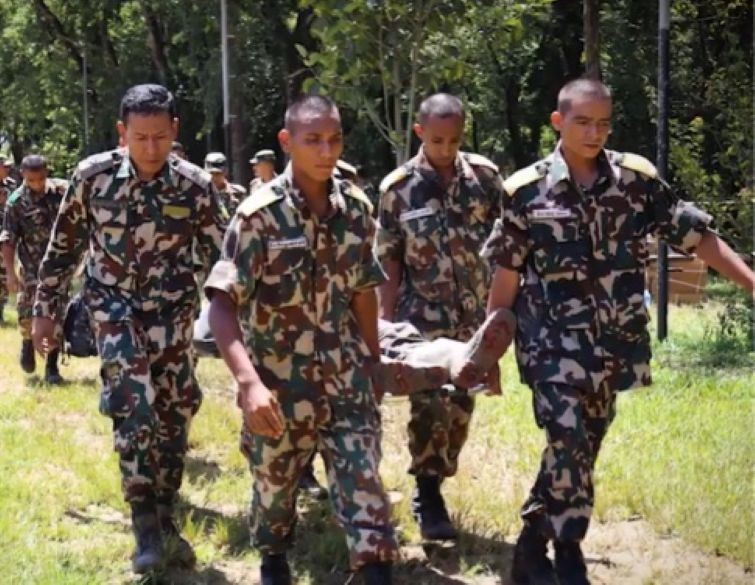
At least 675 bodies have been recovered so far after a tsunami-like surge of water and mud struck villages and towns on Wednesday morning.
Chitwan, a district in southern Nepal bordering India, has reported the highest number of recoveries, with 233 bodies found so far.
Bodies kept in temporary cooling centre
Authorities in Chitwan have been struggling to prevent the bodies from decomposing due to a shortage of space and adequate facilities at hospitals.
Officials decided on Saturday to proceed with burials after health experts warned that the increasing decomposition and foul smell from bodies being kept in temporary arrangements could raise the risk of infection.
With bodies piling up, authorities had been using a house as a temporary cooling centre. Officials said the facility eventually ran out of space, leaving burial as the only viable option.
अवरुद्ध सडक खुलाउन सहयोग गर्दै #नेपालीसेना !!!
— Nepali Army (@NepaliArmyHQ) August 27, 2026
बाढी प्रभावित क्षेत्रहरूमा राहत वितरण तथा उद्धारमा #नेपालीसेना....#NepaliArmy#BhoteKoshiFlood pic.twitter.com/Ol2OF7SiuX
DNA samples collected before burial
Authorities are taking DNA samples from the bodies before burial and assigning each one a unique identification or reference number.
Records are also being maintained along with location details to ensure that bodies can be identified and recovered if DNA matches are established later.
By Saturday afternoon, DNA profiling had been completed for more than 100 bodies that were ready for burial.
Burial pits dug 1.5 metres deep
The burial pits are being dug to a depth of 1.5 metres, with authorities deliberately leaving a 40-centimetre gap between bodies.
The arrangement is intended to make future exhumation possible while ensuring that only the specific body identified through DNA matching can be retrieved.
The bodies are being placed in bags marked with identification numbers.
बाढी प्रभावितहरूको उद्धारमा #नेपालीसेना....
— Nepali Army (@NepaliArmyHQ) August 27, 2026
जहाँ संकट, त्यहाँ #नेपालीसेना !!!#NepaliArmy#BhoteKoshiFlood pic.twitter.com/roAhhUGMNt
Concrete platforms with signboards carrying the corresponding numbers are also being constructed at burial sites.
Authorities plan to document the burials through video and photography and geo-tag each burial location.
Families can use DNA matching to recover bodies
Relatives searching for missing family members will be able to provide DNA samples at designated hospitals across Nepal.
Once the test results are available, the Health Department will compare relatives' DNA with samples collected from the unidentified bodies.
If a match is established, authorities will use the corresponding identification number and burial records to locate the body.
बाढी प्रभावितहरूको उद्धारमा #नेपालीसेना....
— Nepali Army (@NepaliArmyHQ) August 26, 2026
जहाँ संकट, त्यहाँ #नेपालीसेना !!! #NepaliArmy #BhotekoshiFlood pic.twitter.com/uMSYEAQqo6
The identified remains will then be exhumed and handed over to the family.
Police have also uploaded details of unidentified and unclaimed bodies on a website to assist families searching for missing relatives.
More than 2,400 people still missing
The move comes as the scale of the disaster continues to emerge.
According to officials, 2,426 people, including hundreds of foreigners, remain missing in Nepal.