
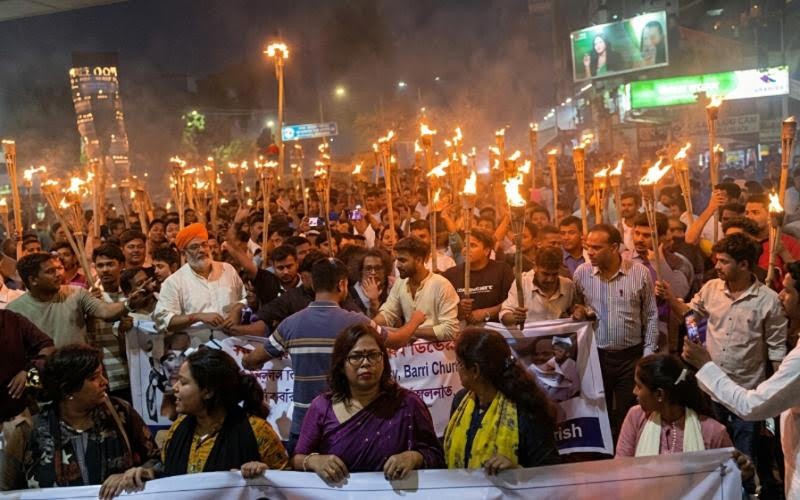
The demonstrations erupted days after work on an 81-foot statue of Lord Ram in northern Bangladesh was suspended following reported threats from Islamist groups.
The protests have intensified debate over the treatment of religious minorities in Muslim-majority Bangladesh and come amid growing concern over a series of communal incidents reported this year.
#Bangladesh
— Hindu Voice (@HinduVoice_in) June 19, 2026
Hindu minorities are protesting in all over Bangladesh against the insult of Prabhu Sri Ram by the Islamists. pic.twitter.com/31k7WfqpIA
Large-scale protests in Dhaka
Several Hindu organisations, students and community members gathered at Dhaka’s Shahbagh intersection before marching towards the National Press Club.
The demonstration was organised by the Hindu Mahajot, which also formed a human chain outside the National Press Club. Another group staged a separate protest near the Dhaka Reporters Unity building.
'JAY SHREE RAM' Slogans Raised In Bangladesh
— India Strikes YT 🇮🇳 (@IndiaStrikes_) June 17, 2026
Bangladeshi Hindus are continuing to protest against Islamists for insluting Prabhu Ram.
Better later than never.#Bangladesh #BangladeshiHindus #JayShreeRam https://t.co/Ov5bATyKrK pic.twitter.com/36RXGPnUD1
Protesters alleged that an Islamist crowd had desecrated a picture of Lord Ram during a demonstration in Gaibandha earlier this month by placing a shoe on the image.
Although a case has reportedly been registered, demonstrators claimed that no arrests had been made.
ढाका में गूंजा जय श्रीराम
— The Hindu Association (@HinduAsociation) June 20, 2026
भगवान श्रीराम के कथित अपमान पर बांग्लादेशी हिंदुओं का जबरदस्त सड़क पर विरोध प्रदर्शन
बांग्लादेश के हिंदुओं को नमन जो जिहादियों के गढ़ में आज भी सनातन विरोधियों को मुहतोड़ जवाब दे रहे
सनातन के सम्मान पर कोई समझौता नहीं
जय श्रीराम 🚩🙏 pic.twitter.com/0GFJSMYHmL
In Rangpur, a minor confrontation occurred after police stopped a group of Hindus from holding a protest rally.
Protesters issue 72-hour ultimatum
Participants accused the government of failing to take swift action against those allegedly involved in the incident.
The protesters issued a 72-hour ultimatum demanding arrests and warned that further demonstrations would follow if their demands were not met.
Community leaders also announced plans to submit a memorandum to the Ministry of Religious Affairs.
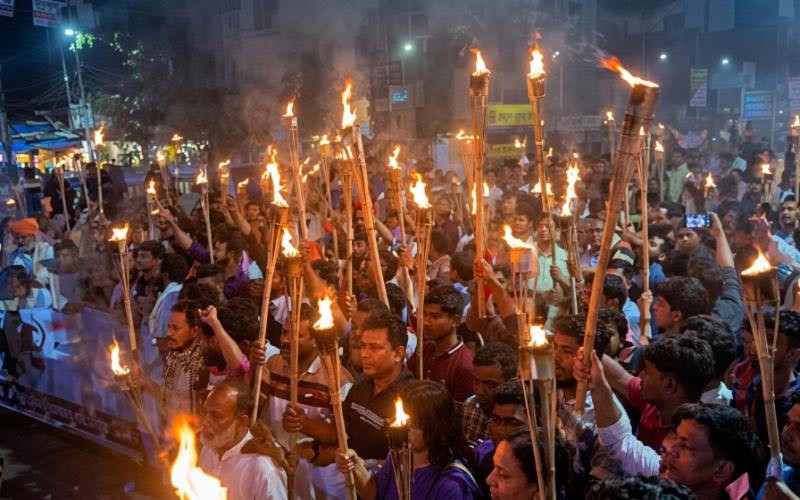 Dhaka witnesses massive Hindu protests over Lord Ram's image desecration. Photo: Screen-grab from X (Quality enhanced with AI)
Meanwhile, Hindu Mahajot stated that if authorities did not permit the construction of the Lord Ram statue to resume, efforts would be made to establish Ram temples across all 64 districts of Bangladesh.
The National Committee for Puja Celebrations has also announced a nationwide protest programme, signalling that demonstrations are likely to continue.
Ram statue project suspended
The controversy centres on a large religious project in Palashbari, located in the northern district of Gaibandha.
The Sri Sri Radha Govinda Temple committee had begun constructing an 81-foot statue of Lord Ram as part of a broader temple complex.
According to organisers, nearly 80 percent of the work has already been completed.
The project, estimated to cost around 22 crore Bangladeshi taka, also includes plans for a 50-foot statue of Lord Krishna and a 30-foot statue of Lord Shiva.
Temple committee president Haridas Chandra Das said work was halted after threats were allegedly made by Islamist groups opposed to the project.
“We are scared, and in fear and out of fear, we have kept the work suspended,” Das told local media.
He appealed to Prime Minister Tarique Rahman to intervene and said the monument was intended as a tribute to one of the central figures of Sanatan (Hindu) Dharma.
Reports also indicated that a radical Islamic preacher had threatened to demolish the statue using a bulldozer.
Temple committee cites social harmony
Temple committee adviser Shyamlal Kumar Mahanta said the decision to suspend construction was taken to prevent tensions from escalating.
“We are stopping this work to maintain law and order and communal harmony. We do not want to become the cause of any dispute, nor do we wish to hurt anyone's religious sentiments,” the committee said in a statement.
Committee members maintained that the move was intended to preserve peace while authorities addressed concerns surrounding the project.
Minority rights concerns resurface
The latest developments have renewed focus on the position of religious minorities in Bangladesh.
Hindus remain the country's largest minority community and account for approximately 8 percent of the population.
The controversy comes amid reports of an increase in attacks and intimidation targeting minority communities in recent months.
According to available figures, around 133 incidents of communal violence were recorded between January 1 and March 31 this year.
Govt reiterates commitment to religious freedom
Prime Minister Tarique Rahman, who assumed office in February, has repeatedly stated that citizens have the right to practise their religion freely.
In his first national address after taking office, Rahman said that religion was a personal matter and that the country “belongs to all”.