
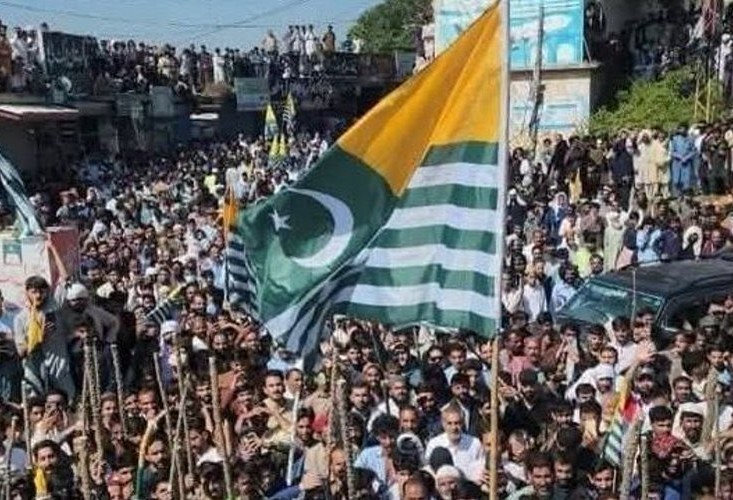
The letter, dated July 30, was led by Imran Hussain, Labour MP for Bradford East and chair of the All-Party Parliamentary Group on Kashmir, and was signed by lawmakers from across political parties, News18 reported.
The MPs sought clarity on the UK government's assessment of the humanitarian situation in the region and asked what steps were being taken to protect British nationals and residents whose family members are living in Pakistan-occupied Kashmir.
The letter reportedly highlighted allegations of the use of live ammunition and excessive force against demonstrators, raising serious concerns about the protection of the rights to peaceful protest and assembly.
The parliamentarians warned that the deteriorating situation could further escalate tensions, undermine public confidence and destabilise an already volatile region.
They also asked about the UK government's efforts to encourage the immediate resumption of negotiations between the Pakistani authorities and representatives of the Joint Awami Action Committee (JAAC), according to News18.
The lawmakers further sought details of measures being taken to ensure British nationals in the region, as well as British citizens with relatives there, could access consular assistance and remain in contact with their families.
Protests Reach London and Washington
A large number of members of the British Kashmiri diaspora recently marched through central London, demanding international attention to the situation in Pakistan-occupied Kashmir.
The demonstration began at Speakers' Corner before protesters marched towards the Pakistan High Commission, carrying banners and raising slogans calling for an end to the alleged violence in the region, News18 reported.
Meanwhile, members of the Jammu and Kashmir community from Washington, DC, Maryland and Virginia recently staged a protest outside the White House, urging the United States and the international community to intervene in the ongoing situation in Pakistan-occupied Kashmir.
According to organisers, around 100 US residents with roots in Pakistan-occupied Kashmir, including women, children and community leaders, participated in the protest, Firstpost reported.
Weeks of Unrest
Pakistan-occupied Jammu and Kashmir has witnessed sustained unrest, with the Joint Awami Action Committee leading demonstrations over economic and political grievances.
The movement has raised concerns over electricity prices, inflation, governance and political representation in the territory.
The protests have continued for several weeks and have increasingly resulted in clashes with security forces.
The first phase of the PoJK Legislative Assembly election was held in the Mirpur division on July 27.
Violence was reported from several polling locations, with conflicting accounts regarding casualties.
The JAAC claimed that 14 of its activists were killed and more than two dozen injured. Pakistani law-enforcement authorities disputed the death toll and accused protesters of opening fire on security personnel.
The violence has added further uncertainty to an already tense electoral process.
JAAC Movement Intensifies
The latest clashes are the culmination of more than seven weeks of protests led by the JAAC, which has expanded its demands beyond economic issues to broader governance reforms.
The organisation has called for the release of detained protesters, withdrawal of legal cases against activists and implementation of its wider demands.
Negotiations between JAAC representatives and Pakistani authorities reportedly failed to produce an agreement, prompting protesters to renew their mobilisation and announce plans for a march towards Muzaffarabad.
The unrest has also drawn reactions from political and human rights organisations.
The United Kashmir People's National Party (UKPNP), for instance, urged Pakistani authorities to avoid the use of force against demonstrators and claimed that more than 40 people had died since June 5 during the continuing unrest. The figure, however, has not been independently verified.
Election Process Disrupted
The ongoing unrest has significantly affected the election schedule.
Polling in the districts of Sudhnoti and Rawalakot was postponed until August 10 because of an ongoing protest sit-in led by the Public Action Committee, according to reports.
The postponement followed the breakdown of talks between protesters and the authorities.
The first phase of polling covered 13 constituencies in the Mirpur division, with Pakistan deploying a three-tier security arrangement comprising police, Rangers and the Army.