
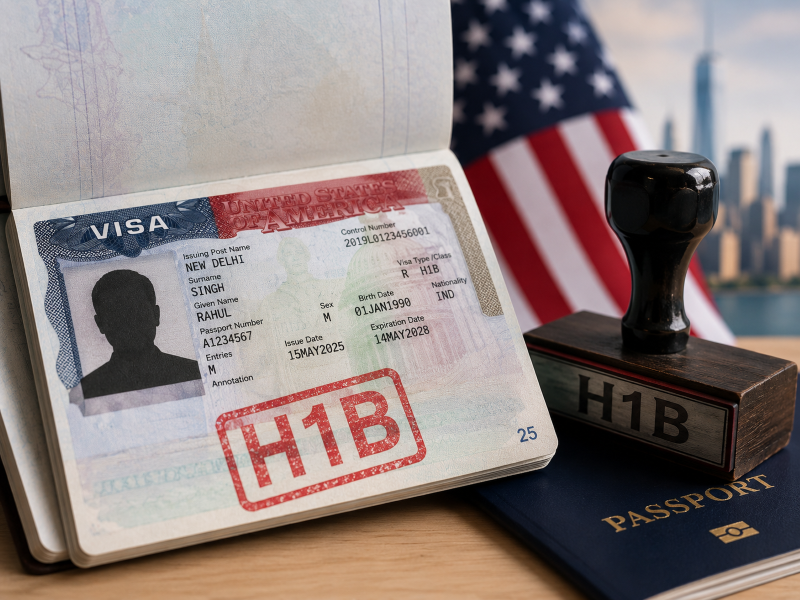
The proposal seeks to reverse a policy that has allowed eligible H-4 dependent spouses to obtain Employment Authorisation Documents (EADs) and work legally in the US for more than a decade.
Indian professionals and their families are likely to be among those most affected, as Indian nationals account for the overwhelming majority of H-4 EAD approvals.
93% of H-4 EAD approvals went to Indians
Data on H-4 EAD applications between 2014 and 2017 showed that 93 per cent of approvals went to Indian nationals, with women accounting for 94 per cent of those approvals.
The proposal, listed on Reginfo.gov under the Office of Information and Regulatory Affairs, is titled “Removing H-4 Dependent Spouses From the Classes of Noncitizens Eligible for Employment Authorisation.”
It has been placed on the Department of Homeland Security's long-term regulatory agenda, although no date has been announced for its formal release.
DHS wants to reverse 2015 rule
The DHS proposal states that it intends to remove certain H-4 dependent spouses of H-1B workers from the category of noncitizens eligible to request employment authorisation under the C26 classification.
“This proposal would reverse the changes made in the 2015 final rule, ‘Employment Authorisation for Certain H-4 Dependent Spouses,’” the notice states.
It would restore what DHS described as its longstanding policy of not extending employment authorisation eligibility to H-4 dependent spouses.
H-4 EADs not ending immediately
The proposal does not mean H-4 work permits are being cancelled immediately.
Before the policy can take effect, DHS would have to publish a formal Notice of Proposed Rulemaking in the Federal Register.
The public would then have an opportunity to submit comments before the department considers issuing a final rule.
Until that process is completed and a final rule takes effect, H-4 spouses with valid EADs can continue working under the existing rules.
Trump previously tried to end H-4 EADs
This is not the first time the Trump administration has sought to eliminate H-4 work authorisation.
During Trump's first term, DHS proposed in 2017 to remove employment authorisation for certain H-4 spouses.
However, the proposal was never finalised and was ultimately withdrawn in 2021.
What H-4 visa holders could lose
An H-4 visa itself does not provide work authorisation. It allows spouses and children of H-1B visa holders to live in the United States with the principal visa holder.
Eligible H-4 spouses can currently apply separately for an EAD, allowing them to work legally in the US.
Eligibility generally applies when the H-1B spouse is sufficiently far along in the employment-based green card process, such as having an approved I-140 or qualifying for certain AC21 extensions.
Without an EAD, an H-4 holder can continue living in the US but cannot legally take up employment.
H-1B families face wider immigration changes
The proposed H-4 EAD rollback comes amid several other immigration measures targeting the H-1B programme.
The administration has also proposed a $103,265 fee for new H-1B hires, while the White House has sought to eliminate the existing 60-day grace period that allows H-1B workers who lose their jobs time to find a new employer.
The potential impact on Indian H-1B families could be significant. Indian nationals accounted for about 71 per cent of approved H-1B petitions in fiscal year 2024, according to USCIS data.
If the H-4 EAD proposal eventually becomes a final rule, many spouses who have built careers in the US under the decade-old work authorisation policy could be forced to stop working.