
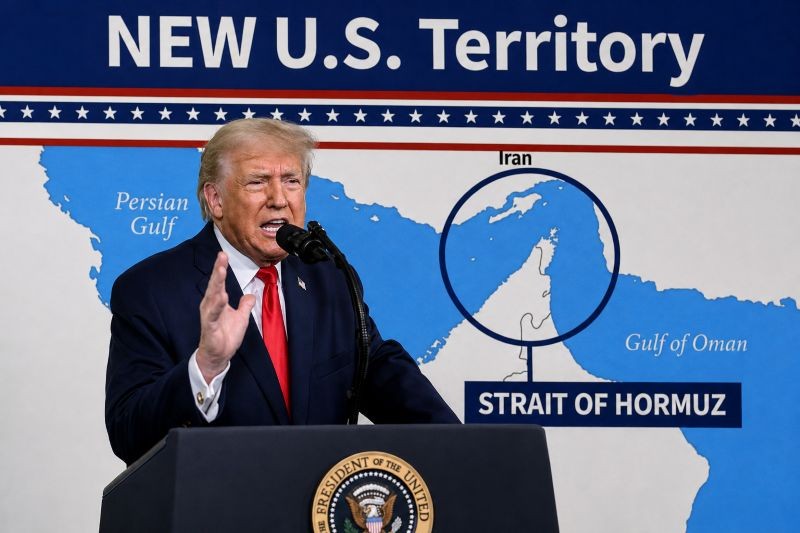
Trump posted the image on his Truth Social platform, with the Strait of Hormuz — a crucial global route for oil, natural gas and other supplies — circled and labelled as the "new US territory".
The US president had shared the same image earlier on August 18.
Trump had threatened to claim Hormuz
Trump first floated the idea of declaring the Strait of Hormuz part of US territory on August 15 during a rally in New York.
"After we finish defeating Iran, which is being very badly defeated -- pretty soon I'll be declaring the Hormuz Strait a territory of the United States," Trump had said.
"It's true," he added.
Before the war, roughly one-fifth of global oil and LNG exports passed through the strategic waterway.
Iran has asserted control over the strait since the conflict began on February 28 and has required vessels seeking to pass through it to obtain permission and pay transit fees.
Trump, meanwhile, has claimed that the US has "total control" over the waterway.
Iran says Strait will remain closed
Iran on Saturday reiterated that the Strait of Hormuz would remain closed until the United States fulfils its commitments and changes its conduct.
Mohsen Rezaei, head of Iran's Supreme National Security Council, said on state television that the waterway would not reopen until Washington "corrects its behaviour".
"The Strait of Hormuz is closed, despite American claims, and will not open until America corrects its behaviour," Rezaei said.
"This time, America must first fulfil its obligations," he added.
Iran warns countries against joining US 'economic war'
Rezaei also warned other countries against supporting what he described as Trump's "economic war" against Iran.
He said nations participating in economic restrictions against Tehran would be regarded as enemies and warned that Iran could target their interests if they refused to distance themselves from the United States.
Rezaei further claimed that Iran had not yet targeted US economic interests, saying Tehran had so far focused on military bases.
However, he warned that if Washington imposed further economic sanctions, Iranian forces could target American oil and economic companies in the region and elsewhere.
"If they want to impose economic sanctions on us, the United States has oil and economic companies around Iran and elsewhere, and we will strike them," he said.
Rezaei also warned that any further US action could trigger a much wider confrontation, saying Iran's response would be "like an earthquake".