
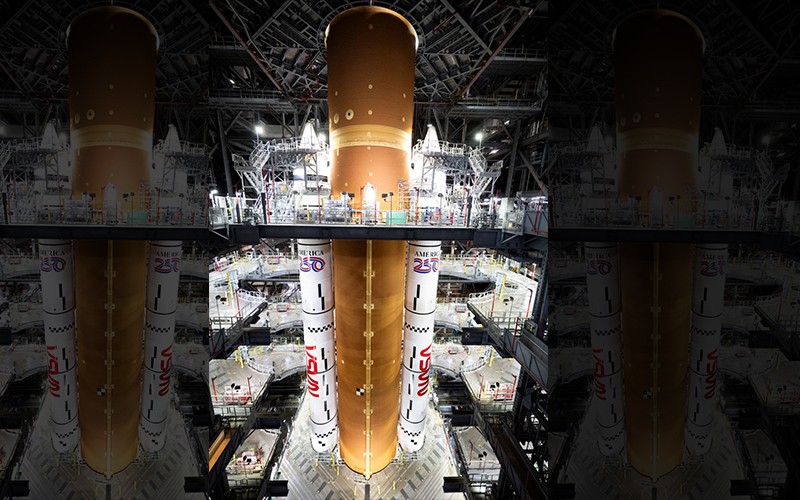
After 50 years, humans are going back to the Moon — NASA’s Artemis II launch is days away
NASA is just days away from launching its next mission to the Moon, marking humanity’s return to the lunar neighbourhood for the first time in more than 50 years.
The upcoming flight will be Artemis II, the second mission under NASA’s Artemis campaign and the first to carry astronauts beyond low-Earth orbit since the Apollo era.
“Artemis II will be a momentous step forward for human spaceflight. This historic mission will send humans farther from Earth than ever before and deliver the insights needed for us to return to the Moon — all with America at the helm,” NASA Administrator Jared Isaacman said.
Isaacman added that Artemis II represents progress toward establishing a sustained human presence on the Moon and advancing NASA’s long-term goal of sending astronauts to Mars.
“I could not be more impressed by our NASA team and the Artemis II crew, and wish them well. Boldly forward,” he said.
Why does the Artemis campaign matter?
NASA says the Artemis programme is central to its plans to explore the Moon for scientific discovery, technology development, and understanding how humans can live and work on another world. The lessons learned from Artemis missions are expected to play a critical role in future crewed missions to Mars.
Launch preparations underway
NASA said it is targeting no earlier than 7 a.m. EST on Saturday, January 17, to begin the multi-hour rollout of the Artemis II launch vehicle from the Vehicle Assembly Building to Launch Pad 39B at the Kennedy Space Center in Florida.
The agency’s crawler-transporter 2 will move the nearly 11-million-pound Space Launch System stack at a speed of about one mile per hour along the four-mile route. The journey to the launch pad is expected to take up to 12 hours.
IBNS
Senior Staff Reporter at Northeast Herald, covering news from Tripura and Northeast India.
Related Articles

Breast cancer cases expected to reach over 3.5 million globally by 2050: Study
Despite recent advancements in breast cancer treatments, new breast cancer cases in women are predicted to rise by a third globally from 2.3 million in 2023 to more than 3.5 million in 2050. Similarly, yearly deaths from the disease are projected to surge 44%, from around 764,000 to 1.4 million, with disproportionate impact in countries with limited resources, according to a major new analysis from the Global Burden of Disease Study Breast Cancer Collaborators, published in The Lancet Onco...

Modi launches nationwide HPV vaccine drive, calls it a game-changer for India’s daughters
Prime Minister Narendra Modi launched the nationwide HPV vaccination campaign from Ajmer, Rajasthan, describing it as a pivotal step toward empowering India’s ‘Nari Shakti’ (women power) and ensuring the health of mothers and daughters.

Big health push! PM Modi to launch nationwide HPV vaccine drive from Rajasthan tomorrow
Indian PM Narendra Modi will launch the nationwide Human Papillomavirus (HPV) Vaccination Programme for 14-year-old girls on Saturday at 11:30 am from Ajmer, Rajasthan.

Is academic pressure driving teens into depression? Study raises alarm
Pressure to achieve at school at age 15 is linked to depressive symptoms and risk of self-harm, and the association appears to persist into adulthood, finds a study led by UCL researchers.
Latest News

Canada: Debate intensifies over deportation of Humboldt bus crash driver

Parked Iranian aircraft destroyed at Bushehr as US-Israel strikes intensify: Report

Explosions rock Dubai, Doha as Iran escalates drone and missile strikes

Drone strikes hit Amazon data centers in UAE, Bahrain amid ongoing Middle East conflict

