
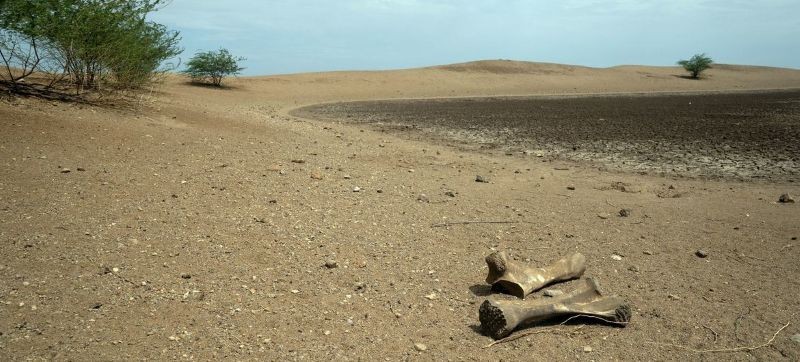
For decades, scientists, policymakers and the media warned of a “global water crisis,” implying temporary shock – followed by recovery.
What is now emerging in many regions, however, is a persistent shortage whereby water systems can no longer realistically return to their historical baselines.
“For much of the world, ‘normal’ is gone,” said Kaveh Madani, Director of the UN University Institute for Water, Environment and Health.
“This is not to kill hope but to encourage action and an honest admission of failure today to protect and enable tomorrow,” he told a press briefing in New York on Tuesday.
Unequal burdens
Mr. Madani emphasised that the findings do not suggest worldwide failure – but there are enough bankrupt or near-bankrupt systems, interconnected through trade, migration and geopolitical dependencies, that the global risk landscape has been fundamentally altered.
The burdens fall disproportionately on smallholder farmers, Indigenous Peoples, low-income urban residents and women and youth, while the benefits of overuse often accrued to more powerful actors.
From crisis to recovery?
The report introduces water bankruptcy as a condition defined by both insolvency and irreversibility.
Insolvency refers to withdrawing and polluting water beyond renewable inflows and safe depletion limits.
Irreversibility refers to the damage to key parts of water-related natural capital, such as wetlands and lakes, that makes restoration of the system to its initial conditions infeasible.
But all is not lost: comparing water action to finance, Madani said that bankruptcy is not the end of action.
“It is the start of a structured recovery plan: you stop the bleeding, protect essential services, restructure unsustainable claims, and invest in rebuilding,” he noted.
Costly tab
The world is rapidly depleting its natural “water savings accounts”, according to the study: more than half the world’s large lakes have declined since the early 1990’s, while around 35 per cent of natural wetlands have been lost since 1970, Madani said.
The human toll is already significant. Nearly three-quarters of the world’s population live in countries classified as water-insecure or critically water-insecure.
Around four billion people experience severe water scarcity for at least one month each year, while drought impacts cost an estimated $307 billion annually.
“If we continue to manage these failures as temporary ‘crises’ with short-term fixes, we will only deepen the ecological damage and fuel social conflict,” Madani warned.
Course corrections
The report calls for a transition from crisis response to bankruptcy management, grounded in honesty about the irreversibly of losses, protection of remaining water resources – and policies that match hydrological reality rather than past norms.