
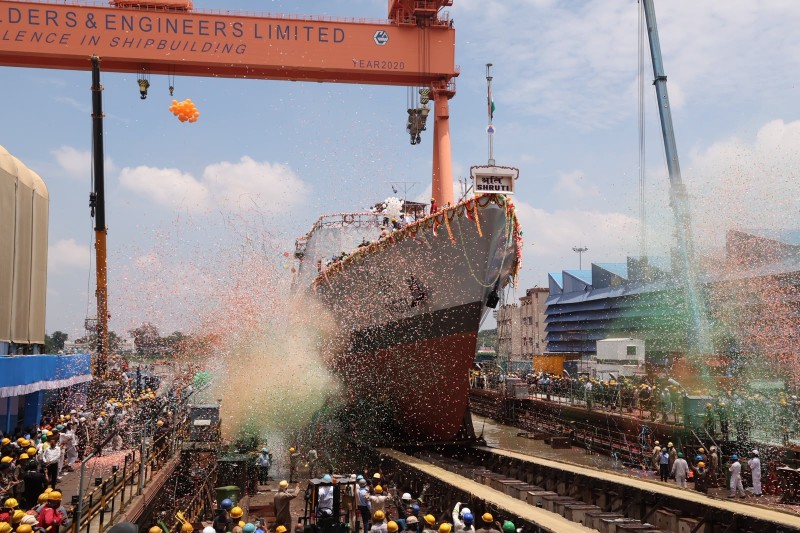
The vessel was launched on Tuesday (August 11), less than three months after GRSE launched ‘Sanghmitra’, the first NGOPV from the shipyard, on May 20.
GRSE, a Navratna Defence Public Sector Undertaking under the Ministry of Defence, is constructing four NGOPVs as part of the Indian Navy’s wider 11-ship NGOPV programme.
The launch ceremony was conducted amid traditional rituals and the chanting of Vedic shlokas.
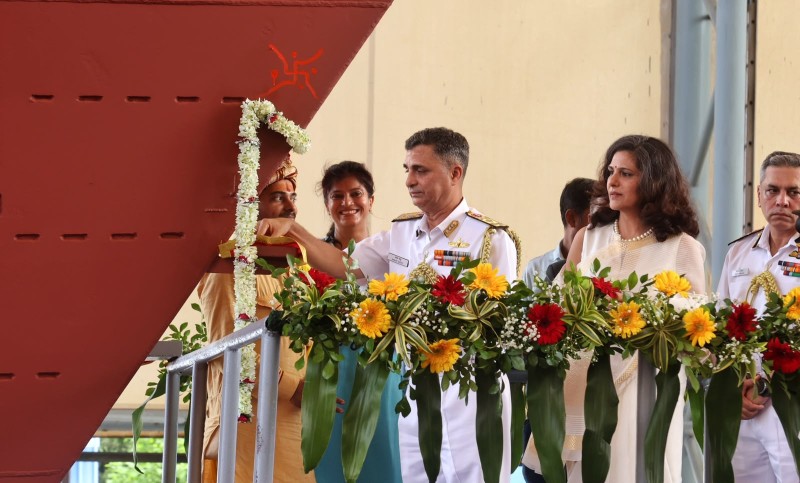 Photo: Avishek Mitra/IBNS
Manika Sadhu, wife of Vice Admiral Sanjay Sadhu, Controller of Warship Production & Acquisition (CWP&A), Indian Navy, formally launched the vessel.
Vice Admiral Sanjay Sadhu attended the ceremony as Chief Guest.
Senior Indian Navy and GRSE officials, including Cmde PR Hari, IN (Retd), Chairman and Managing Director of GRSE, and other directors and senior officers, were present at the event.
#GRSE launches Next Generation Offshore Patrol Vessel "Shruti" in #Kolkata. pic.twitter.com/8x7cBhA6fI
— India Blooms (@indiablooms) August 11, 2026
‘Shruti’ designed for wider maritime missions
The name ‘Shruti’, meaning “that which is heard”, has its roots in Indian tradition and refers to the four Vedas, ancient scriptures preserved through oral tradition.
The NGOPVs are larger and more capable than the Offshore Patrol Vessels previously built by the shipyard.
According to GRSE, the new vessels are designed to provide greater endurance, firepower and operational flexibility.
The ships measure around 113 metres in length and 14.6 metres in width, with a displacement of approximately 3,000 tonnes.
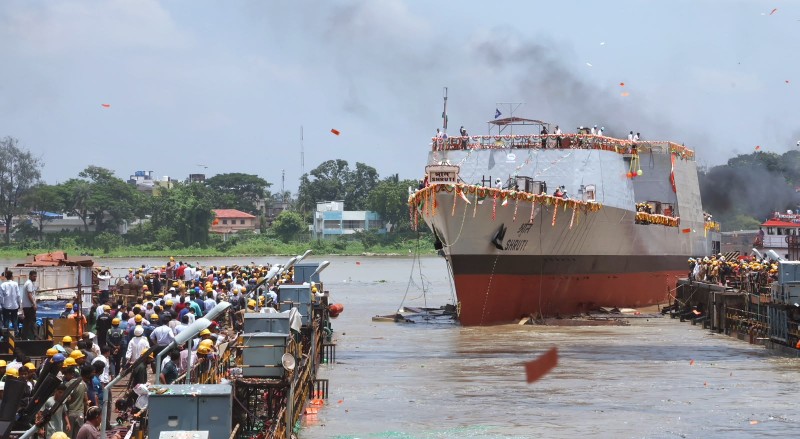 Next-Gen Offshore Patrol Vessel 'Shruti'. Photo: Avishek Mitra/IBNS
They will be capable of reaching speeds of up to 23 knots and have an endurance of 8,500 nautical miles while cruising at 14 knots.
The vessels are intended to perform a broad range of maritime missions, including coastal and offshore asset protection, maritime interdiction, surveillance and visit, board, search and seizure (VBSS) operations.
Their planned roles also include mine warfare, special operations, anti-piracy and counter-infiltration missions.
The NGOPVs will additionally support Out of Area Contingency Operations, humanitarian assistance and disaster relief, search and rescue missions, hospital support, communications intelligence and fleet maintenance.
Indian Navy eyes greater indigenous capability
Speaking at the launch, Vice Admiral Sanjay Sadhu said the induction of the new vessel would strengthen the Indian Navy’s operational capabilities.
“Today, the second Next Generation Offshore Patrol Vessel made by GRSE was launched. Once it is inducted, the capabilities of the Indian Navy will be enhanced,” he said.
Sadhu said the Navy was looking forward to the vessel’s induction, potentially in early 2027, while highlighting India’s expanding domestic shipbuilding capacity.
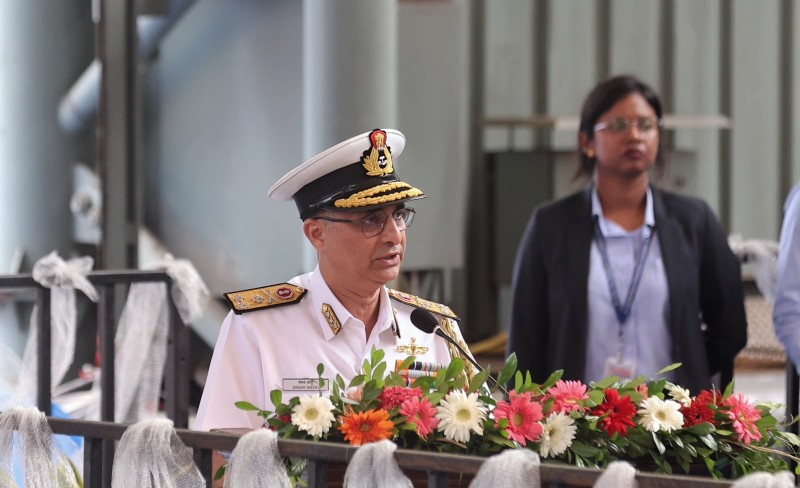 Indian Navy's Vice Admiral Sanjay Sadhu. Photo: Avishek Mitra/IBNS
“We have pioneered in shipbuilding and self-reliance. India has been building ships for the last 60 years, and today we have 44 ships being built indigenously inside various shipyards across the country,” he said.
He added that the vessel had been built with a high level of indigenous content.
“We have built this ship almost 85 percent indigenously. The government has done a lot; policies are there; we are moving to build warships and vessels 100 percent indigenously in the near future,” Sadhu said.
Indian Navy's Vice Admiral Sanjay Sadhu: "We have a focus on capturing 5% of global shipbuilding by 2035, and we want to be among top five global ship manufacturers by 2047." #GRSE #Kolkata pic.twitter.com/3KMxHmDsw0
— India Blooms (@indiablooms) August 11, 2026
He also outlined an international ambition for India’s shipbuilding sector, saying, “We have a focus on capturing five percent of global shipbuilding by 2035, and we want to be among the top five global ship manufacturers by 2047.”
GRSE marks record warship-building momentum
The launch of ‘Shruti’ comes as GRSE continues to expand its warship-building output.
GRSE Chairman and Managing Director Cmde PR Hari said the shipyard had reached a significant milestone by building 118 warships, including 80 for the Indian Navy.
“The last year has been very exciting for GRSE. GRSE has reached a milestone of building 118 warships, while supporting India’s broader domestic naval demand, which aggregates over 200 platforms across active and upcoming expansion plans,” Hari said.
He highlighted the pace of deliveries achieved by the shipyard during the previous financial year.
“In 2025, we built eight warships. That means, in every 45 days, we delivered one warship,” he said.
GRSE has adopted a different production model for the current year, with a combination of deliveries and launches planned across its ongoing programmes.
“This year, we have a hybrid model. We are delivering five warships and launching four vessels, of which you have seen the launch of the second one today. It has been a huge success,” Hari said.
Six decades of indigenous naval construction
GRSE has been involved in Indian shipbuilding for more than six decades and traces its origins to 1884, when it began as a small workshop repairing vessels for the River Steam Navigation Company.
The Government of India took over the company in 1960.
A year later, GRSE built the Seaward Defence Boat INS Ajay, becoming the first shipyard of independent India to construct a warship for the Indian Navy.
Since then, the shipyard has expanded its portfolio across frigates, corvettes, fleet tankers, Landing Ship Tanks, Landing Craft Utility vessels, survey vessels, Offshore Patrol Vessels and fast attack craft.
GRSE has built more than 800 platforms, including 118 warships for the Indian Navy, Indian Coast Guard and friendly foreign countries, according to the company.
The shipyard also delivered MCGS Barracuda, India's first exported warship, to Mauritius in 2014.
It subsequently built the fast patrol vessel SCG PS Zoroaster for Seychelles and the ocean-going cargo and passenger ferry MV Ma Lisha for Guyana.
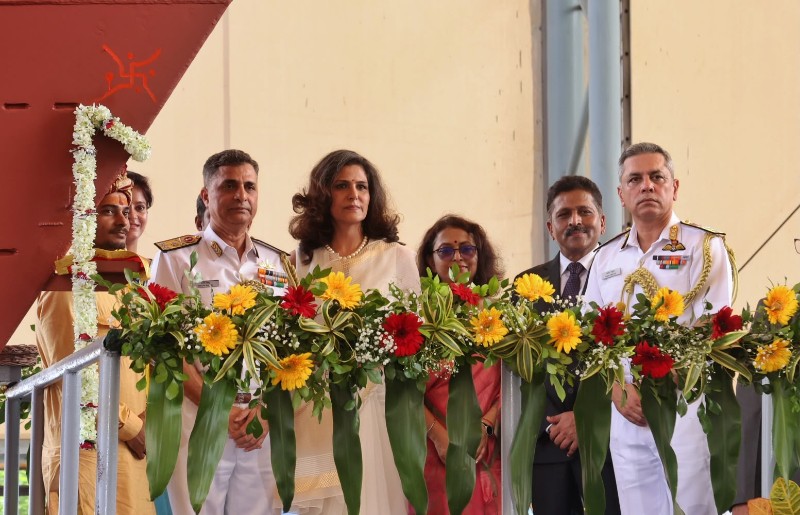 Photo: Avishek Mitra/IBNS
Expansion supports 'self-reliance' push
GRSE said its current expansion plans are focused on strengthening domestic shipbuilding capabilities and supporting the government's wider emphasis on Atmanirbharta and self-reliance in defence manufacturing.
During financial year 2025-26, the shipyard delivered eight warships belonging to three different classes to the Indian Navy.
This included the simultaneous delivery of three warships on March 30, 2026.
The shipbuilder has also invested in infrastructure modernisation and can undertake the concurrent construction of up to 28 ships.
Its design capabilities are supported by a team of design engineers, a Next Generation Virtual Reality Lab and modern design and engineering software.
Beyond shipbuilding and ship repair, GRSE has diversified into engineering activities involving prefabricated steel bridges, deck machinery, marine diesel engine assembly, testing and overhauling, as well as the manufacture of 30mm naval surface guns.