
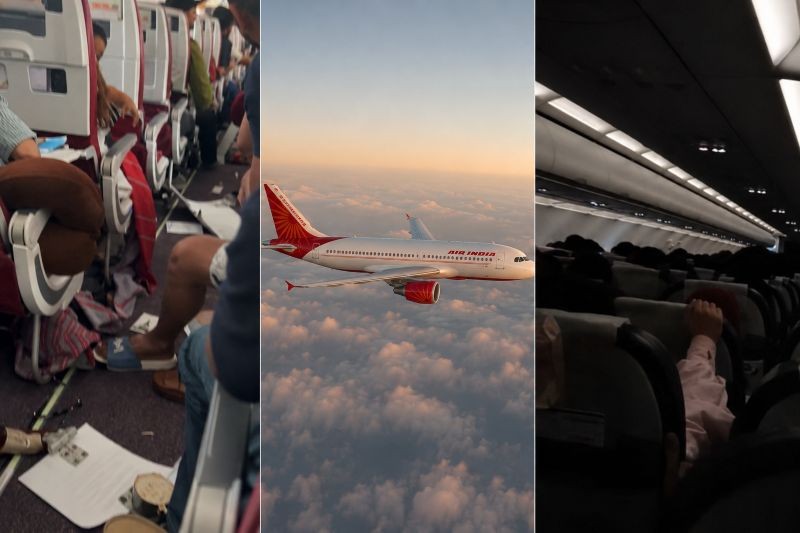
The Air India flight AI-2379, carrying 137 passengers and eight crew members, was flying from Phuket to Delhi on August 4 when it encountered severe turbulence and abruptly lost altitude during its cruise phase. At least 20 passengers and four crew members were injured.
Two crew members suffered spinal injuries, including injuries near the tailbone and neck, Civil Aviation Minister Ram Mohan Naidu said.
Air India: Phuket - Delhi, 04.08.2026.
— Minchen (@minchen_t) August 4, 2026
The worst two hours of my life. Please, please, please always wear your seatbelt on a plane, even when the seatbelt sign is off.
I saw people being thrown into the air, hitting their heads, and getting injured. For a while, I genuinely… pic.twitter.com/3bVjcZZ18g
Second test also returns positive
According to reports, the pilot had earlier tested positive for psychoactive substances during post-flight screening in Delhi.
A second test conducted later has also returned positive.
The test reportedly indicated that the pilot had consumed marijuana, commonly referred to as weed.
The development comes as investigators examine whether the sudden altitude loss was caused by turbulence, pilot action, a technical issue or a possible hydraulic malfunction.
Pilot reportedly not in seat during altitude loss
As per NDTV's sources, the pilot was not seated at the time the aircraft suddenly dropped 300 feet, leaving the co-pilot in command of the Airbus A320neo.
The aircraft reportedly entered a "negative-G" situation during the sudden descent. In such a scenario, occupants and unsecured objects can momentarily become weightless.
The sudden movement caused the pilot and objects inside the cockpit to float upward, while passengers and crew members who were not strapped into their seats at the rear of the aircraft were thrown about, resulting in injuries.
This is called Clear Air Turbulence, or CAT. No clouds, but the air is still bumpy because of:
— Fahad Naim (@Fahadnaimb) June 9, 2026
-Jet streams up high.. these fast rivers of wind (over 100-200 knots) slamming into slower air, creating invisible wind shear.
-Mountain waves... wind blowing over mountains sends… pic.twitter.com/NVCi7ZPzi2
However, it remains unclear what caused the aircraft to enter the negative-G condition.
AAIB launches investigation
The Aircraft Accident Investigation Bureau (AAIB) has begun a detailed investigation into the incident.
The Ministry of Civil Aviation said investigators are collecting and examining technical, operational, medical and human-factor evidence.
This includes inspection of the aircraft and its systems, analysis of recorded flight data, examination of operational and maintenance records, medical information and interviews with people connected to the incident.
The ministry stressed that investigators would examine all available evidence before reaching any conclusions.
"The sole objective of the investigation is to determine the circumstances and contributing factors relating to the occurrence and to identify appropriate safety measures to prevent recurrence," the ministry said.
It also cautioned against drawing conclusions from any single piece of information while the investigation remains underway.
Aviation ministry takes incident seriously
Air India's outgoing CEO Campbell Wilson met senior officials of the aviation ministry on Tuesday to provide an update on the incident.
Civil Aviation Minister Ram Mohan Naidu said the government was treating the matter with utmost seriousness.
"We wanted to get a direct update from Air India also on the incident and we wanted to see how they are approaching the issue," Naidu said.
He reiterated that aviation safety remains the ministry's top priority and stressed that there could be no compromise by regulators, airlines or any other stakeholders.
The AAIB investigation is expected to establish the sequence of events that led to the sudden altitude loss and determine whether any operational, technical or human factors contributed to the incident.