
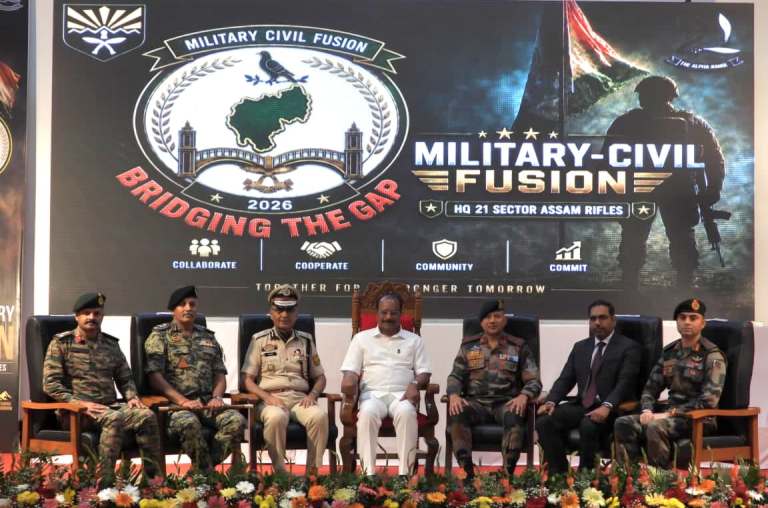
The 21 Sector of the Assam Rifles, under the aegis of Spear Corps, organized a seminar on the theme “Military–Civil Fusion” at Agartala to strengthen inter-agency coordination, collaborative governance, and security cooperation in Tripura and the North Eastern region.
The seminar brought together senior officials from the civil administration, security forces, and the Armed Forces for discussions on emerging security and governance challenges. The Governor of Tripura attended the programme as the Chief Guest.
The deliberations focused on evolving a comprehensive roadmap for enhanced inter-agency cooperation in areas relating to border management, internal security, disaster response, law and order, and developmental initiatives. Emphasis was also laid on the importance of civil-military fusion in ensuring stability, peace and inclusive growth in Tripura and the wider North East Region.
Among the dignitaries who addressed the gathering were the Governor of Tripura, Indrasena Reddy Nallu, Director General of Police (DGP) of Tripura Police, Anurag Dhankar, the Inspector General (IG) of the Border Security Force (BSF), the Home Secretary of the Tripura government, Abhishek Singh and senior Army officers. The speakers highlighted the importance of institutional coordination and joint efforts in addressing security, border management, and developmental issues in the region.
While, delivering the welcome address, Brigadier Nishant Chandel of commandant of 21 sector Assam Rifles, emphasized the importance of cooperation between the civil administration and the military, particularly during times of conflict and crisis.
IG BSF Mr Aloke Kumar Chakraborty spoke on border management and cross-border dynamics, stressing the need to maintain the sanctity of the borders with Bangladesh and Pakistan. He underlined the role of security forces in preventing trans-border crimes and ensuring the safety of villagers residing in border areas.
He also informed that 36 candidates from border areas in Tripura qualified for recruitment in the Central Armed Police Forces (CAPFs) last year. Highlighting the significance of coordination with counterparts, including the Border Guards Bangladesh and Pakistani Rangers, he said civic action programmes by the BSF continue across border regions.
Referring to the political developments in Bangladesh, he said border-related stress has reduced considerably following the formation of the interim government led by Muhammad Yunus. However, he expressed concern over the growing NDPS-related challenges in Tripura, particularly the influx of Yaba tablets from Myanmar.
Tripura DGP, Anurag Dhankar while addressing the seminar, spoke on hybrid and emerging threats affecting law and order. He stated that the law-and-order situation in Tripura has improved significantly in recent years. According to him, Tripura Police detained more than 2,700 Bangladeshi infiltrators and over 400 traffickers during the past two years.
He further said that Tripura recorded its lowest crime rate in 2025, the lowest in the last two decades, and ranked third in the implementation of the new criminal laws in the country.
Brigadier D.K. Singh discussed the concept of military–civil fusion in the context of conventional operations, while Home Secretary Abhishek Singh highlighted government initiatives and policies aimed at strengthening civil-military coordination.
The Home Secretary, Abhishek Singh said all government departments are working collectively to ensure that primitive tribal groups receive the benefits of various welfare schemes. He also pointed out that Tripura is facing serious challenges related to narcotics, particularly injectable drugs.
The seminar concluded with a reaffirmation of the commitment of all participating agencies towards building a stronger framework for coordinated response mechanisms, ensuring security, stability, and inclusive development across Tripura and the North East.