
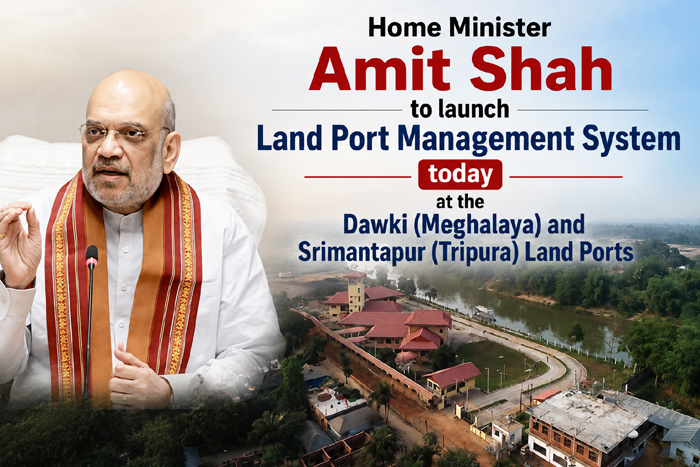
Union Home Minister Amit Shah will launch the Land Port Management System (LPMS) on Tuesday in a significant step towards strengthening India's border management and internal security framework.
According to an official statement, the LPMS is a state-of-the-art digital platform designed to integrate operations across the country's land ports into a unified system. The platform will facilitate secure, real-time exchange of logistics and regulatory information, bringing land ports on par with the advanced digital systems currently operational at airports and seaports.
The initiative reflects the commitment of the Prime Minister Narendra Modi-led government to smart border management through technology-driven solutions aimed at enhancing efficiency, transparency, and security in cross-border trade and passenger movement.
On the occasion, Shah will also inaugurate newly developed stakeholder accommodation facilities at the Dawki Land Port in Meghalaya and the Srimantapur Land Port in Tripura. The facilities are expected to strengthen infrastructure support for border security personnel and other stakeholders involved in border operations.
The LPMS is being hailed as a landmark initiative in India's transition towards a modern, technology-enabled border management system. The platform aligns with the government's broader vision of improving trade facilitation, connectivity, and national security under the "Viksit Bharat 2047" mission.
Officials said the LPMS has been designed as a neutral and open platform to ensure seamless coordination among various stakeholders, including government agencies and private operators. The system is expected to reduce procedural delays and improve operational efficiency across land ports.
The digital platform introduces end-to-end online workflows for cargo and passenger processing, covering services such as slot booking, payment processing, cargo tracking, and single-window clearances.
LPMS has also been integrated with key national digital platforms, including the Indian Customs Electronic Data Interchange Gateway (ICEGATE), the Unified Logistics Interface Platform (ULIP), and the motor vehicle ecosystem, enabling interoperable, efficient, and transparent border management.
The Land Ports Authority of India (LPAI), a statutory body under the Department of Border Management in the Ministry of Home Affairs, is responsible for the development and management of land ports across the country to facilitate trade, connectivity, and regional cooperation.
Currently, LPAI operates 15 land ports along India's international borders. These include Attari and Dera Baba Nanak in Punjab on the India-Pakistan border; Rupaidiha in Uttar Pradesh and Raxaul and Jogbani in Bihar on the India-Nepal border; Darranga in Assam on the India-Bhutan border; Petrapole in West Bengal; Dawki in Meghalaya; Sutarkandi, Golakganj and Mankachar in Assam; Agartala, Srimantapur and Sabroom in Tripura on the India-Bangladesh border; and Moreh in Manipur on the India-Myanmar border.