
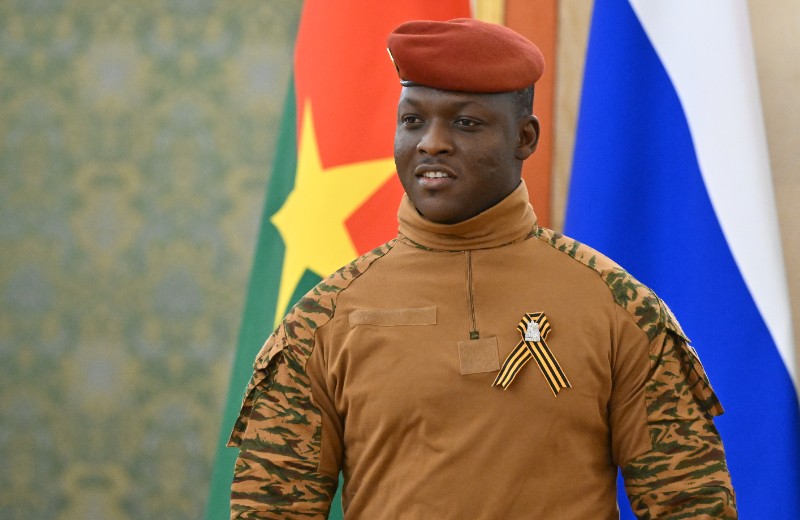
The move, announced through a government decree on Thursday, follows years of suspended political activity and is being widely viewed as a significant setback for democratic governance.
The decree, issued under the leadership of Captain Ibrahim Traore, repeals all laws that previously governed the formation and operation of political parties.
Authorities accused the parties of failing to comply with legal and ethical guidelines, though no specific violations were detailed.
A country gripped by coups and conflict
Burkina Faso has endured repeated political upheaval alongside a worsening security crisis driven by armed groups linked to ISIL and al-Qaeda.
Traore came to power in September 2022, eight months after an earlier coup had removed democratically elected president Roch Marc Kabore.
Despite criticism from opposition leaders and human rights organisations, the 37-year-old junta chief has cultivated a strong following, particularly among pan-Africanist audiences online.
His rhetoric, often framed around anti-colonialism and sovereignty, has drawn comparisons to revolutionary leader Thomas Sankara and is amplified through polished, viral digital content.
Why junta banned political parties
The government has justified the dissolution of political parties as part of a broader effort to “rebuild the state.”
Speaking after a Council of Ministers meeting, Interior Minister Emile Zerbo said a government review concluded that the proliferation of political parties had weakened social cohesion and deepened divisions.
According to Zerbo, the country’s multiparty system had become dysfunctional, encouraging excesses and undermining unity at a time when Burkina Faso faces existential security threats.
However, analysts note that the absence of concrete evidence has fuelled concerns that the move is designed to eliminate political competition altogether.
Analysts warn of democratic backsliding
Experts say the ban further concentrates power in the hands of the military leadership.
Dakar-based analyst Beverly Ochieng of Control Risks warned that recent constitutional changes have already placed the judiciary under government supervision, severely weakening checks and balances.
She added that the dissolution of parties suggests Burkina Faso is entering a prolonged period of military dominance, with limited space for civic engagement or political autonomy, and little indication that elections will be restored anytime soon.
What politics looked like before coups
Before the 2022 coup, Burkina Faso had more than 100 registered political parties, with 15 represented in parliament following the 2020 general elections.
The People’s Movement for Progress held the largest bloc of seats, but the civilian government struggled to contain mounting insecurity, triggering mass protests.
After seizing power, Traore pledged to restore security and promised regional bloc ECOWAS that elections would be held by 2024.
That commitment was later abandoned. Political rallies were banned, elections were postponed to 2029, and the Independent National Electoral Commission was dissolved in July 2025.
Regional realignments and rising violence
Burkina Faso has increasingly aligned itself with fellow military-led states, Mali and Niger.
The three countries withdrew from ECOWAS and the International Criminal Court, forming the Alliance of Sahel States.
They also severed military ties with France, expelling thousands of French troops and turning instead to Russian security support.
Despite these shifts, violence has intensified. Armed groups now control large swathes of Burkinabe territory, and fatalities have surged sharply since Traore took power.
Human rights groups report widespread civilian killings, mass displacement, and atrocities committed by both insurgents and state-aligned forces.
Shrinking civic space and press restrictions
Since the coup, rights organisations say Burkina Faso’s civic space has steadily narrowed.
Political activity was suspended immediately after the military takeover, and media freedoms have since come under sustained pressure.
Authorities have blocked access to international news outlets, detained journalists and judges, and forcibly conscripted critics into military service.
Several prominent figures remain missing, while others resurfaced only after appearing in military fatigues, suggesting coerced deployment.
What's next?
With political parties dismantled, elections delayed, and security deteriorating, analysts see little sign of a near-term return to civilian rule.
The military government appears firmly entrenched, prioritising control and security over pluralism.
As Burkina Faso’s crisis deepens, the ban on political parties underscores a broader transformation underway in the Sahel — one where democratic institutions are being sidelined amid prolonged conflict and expanding military rule.